 Back
BackInfection, Infectious Diseases, and Epidemiology – Study Notes
Study Guide - Smart Notes
 Tailored notes based on your materials, expanded with key definitions, examples, and context.
Symbiotic Relationships Between Microbes and Their Hosts
Types of Symbiosis
Symbiosis refers to the close association between two different biological species. In microbiology, humans have various symbiotic relationships with microorganisms, which can be classified as follows:
Mutualism: Both organisms benefit. Example: Bacteria in the human colon synthesize vitamins for the host and receive nutrients.
Commensalism: One organism benefits, the other is neither helped nor harmed. Example: Mites in human hair follicles.
Amensalism: One organism is harmed, the other is unaffected. Example: Fungus secreting antibiotics that inhibit nearby bacteria.
Parasitism: One organism benefits at the expense of the other. Example: Mycobacterium tuberculosis in human lungs.
Type | Organism 1 | Organism 2 | Example |
|---|---|---|---|
Mutualism | Benefits | Benefits | Bacteria in human colon |
Commensalism | Benefits | Neither benefits nor is harmed | Mites in hair follicles |
Amensalism | Is harmed | Neither benefits nor is harmed | Fungus secreting antibiotic |
Parasitism | Benefits | Is harmed | Tuberculosis bacteria in lungs |
Microbiome of Humans
The microbiome consists of all microorganisms that colonize the body's surfaces without causing disease under normal conditions. These are also called normal microbiota or normal flora.
Resident microbiota: Remain a part of the normal microbiota throughout life; mostly commensal.
Transient microbiota: Remain in the body for only a short period due to competition, elimination, or chemical/physical changes in the host.
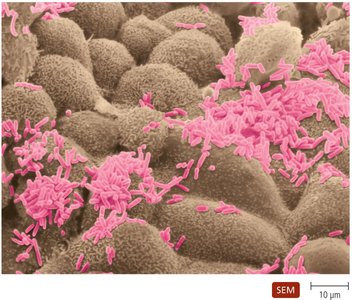
Acquisition and Opportunism of Microbiota
Humans are free of microorganisms in the womb. The microbiome begins to develop during birth and is established in the first months of life. Under certain conditions, normal microbiota can become opportunistic pathogens and cause disease, such as:
Introduction into unusual body sites
Immune suppression
Changes in the normal microbiota (e.g., antibiotics)
Stressful conditions
Reservoirs of Infectious Diseases of Humans
Types of Reservoirs
Reservoirs are sites where pathogens are maintained as a source of infection. Most pathogens cannot survive long outside their host. There are three main types:
Animal reservoirs (Zoonoses): Diseases naturally spread from animal hosts to humans (e.g., rabies, plague, malaria).
Human carriers: Infected individuals who are asymptomatic but can transmit pathogens to others.
Nonliving reservoirs: Soil, water, and food contaminated with pathogens (often by feces or urine).
Disease | Causative Agent | Animal Reservoir | Mode of Transmission |
|---|---|---|---|
Tapeworm infestation | Dipylidium caninum | Dogs | Ingestion of larvae in dog saliva |
Malaria | Plasmodium spp. | Monkeys | Bite of Anopheles mosquito |
Rabies | Lyssavirus sp. | Bats, skunks, foxes, dogs | Bite of infected animal |
Anthrax | Bacillus anthracis | Domestic livestock | Direct contact, inhalation |
The Invasion and Establishment of Microbes in Hosts: Infection
Contamination vs. Infection
Contamination: Presence of microbes in or on the body.
Infection: When microbes evade external defenses, multiply, and become established in the body.
Portals of Entry
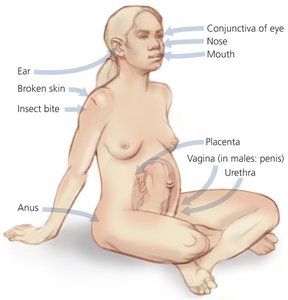
Pathogens enter the body through specific sites called portals of entry:
Skin
Mucous membranes (respiratory, gastrointestinal, urogenital tracts)
Placenta (rare, but can transmit pathogens to fetus)
Parenteral route (circumvents usual portals, e.g., via punctures, cuts)
The Role of Adhesion in Infection
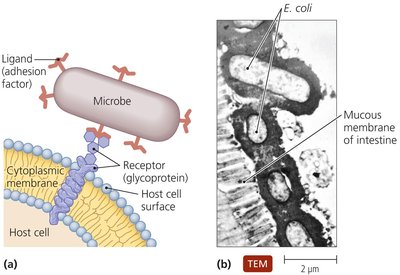
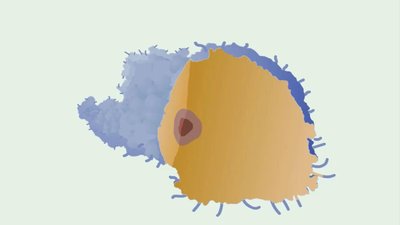
Adhesion is the process by which microorganisms attach to host cells, a critical step for colonization and infection. Microbes use adhesion factors such as specialized structures (fimbriae, pili) or attachment molecules (ligands) to bind to host cell receptors.
The Nature of Infectious Disease
Infection and Disease
Infection: Invasion of the host by a pathogen.
Disease (Morbidity): Results when infection alters normal body functions.
Manifestations of Disease
Symptoms: Subjective characteristics felt only by the patient (e.g., pain, nausea).
Signs: Objective manifestations observed or measured by others (e.g., fever, rash).
Syndrome: A group of symptoms and signs that characterize a disease.
Asymptomatic (subclinical) infections: Lack symptoms but may have signs.
Symptoms (Patient) | Signs (Observer) |
|---|---|
Pain, nausea, headache, chills, sore throat, fatigue, malaise, itching, abdominal cramps | Swelling, rash, vomiting, diarrhea, fever, pus, anemia, leukocytosis/leukopenia, bubo, tachycardia/bradycardia |
Causation of Disease: Etiology
Etiology is the study of the cause of disease. The germ theory of disease states that infections by pathogenic microorganisms cause disease. Koch’s postulates are a set of criteria used to prove that a specific pathogen causes a specific disease:
The suspected agent must be present in every case of the disease.
The agent must be isolated and grown in pure culture.
The cultured agent must cause the disease when inoculated into a healthy host.
The same agent must be reisolated from the diseased experimental host.
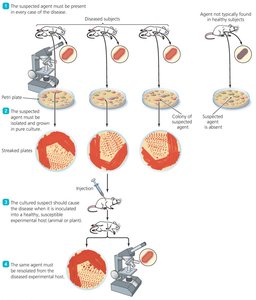
Exceptions: Some pathogens cannot be cultured, diseases may have multiple causes, and ethical considerations may prevent testing in humans.
Virulence Factors of Infectious Agents
Pathogenicity is the ability to cause disease; virulence is the degree of pathogenicity. Virulence factors include:
Adhesion factors
Biofilms
Extracellular enzymes
Toxins (exotoxins and endotoxins)
Antiphagocytic factors
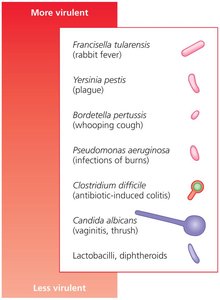
Extracellular Enzymes
Secreted by pathogens to dissolve structural chemicals in the body, aiding invasion and evasion of host defenses. Mutants lacking these enzymes are often avirulent.
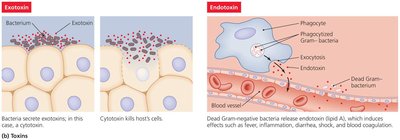
Toxins
Chemicals that harm tissues or trigger damaging immune responses. Toxemia is the presence of toxins in the bloodstream. Two main types:
Exotoxins: Secreted by bacteria; can kill host cells.
Endotoxins: Released from dead Gram-negative bacteria; can cause fever, inflammation, shock.
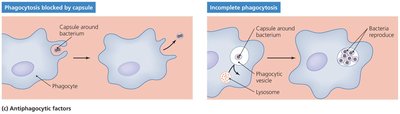
Antiphagocytic Factors
These factors help pathogens evade phagocytosis by host immune cells:
Bacterial capsules: Composed of chemicals not recognized as foreign; slippery and hard to engulf.
Antiphagocytic chemicals: Prevent fusion of lysosome and phagocytic vesicle; leukocidins destroy phagocytes.
Stages of Infectious Disease
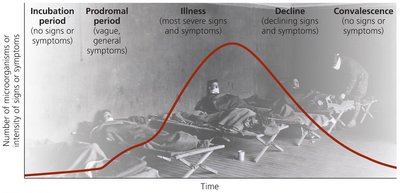
Infectious diseases typically progress through five stages:
Incubation period: No signs or symptoms.
Prodromal period: Mild, general symptoms.
Illness: Most severe signs and symptoms.
Decline: Declining signs and symptoms.
Convalescence: No signs or symptoms; recovery.
Disease | Incubation Period |
|---|---|
Staphylococcus foodborne infection | <1 day |
Influenza | About 1 day |
Cholera | 2 to 3 days |
Genital herpes | About 5 days |
Tetanus | 5 to 15 days |
Syphilis | 10 to 21 days |
Hepatitis B | 70 to 100 days |
AIDS | 1 to >8 years |
Leprosy | 10 to >30 years |
The Movement of Pathogens Out of Hosts: Portals of Exit
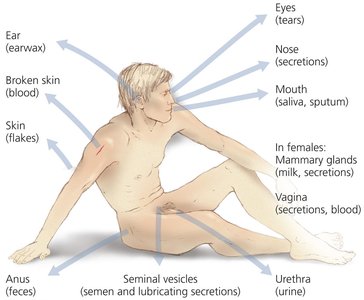
Pathogens leave the host through specific portals of exit, often the same as portals of entry. They are commonly found in materials the body secretes or excretes (e.g., saliva, feces, urine, blood).
Modes of Infectious Disease Transmission
Transmission Pathways
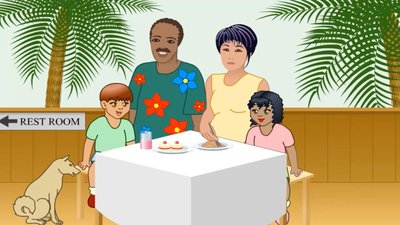
Transmission occurs from a reservoir or portal of exit to another host’s portal of entry. There are three main groups:
Contact transmission: Direct (person-to-person), indirect (via fomites), or droplet (via mucus droplets).
Vehicle transmission: Airborne (aerosols), waterborne (fecal-oral), foodborne, or via bodily fluids.
Vector transmission: Biological vectors (e.g., mosquitoes) or mechanical vectors (e.g., flies).

Classification of Infectious Diseases
Term | Definition |
|---|---|
Acute disease | Symptoms develop rapidly, runs course quickly |
Chronic disease | Mild symptoms, develop slowly, last long time |
Subacute disease | Symptoms/time course between acute and chronic |
Asymptomatic disease | No symptoms |
Latent disease | Appears long after infection |
Communicable disease | Transmitted from host to host |
Contagious disease | Easily spread communicable disease |
Noncommunicable disease | Not passed person to person |
Local infection | Confined to small region |
Systemic infection | Widespread, often in blood or lymph |
Focal infection | Site serves as source for other infections |
Primary infection | Initial infection |
Secondary infection | Follows primary infection, often opportunistic |
Epidemiology of Infectious Diseases
Frequency of Disease
Incidence: Number of new cases in a given area during a given period.
Prevalence: Total number of cases in a given area during a given period.
Epidemiological Studies
Descriptive epidemiology: Tabulation of data, location, time, and patient information; identifies index case.
Analytical epidemiology: Determines probable cause, mode of transmission, and prevention; often retrospective.
Healthcare-Associated (Nosocomial) Infections
Nosocomial infections are acquired in healthcare settings. Types include:
Exogenous: Pathogen acquired from the healthcare environment.
Endogenous: Pathogen arises from normal microbiota within the patient.
Iatrogenic: Result from modern medical procedures.
Superinfections: Use of antimicrobials inhibits resident microbiota, allowing others to thrive.
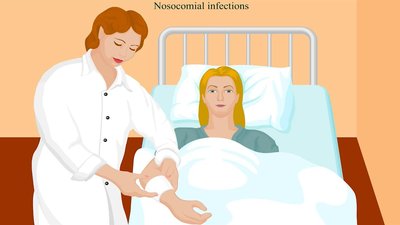
Prevention: Aggressive control measures are required; handwashing is the most effective method.
Epidemiology and Public Health
Public health agencies (local, national, global) play a key role in interrupting disease transmission by:
Enforcing cleanliness of water and food supplies
Reducing disease vectors and reservoirs
Establishing immunization schedules
Locating and treating exposed individuals
Implementing isolation and quarantine
Providing public health education
Examples of agencies: U.S. Public Health Service (CDC), World Health Organization (WHO).
