 Back
BackInnate and Adaptive Immunity: Structure and Function in Immunology
Study Guide - Smart Notes
 Tailored notes based on your materials, expanded with key definitions, examples, and context.
Innate and Adaptive Immunity
Overview of Immune System Function
The immune system is divided into two main branches: innate immunity and adaptive immunity. These systems work together to protect the body from pathogens through a series of coordinated responses. Innate immunity provides immediate, non-specific defense, while adaptive immunity offers specific, long-lasting protection after exposure to pathogens.
Innate Immunity: Always present, non-specific, rapid response.
Adaptive Immunity: Requires prior exposure, specific, slower but more effective upon re-exposure.
Lines of Defense
The immune system operates through three lines of defense:
First Line (Innate): Physical and chemical barriers such as skin, mucous membranes, and secretions (e.g., lysozyme in saliva).
Second Line (Innate): Cellular and molecular mechanisms including phagocytes, granulocytes, and the complement system.
Third Line (Adaptive): Specific recognition and response by lymphocytes (B-cells and T-cells) after antigen exposure.
Innate Immunity
Characteristics and Components
Innate immunity is the body's immediate response to pathogens and does not require prior exposure. It includes both cellular and non-cellular components, and is effective against a broad range of pathogens.
Cellular Components: Phagocytes (Neutrophils, Macrophages, Dendritic cells), cytolytic and inflammatory cells.
Non-cellular Components: Physical barriers (skin, mucous membranes), chemical barriers (secretions, lysozyme), and proteins (complement system).
Recognition: Innate immune cells recognize PAMPs (Pathogen-Associated Molecular Patterns) via PRRs (Pattern-Recognition Receptors), such as TLR4 recognizing LPS.
Inflammation and Fever
Inflammation is a non-specific response to tissue damage or infection, characterized by heat, redness, swelling, and pain. Fever is triggered by pyrogens and is a systemic response to infection.
Acute Inflammation: Rapid onset, short duration, beneficial for pathogen clearance and tissue repair.
Chronic Inflammation: Long-lasting, can lead to tissue damage and disease.
Fever: Body temperature above 37°C, induced by cytokines acting on the hypothalamus.
Non-Cellular Immunity
Non-cellular mechanisms include competitive exclusion by normal microbiota, physical and chemical barriers, and protein-based defenses.
Physical Barriers: Skin, mucous membranes.
Chemical Barriers: Saliva, mucus, urine.
Proteins: Lysozyme, complement system (opsonization, MAC formation, inflammation).
Processes: Ciliated epithelium in the respiratory tract helps remove pathogens.
The Blood and Lymphatic Systems
Blood Components
Blood contains cells and plasma, which are essential for immune function and transport.
Erythrocytes: Red blood cells, transport oxygen.
Leukocytes: White blood cells, immune function.
Platelets: Coagulation and wound healing.
Plasma: Liquid portion, contains electrolytes, nutrients, proteins.
Serum: Plasma without clotting factors; contains complement proteins, iron-binding compounds, antibodies.
Lymphatic System Structure and Function
The lymphatic system collects fluid from tissues, transports immune cells and antigens, and facilitates interactions between innate and adaptive immunity in lymph nodes.
Lymph Nodes: Sites for antigen presentation and activation of adaptive immune cells.
Lymphatic Vessels: Transport cells and antigens to lymph nodes.
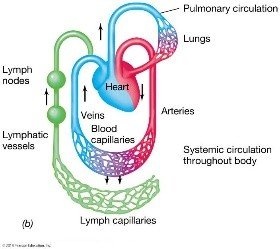
This diagram illustrates the relationship between the blood and lymphatic circulatory systems, showing how lymphatic vessels collect fluid and antigens from tissues and transport them to lymph nodes for immune surveillance.
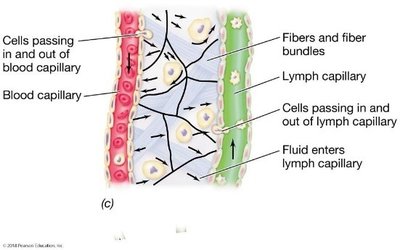
This image shows the movement of cells and fluid between blood capillaries and lymph capillaries, highlighting the entry of immune cells and antigens into the lymphatic system.
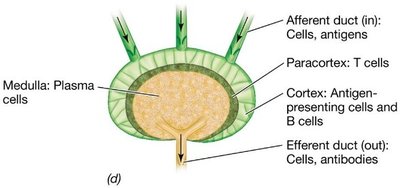
This diagram details the internal structure of a lymph node, including the cortex (antigen-presenting cells and B cells), paracortex (T cells), and medulla (plasma cells), as well as the flow of cells and antigens through afferent and efferent ducts.
Phagocytosis and Immune Cell Recruitment
Phagocytosis Process
Phagocytes recognize pathogens via PRRs binding to PAMPs, leading to engulfment and destruction of pathogens. Activated phagocytes increase production of free radicals to kill pathogens.
PRR: Pattern-Recognition Receptor (e.g., TLR4, TLR9).
PAMP: Pathogen-Associated Molecular Pattern (e.g., LPS, flagellin).
Phagocytosis: Engulfment of pathogen into a phagosome, killing via ROS (Reactive Oxygen Species) and RNI (Reactive Nitrogen Intermediates).
Recruitment of Phagocytes
During infection, histamine induces vasodilation, allowing phagocytes to migrate from blood to tissue (diapedesis). Cytokines and chemokines attract additional immune cells to the site.
Cytokines: Signaling molecules coordinating immune cell actions.
Chemokines: Subset of cytokines that attract cells to infection sites.
Adaptive Immunity
General Aspects
Adaptive immunity is activated upon exposure to a pathogen and involves expansion of specific lymphocytes. It provides long-lasting, specific protection and forms memory cells for faster response upon re-exposure.
Cellular Components: Lymphocytes (B-cells, T-cells).
Non-cellular Components: Antibodies (humoral response).
Specificity: Immunity is specific to pathogen species or strain.
Inducibility: Induced by infection or vaccination.
MHC Molecules and Antigen Presentation
Antigen-presenting cells (APCs) display antigens to T-cells via MHC molecules, linking innate and adaptive immunity.
MHC-I: Presents cytoplasmic proteins; found on all cells.
MHC-II: Presents phagocytosed/endocytosed molecules; found on B-cells and phagocytes.
APCs: B-cells and phagocytes perform antigen presentation.
T-cell Receptors: Recognize antigens presented by MHC molecules.
Function of Antibodies
Antibodies mediate several immune functions, including opsonization, complement activation, toxin inactivation, and blocking pathogen adherence.
Opsonization: Antibodies tag pathogens for phagocytosis.
Complement Activation: Antibodies trigger complement system to lyse pathogens.
Toxin Inactivation: Antibodies neutralize toxins.
Blocking Adherence: Antibodies prevent pathogens from attaching to host cells.
Classes of Adaptive Immunity
Active and Passive Immunity
Adaptive immunity can be acquired actively or passively, through natural or artificial means.
Type | Natural | Artificial |
|---|---|---|
Active | Infection | Vaccination |
Passive | Maternal antibodies (gestation, breastfeeding) | Immunotherapy (antibodies or T-cells from another source) |
Key Concepts and Review Questions
Differentiate innate and adaptive immunity.
Which system requires previous exposure?
Which system increases response over time?
What are cytokines?
What are the cellular and non-cellular components of each immune system?
What is the function of mucus and ciliated epithelium?
How does lysozyme kill bacteria?
How does the complement system target and kill bacteria?
How does the complement system contribute to inflammation?
Additional info: Academic context was added to clarify immune system mechanisms, cell types, and molecular processes for exam preparation.
