Back
BackMicrobial Genetics: DNA Replication, Gene Expression, and Horizontal Gene Transfer
Study Guide - Smart Notes
 Tailored notes based on your materials, expanded with key definitions, examples, and context.
Genetics: DNA Replication
Semiconservative DNA Replication
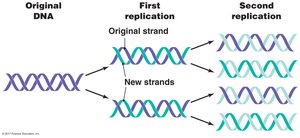
DNA replication is a fundamental process in microbial genetics, ensuring the faithful transmission of genetic information. The process is semiconservative, meaning each new DNA molecule consists of one original (parental) strand and one newly synthesized strand.
Template Function: DNA serves as a template for the synthesis of new strands.
Semiconservative Mechanism: After replication, each chromosome contains one old and one new strand.
Replication Cycles: Successive replications maintain the semiconservative nature.
Example: The Meselson-Stahl experiment demonstrated semiconservative replication in Escherichia coli.
Steps in Bacterial DNA Replication
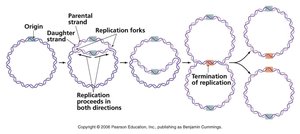
Bacterial DNA replication begins at a specific location called the origin of replication and proceeds bidirectionally.
Origin of Replication: The site where replication starts.
Bidirectional Replication: Replication forks move away from the origin in both directions.
Termination: Replication ends when forks meet at the termination site.
Enzymes and Proteins in DNA Replication
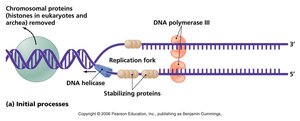
Several enzymes and proteins coordinate the unwinding and synthesis of DNA strands.
Helicase: Unwinds and unzips the DNA double helix, forming the replication fork.
Single-Stranded Binding Proteins (SSBP): Stabilize the unwound DNA strands.
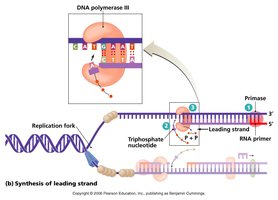
DNA Polymerase III: Synthesizes new DNA strands in the 5' to 3' direction and proofreads for errors.
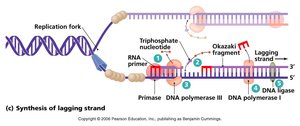
Primase: Synthesizes short RNA primers to initiate DNA synthesis.
Leading and Lagging Strand Synthesis
DNA polymerase III synthesizes the leading strand continuously, while the lagging strand is synthesized discontinuously in short segments called Okazaki fragments.
Leading Strand: Synthesized continuously toward the replication fork.
Lagging Strand: Synthesized in short segments away from the fork; fragments are joined by DNA ligase.
RNA Primers: Required for both strands to initiate synthesis.
Mechanism of Nucleotide Addition
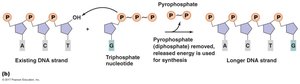
Nucleotides are added to the growing DNA strand by DNA polymerase III, using the energy released from the removal of pyrophosphate.
Direction: Nucleotides are added to the 3' end of the growing strand.
Energy Source: The hydrolysis of triphosphate nucleotides provides energy for bond formation.
Gene Expression: Transcription and Translation
Transcription: DNA to mRNA
Transcription is the process by which genetic information in DNA is copied into messenger RNA (mRNA).
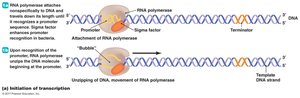
Initiation: RNA polymerase binds to the promoter region of DNA.
Promoter: A DNA sequence (20-200 bases) that signals the start of transcription.
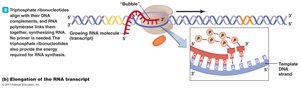
Elongation: RNA polymerase synthesizes RNA in the 5' to 3' direction, using DNA as a template.
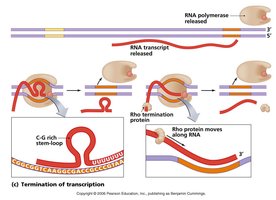
Termination: RNA polymerase recognizes termination signals and releases the RNA transcript.
Types of RNA Molecules
Three main types of RNA are involved in gene expression:
mRNA (Messenger RNA): Carries genetic information from DNA to the ribosome; contains codons.
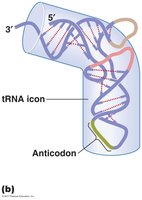
tRNA (Transfer RNA): Brings amino acids to the ribosome; contains anticodons complementary to mRNA codons.
rRNA (Ribosomal RNA): Structural and functional component of ribosomes.
Translation: mRNA to Protein
Translation is the process by which ribosomes synthesize proteins using the information encoded in mRNA.
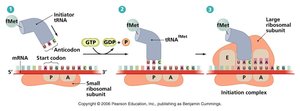
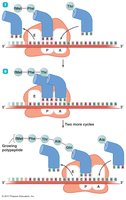
Initiation: Ribosomes assemble at the 5' end of mRNA; initiator tRNA binds to the start codon (AUG).
Elongation: tRNAs bring amino acids to the ribosome; peptide bonds form between amino acids.
Termination: Translation ends when a stop codon (UAA, UAG, UGA) is reached.
Genetic Code and Codon Table
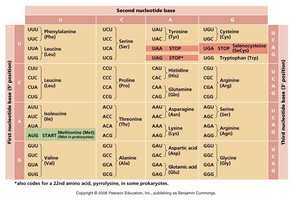
The genetic code is a set of rules by which information encoded in mRNA is translated into proteins. Each codon (three nucleotides) specifies an amino acid.
Start Codon: AUG (methionine in eukaryotes, N-formylmethionine in prokaryotes).
Stop Codons: UAA, UAG, UGA.
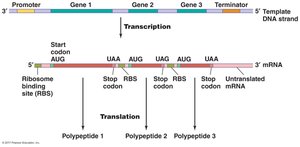
Polycistronic mRNA: In prokaryotes, a single mRNA can code for multiple polypeptides.
Eukaryotic vs. Prokaryotic Gene Expression
Gene expression differs between prokaryotes and eukaryotes in several key ways.
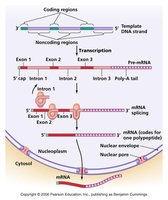
Introns and Exons: Eukaryotic DNA contains introns (non-coding) and exons (coding); introns are removed during mRNA processing.
Location: Transcription occurs in the nucleus and translation in the cytoplasm in eukaryotes; both processes can occur simultaneously in prokaryotes.
First Amino Acid: Methionine in eukaryotes; N-formylmethionine in prokaryotes.
Genetics: Operons and Regulation
Operon Structure and Function
Operons are clusters of genes and regulatory sequences that are transcribed as a single unit, primarily in prokaryotes.
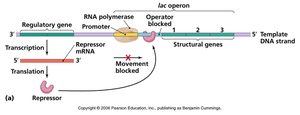
Structural Genes: Code for enzymes and polypeptides.
Operator: Region where repressor protein binds.
Promoter: Region where RNA polymerase binds.
Regulatory Gene: Codes for repressor protein, often located away from the operon.

Inducible Operons: The Lac Operon
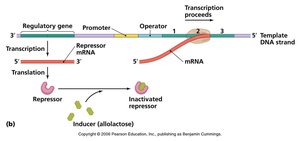
The lac operon is an example of an inducible operon, which is normally off but can be turned on in the presence of an inducer (lactose).
Repressor: Binds to operator, blocking transcription in the absence of lactose.
Inducer (Lactose): Binds to repressor, inactivating it and allowing transcription.
Result: Enzymes for lactose metabolism are synthesized only when lactose is present.
Repressible Operons: The trp Operon
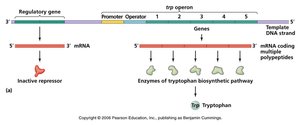
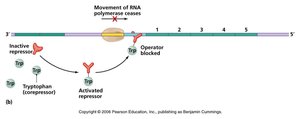
The trp operon is an example of a repressible operon, which is normally on but can be turned off when the end product (tryptophan) is abundant.
Inactive Repressor: Cannot bind operator without tryptophan.
Corepressor (Tryptophan): Binds to repressor, activating it and blocking transcription.
Result: Tryptophan synthesis stops when tryptophan is plentiful.
Horizontal Gene Transfer in Bacteria
Mechanisms of Horizontal Gene Transfer
Horizontal gene transfer allows bacteria to acquire new genetic traits from other organisms, contributing to genetic diversity and adaptation.
Transformation: Uptake of naked DNA from the environment.
Transduction: Transfer of DNA by bacteriophage (virus).
Conjugation: Direct transfer of DNA between bacteria via cell-to-cell contact.
Plasmids: Small, circular, self-replicating DNA molecules that can carry non-essential genes.
Transformation
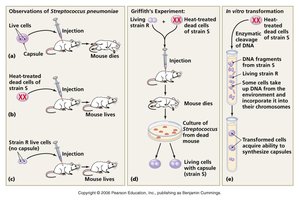
Transformation involves the uptake of free DNA fragments or plasmids from the environment by competent cells.
Competence: Cells must have specific proteins to bind and import DNA.
Artificial Competence: Can be induced by CaCl2 and heat shock or electroporation.
Application: Used in recombinant DNA technology.
Example: Griffith's experiment with Streptococcus pneumoniae demonstrated transformation.
Transduction
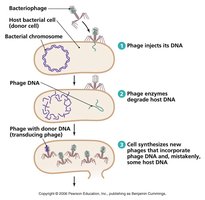
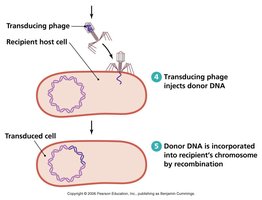
Transduction is the transfer of bacterial DNA by a bacteriophage. It occurs naturally in many bacteria and usually requires the donor and recipient to be of the same species.
Bacteriophage: Virus that infects bacteria and mediates DNA transfer.
Generalized Transduction: Any bacterial gene can be transferred.
Specialized Transduction: Only specific genes near the phage integration site are transferred.
Conjugation
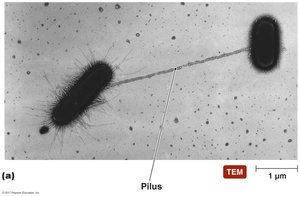
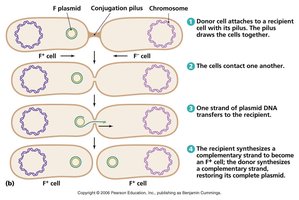
Conjugation is the direct transfer of DNA between bacteria, primarily in Gram-negative species, via a pilus.
Pilus: Structure that connects donor (F+) and recipient (F-) cells.
F Plasmid: Fertility plasmid required for pilus formation and DNA transfer.
Result: Recipient cell becomes F+ and can participate in further conjugation.
High Frequency Recombination (HFR)
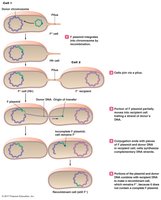
HFR cells have the F factor integrated into their chromosome, allowing transfer of chromosomal genes at high rates during conjugation.
Integration: F plasmid integrates into bacterial chromosome.
Gene Transfer: Adjacent chromosomal genes are transferred to recipient during conjugation.
Reversibility: The process can revert, restoring the F plasmid to its original state.