 Back
BackMicrobial Genetics: Mutations, Gene Transfer, and Genomic Integrity
Study Guide - Smart Notes
 Tailored notes based on your materials, expanded with key definitions, examples, and context.
Microbial Genetics: Mutations, Gene Transfer, and Genomic Integrity
Introduction
This study guide covers the fundamental concepts of microbial genetics, focusing on mutations, genetic recombination, gene transfer mechanisms in Bacteria and Archaea, mobile genetic elements, and the preservation of genomic integrity. These topics are essential for understanding microbial adaptation, evolution, and the molecular basis of genetic diversity.
Mutations and Mutants
Definition and Role of Mutation
Mutation is a heritable change in the genome that can alter the properties of an organism. Mutations are a primary source of genetic variation and fuel adaptation and diversification in microbial populations.
Mutation: Heritable change in DNA sequence.
Wild-type strain: The original, naturally occurring strain.
Mutant: A cell or virus derived from wild type with a nucleotide sequence change.
Genotype: Designated by three lowercase letters and a capital (e.g., hisC).
Phenotype: Observable properties, designated by capital letter and two lowercase letters (e.g., His+).
Mutations can be beneficial, detrimental, or neutral.
Isolation of Mutants: Screening vs. Selection
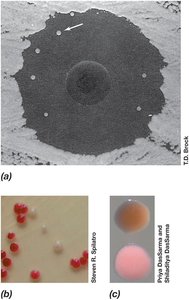
Mutants can be isolated by screening or selection, depending on whether the mutation confers a growth advantage.
Selectable mutations: Provide an advantage under certain conditions (e.g., antibiotic resistance).
Nonselectable mutations: Do not confer an advantage; require laborious screening.
Common Classes of Mutants
Mutants are classified based on their phenotypic changes and detection methods.
Phenotype | Nature of Change | Detection |
|---|---|---|
Auxotroph | Loss of enzyme in biosynthetic pathway | Inability to grow without nutrient |
Temperature-sensitive | Altered protein, heat-sensitive | Inability to grow at high temperature |
Drug-resistant | Altered drug target or permeability | Growth in presence of drug |
Pigmentless | Loss of pigment biosynthesis | Lack of color |
Nonmotile | Loss of flagella | Lack of motility |
Virus-resistant | Loss of virus receptor | Growth in presence of virus |
Sugar fermentation | Loss of degradative enzyme | No color change on indicator agar |
Isolation of Nutritional Auxotrophs
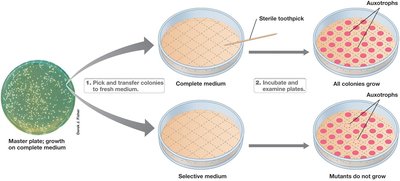
Replica plating is used to screen for mutants with additional nutritional requirements.
Auxotroph: Requires extra nutrient for growth.
Prototroph: Wild-type strain, grows without extra nutrient.
Complementation: Restoration of wild-type phenotype by providing functional gene copy.
Molecular Basis of Mutation
Types of Mutations
Mutations can occur spontaneously or be induced by environmental factors.
Spontaneous mutations: Occur without external intervention, often due to DNA polymerase errors.
Induced mutations: Caused by chemicals or radiation.
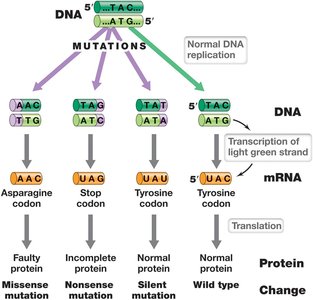
Point mutations: Change a single base pair; include missense, nonsense, and silent mutations.
Base-pair Substitutions
Substitutions can result in different effects depending on the codon and location.
Silent mutation: No change in polypeptide or phenotype.
Missense mutation: Changes amino acid sequence; may affect protein function.
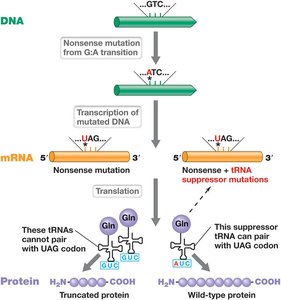
Nonsense mutation: Introduces stop codon; results in truncated protein.
Frameshift Mutations
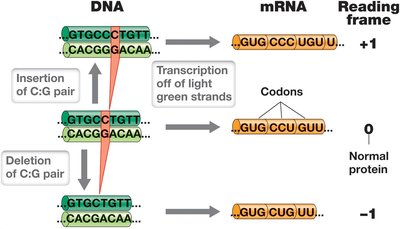
Insertions or deletions of base pairs can shift the reading frame, often resulting in nonfunctional proteins.
Frameshift mutation: Alters reading frame, scrambling downstream sequence.
Insertion/deletion of three base pairs adds/deletes a codon, less severe.
Reversions and Mutation Rates
Reversions and Suppressors
Mutations can be reversed, restoring the original phenotype.
Reversion: Mutation that restores original sequence or function.
Same-site revertant: Mutation at the same site as original.
Second-site revertant: Mutation elsewhere compensates for original effect.
Suppressor tRNA: tRNA mutation that allows translation past a stop codon.
Mutation Rates
Mutation rates vary among organisms and are influenced by DNA repair efficiency.
Typical bacterial mutation rate: to per kb.
Eukaryotes: 10-fold lower error rates.
DNA viruses: 100–1000× higher error rates.
RNA viruses: Even higher due to lack of repair mechanisms.
Mutagenesis
Chemical Mutagens and Radiation
Mutagens are agents that increase mutation rates by altering DNA.
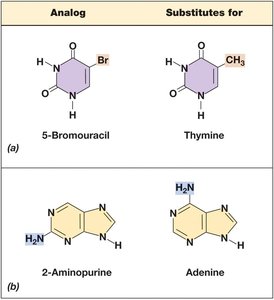
Nucleotide base analogs: Mimic normal bases, cause faulty pairing.
Alkylating agents: Add alkyl groups, alter base pairing.
Intercalating agents: Insert between base pairs, cause insertions/deletions.
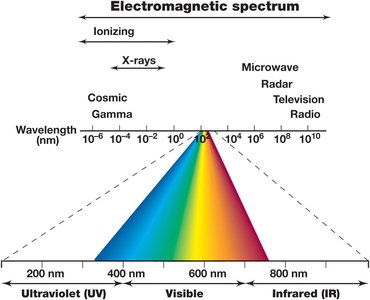
Radiation: UV causes pyrimidine dimers; ionizing radiation causes DNA breaks.
Agent | Action | Result |
|---|---|---|
5-Bromouracil | Incorporated like T; faulty pairing with G | AT→GC |
2-Aminopurine | Incorporated like A; faulty pairing with C | AT→GC |
Nitrous acid | Deaminates A and C | AT→GC, GC→AT |
UV | Pyrimidine dimer formation | Error or deletion |
X-rays | Free-radical attack, chain break | Error or deletion |
DNA Repair and the SOS System
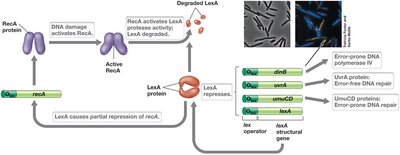
Bacteria have emergency repair systems to fix DNA damage.
SOS repair system: Activated by DNA damage; initiates multiple repair processes.
LexA: Repressor protein; RecA: Recombinase and SOS regulator.
Some repair is error-prone, leading to mutations.
Gene Transfer in Bacteria
Horizontal Gene Transfer
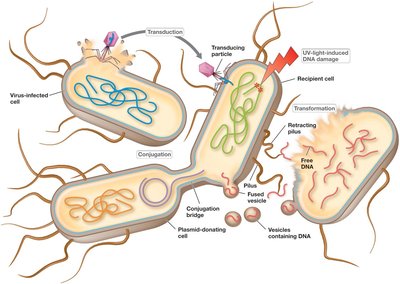
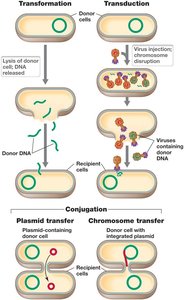
Genes can move between cells via transformation, transduction, and conjugation, enabling rapid adaptation.
Transformation: Uptake of free DNA.
Transduction: DNA transfer by bacteriophage.
Conjugation: Cell-to-cell contact, plasmid transfer.
Genetic Recombination
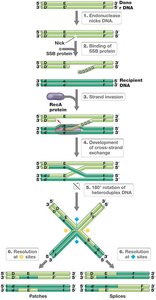
Homologous recombination is the physical exchange of DNA between genetic elements, facilitated by RecA protein.
Endonuclease nicks donor DNA.
Helicase separates strands.
RecA mediates strand invasion and pairing.
Produces heteroduplex regions.
Detection of Recombinants
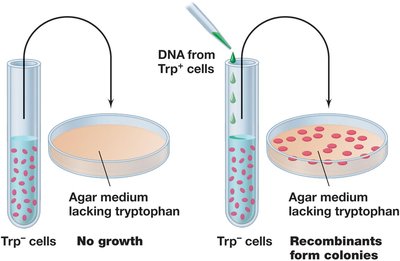
Recombinant cells are detected by their ability to grow without a selectable characteristic.
Complementation
Complementation restores wild-type phenotype by providing a functional gene copy, often via plasmid or phage.
Transformation
Mechanism and Competence
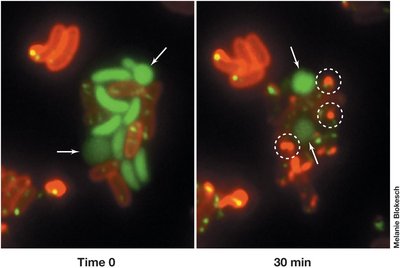
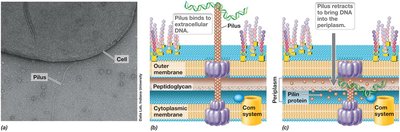
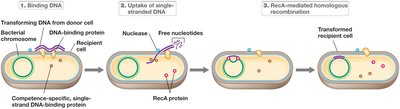
Transformation involves the uptake of free DNA by competent cells, which is genetically determined.
Competence can be natural or induced.
Pili or membrane proteins facilitate DNA uptake.
DNA is converted to single-stranded form and integrated by RecA.
Regulation of Competence
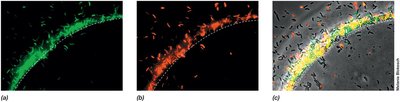
Competence is regulated by environmental signals such as quorum sensing and nutrient availability.
Transduction
Generalized and Specialized Transduction
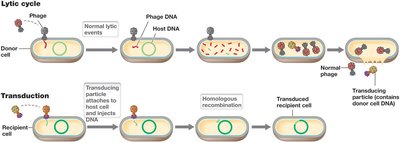
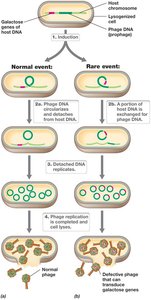
Transduction is the transfer of DNA by bacteriophage, with two main modes:
Generalized transduction: Any gene can be transferred; host DNA is accidentally packaged.
Specialized transduction: Only specific genes near phage integration site are transferred.
Phage Conversion and Gene Transfer Agents
Phage conversion alters host phenotype by lysogenization. Gene transfer agents (GTAs) are virus-like particles that transfer DNA between cells.
Conjugation
Mechanism and F Plasmid
Conjugation is plasmid-encoded horizontal gene transfer requiring cell-to-cell contact.
F plasmid: Fertility plasmid in Escherichia coli, encodes transfer functions.
Pili mediate cell pairing and DNA transfer.
DNA is transferred by rolling circle replication.
Hfr Strains and Chromosome Mobilization
Formation and Transfer
F plasmid can integrate into the chromosome, forming Hfr (high frequency of recombination) strains that mobilize chromosomal genes.
Integration occurs via homologous recombination at insertion sequences.
Hfr strains transfer chromosomal genes during conjugation.
F' plasmids contain chromosomal genes and transfer them at high frequency.
Horizontal Gene Transfer in Archaea
Mechanisms and Examples
Archaea utilize transformation, conjugation, and transduction for gene transfer, though mechanisms differ from Bacteria.
Many Archaea are extremophiles with unique genetic systems.
Plasmid exchange and membrane vesicle-mediated transfer are observed.
Specialized structures such as nanotubes facilitate DNA transfer.
Mobile DNA: Transposable Elements (Jumping genes)
Types and Mechanisms
Transposable elements are mobile DNA segments that move within genomes, creating mutations and genetic diversity.
Insertion sequences (ISs): Simplest transposable elements, encode transposase.
Transposons: Larger, carry additional genes (e.g., antibiotic resistance).
Conservative transposition: Transposon excised and reinserted elsewhere.
Replicative transposition: New copy inserted, increasing copy number.
Utility of Transposon Mutagenesis
Transposon mutagenesis is a powerful tool for creating mutants and studying gene function, often using antibiotic resistance markers.
Preserving Genomic Integrity and CRISPR
Innate and Adaptive Immunity
Bacteria and Archaea have mechanisms to prevent horizontal gene transfer and viral infection.
Restriction endonucleases: Cut foreign DNA; host DNA protected by methylation.
Phage exclusion: Prevents replication of foreign DNA.
Abortive infection: Programmed cell death to prevent viral spread.
DNase enzyme that inhibits transformation), by destroying free DNA.
CRISPR-Cas System
CRISPR is an adaptive immune system that provides sequence-specific defense against viruses and foreign DNA.
CRISPR regions contain repeats and spacers from previous invaders.
Cas proteins mediate defense and incorporate new spacers.
Spacer RNAs (crRNA) guide Cas proteins to destroy matching viral DNA.
CRISPR is widely distributed in Archaea and Bacteria; viruses evolve to evade it.
Summary Table: Mechanisms of Horizontal Gene Transfer
Mechanism | Process | Key Features |
|---|---|---|
Transformation | Uptake of free DNA | Requires competence, RecA-mediated integration |
Transduction | DNA transfer by phage | Generalized or specialized, recombination required |
Conjugation | Cell-to-cell contact | Plasmid-encoded, rolling circle replication |
Additional info: This guide expands on brief points with academic context, definitions, and examples to ensure completeness and clarity for exam preparation.
