 Back
BackMicrobial Genetics: Structure, Function, and Expression of Genetic Material
Study Guide - Smart Notes
 Tailored notes based on your materials, expanded with key definitions, examples, and context.
Genetics: The Foundation of Microbial Traits
Genotype and Phenotype
Genetics is the study of genes, their function, and how variations arise in genomes. The genome is the entire collection of genetic material in a cell or virus. The genotype refers to the genetic makeup of an organism, while the phenotype is the set of observable physiological and physical traits determined by the genotype.
Gene: A distinct sequence of nucleotides in DNA that codes for a trait.
Allele: Alternative forms of a gene.
Genotype: The genetic constitution (e.g., dominant homozygous, recessive homozygous, heterozygous).
Phenotype: The observable traits resulting from gene expression.
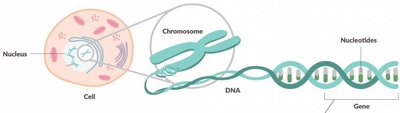
Genome Organization
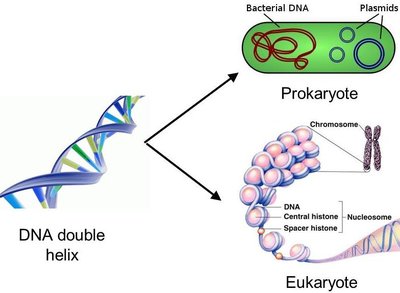
Cells organize their genomes into chromosomes, which are strands of DNA associated with organizational proteins called histones (in eukaryotes) or histone-like proteins (in prokaryotes). DNA wraps around these proteins to form nucleosomes, which further condense to form chromosomes.
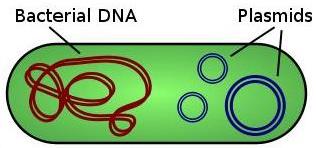
Prokaryotic genomes: 1–3 circular chromosomes, located in the nucleoid region, often contain plasmids.
Eukaryotic genomes: Multiple linear chromosomes, located in the nucleus, organized with histones. Mitochondria and chloroplasts contain prokaryote-like chromosomes.
Plasmids: Small, circular DNA molecules that replicate independently of chromosomal DNA. Common in bacteria, sometimes found in yeast and plants, often carry genes for antibiotic resistance.
Genome Size and Complexity
Genome size varies widely among organisms. Eukaryotic genomes are generally larger and more complex than prokaryotic genomes, but exceptions exist. For example, nonpathogenic E. coli K12 has ~4,400 genes, while the pathogenic O157:H7 strain has ~5,500 genes. Human cells have about 21,000 genes.
Factor | Prokaryotic Genomes | Eukaryotic Genomes |
|---|---|---|
Complexity | Simple | More complex |
Genome can include | Chromosomal DNA and plasmids | Chromosomal DNA, DNA in mitochondria/chloroplasts, and plasmids |
Chromosomes | Few (usually one); circular | Many; linear |
Location | Nucleoid region | Nucleus |
DNA organized by | Histone-like proteins | Histones |
Nucleic Acids: DNA and RNA Structure
Nucleotide Structure
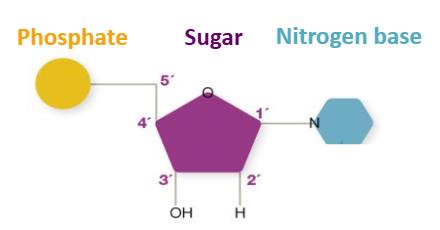
Nucleic acids (DNA and RNA) are polymers of nucleotides. Each nucleotide consists of:
A phosphate group
A five-carbon sugar (deoxyribose in DNA, ribose in RNA)
A nitrogenous base (Adenine, Guanine, Cytosine, Thymine in DNA; Uracil replaces Thymine in RNA)
Nitrogenous Bases
Pyrimidines: Cytosine (C), Thymine (T, DNA only), Uracil (U, RNA only)
Purines: Adenine (A), Guanine (G)
DNA Structure
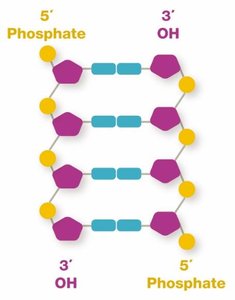
DNA is a double-stranded helix composed of nucleotides. The backbone is formed by sugar-phosphate linkages, and the "rungs" are nitrogenous base pairs (A-T, G-C). DNA strands are antiparallel: one runs 5' to 3', the other 3' to 5'.
Phosphodiester bonds link nucleotides between the 5' phosphate and 3' hydroxyl groups.
Base pairing: A with T (2 hydrogen bonds), G with C (3 hydrogen bonds).
RNA Structure
RNA is usually single-stranded, contains ribose sugar, and uses uracil instead of thymine. RNA can fold into complex structures and exists in three main forms: mRNA, tRNA, and rRNA.
DNA vs. RNA Comparison
Property | DNA | RNA |
|---|---|---|
Function | Stores genetic information | Transfers genetic information for protein synthesis |
Structure | Double-stranded helix | Single-stranded, may form secondary structures |
Sugar | Deoxyribose | Ribose |
Bases | A, T, G, C | A, U, G, C |
Location (Eukaryotes) | Nucleus, mitochondria, chloroplasts | Nucleolus (synthesized), cytoplasm (function) |
Directionality | 5' to 3' | 5' to 3' |
The Central Dogma of Molecular Biology
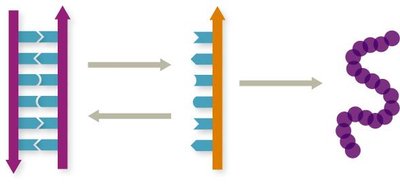
The central dogma describes the flow of genetic information: DNA is transcribed into RNA, which is then translated into protein. Some viruses can reverse this flow using reverse transcription.
DNA Replication
Overview and Enzymes
DNA replication is the process by which a cell copies its genome before division. It is semiconservative: each new DNA molecule contains one original (parent) strand and one newly synthesized (daughter) strand.
Helicase: Unwinds the DNA helix at the origin of replication.
Primase: Synthesizes short RNA primers to initiate replication.
DNA polymerase III: Main enzyme that adds nucleotides in the 5' to 3' direction.
DNA polymerase I: Replaces RNA primers with DNA; involved in repair.
Ligase: Seals nicks in the sugar-phosphate backbone, joining Okazaki fragments on the lagging strand.
Gyrase/Topoisomerases: Relieve torsional stress ahead of the replication fork.
Single-stranded binding proteins: Stabilize unwound DNA strands.
Leading vs. Lagging Strand Synthesis
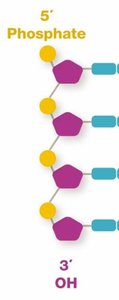
Leading strand: Synthesized continuously in the direction of the replication fork.
Lagging strand: Synthesized discontinuously, forming Okazaki fragments, away from the replication fork.
Prokaryotic vs. Eukaryotic DNA Replication
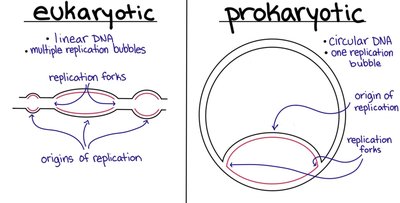
Prokaryotes: Single origin of replication, circular DNA, replication is rapid.
Eukaryotes: Multiple origins of replication, linear DNA, more complex machinery, slower process.
Transcription: From DNA to RNA
Process and Steps
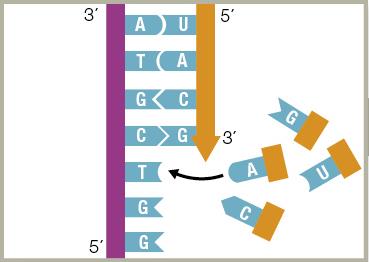
Transcription is the synthesis of RNA from a DNA template. It occurs in three main steps:
Initiation: RNA polymerase binds to the promoter region, DNA unwinds.
Elongation: RNA polymerase synthesizes RNA in the 5' to 3' direction, pairing ribonucleotides with the DNA template.
Termination: RNA polymerase reaches a termination sequence and releases the newly made RNA.
Transcription in Prokaryotes vs. Eukaryotes
Prokaryotes: Occurs in the cytoplasm; mRNA is immediately available for translation; no introns/exons, so no splicing.
Eukaryotes: Occurs in the nucleus; mRNA must be processed (splicing to remove introns) before export to the cytoplasm for translation.
Reverse Transcription
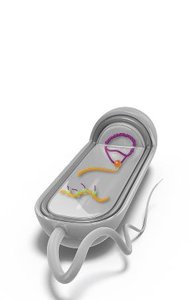
Some viruses and cells can use RNA as a template to synthesize complementary DNA (cDNA) via the enzyme reverse transcriptase. This process is important in retroviruses and biotechnology applications.
Translation: From RNA to Protein
Types of RNA and Their Functions
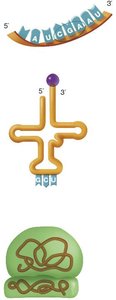
mRNA (messenger RNA): Carries genetic code in codons to the ribosome for translation.
tRNA (transfer RNA): Adaptor molecule that brings amino acids to the ribosome, matching codons with anticodons.
rRNA (ribosomal RNA): Combines with proteins to form ribosomes, the site of protein synthesis.
The Genetic Code
Composed of codons: sequences of three nucleotides on mRNA.
There are 64 codons: 61 code for amino acids (sense codons), 3 are stop signals (nonsense codons), and 1 start codon (AUG).
The code is degenerate: multiple codons can code for the same amino acid.
Steps of Translation
Initiation: Ribosome assembles on the mRNA at the start codon (AUG), and the initiator tRNA binds.
Elongation: tRNAs bring amino acids to the ribosome, peptide bonds form, and the ribosome moves along the mRNA.
Termination: When a stop codon is reached, the ribosome releases the completed polypeptide.
Mutations and Genetic Variation
Types of Mutations
Substitution: One nucleotide is replaced by another.
Insertion: Addition of one or more nucleotides.
Deletion: Removal of one or more nucleotides.
Mutation effects:
Silent mutation: No change in amino acid sequence.
Missense mutation: Changes one amino acid.
Nonsense mutation: Introduces a premature stop codon.
Frameshift mutation: Insertion or deletion not in multiples of three, altering the reading frame.
Sources of Mutation
Spontaneous mutations: Occur naturally during DNA replication.
Induced mutations: Caused by mutagens (chemical, physical, or biological agents).
Carcinogens: Mutagens that increase cancer risk.
Genetic Exchange in Microbes
Vertical and Horizontal Gene Transfer
Vertical gene transfer: Genetic information passed from parent to offspring during cell division.
Horizontal gene transfer: Genetic information exchanged between cells independently of cell division.
Types of Horizontal Gene Transfer
Conjugation: Transfer of plasmids via a pilus between bacteria.
Transformation: Uptake of free DNA from the environment by competent cells.
Transduction: Transfer of DNA by bacteriophages (viruses that infect bacteria).
Transposons: "Jumping genes" that move within the genome by cut-and-paste or copy-and-paste mechanisms.
Summary Table: Key Terms in Microbial Genetics
Term | Definition |
|---|---|
Genotype | Genetic makeup of an organism |
Phenotype | Observable traits |
Gene | DNA sequence coding for a trait |
Plasmid | Small, circular DNA molecule in bacteria |
Mutation | Change in DNA sequence |
Conjugation | Plasmid transfer via pilus |
Transformation | Uptake of environmental DNA |
Transduction | DNA transfer by bacteriophage |
Transposon | Mobile genetic element |
