 Back
BackMicrobial Metabolism: Pathways, Enzymes, and Energy Production
Study Guide - Smart Notes
 Tailored notes based on your materials, expanded with key definitions, examples, and context.
Microbial Metabolism
Overview of Metabolism
Microbial metabolism encompasses all the chemical reactions that occur within a microorganism, including both the breakdown and synthesis of molecules. These reactions are essential for energy production, growth, and cellular maintenance.
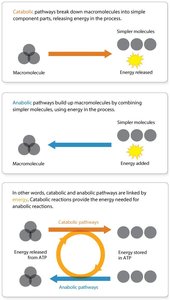
Catabolism: The breakdown of complex molecules into simpler ones, releasing energy in the process. Catabolic reactions are exergonic (energy-releasing).
Anabolism: The synthesis of complex molecules from simpler ones, requiring energy input. Anabolic reactions are endergonic (energy-consuming).
Catabolic and anabolic pathways are interconnected, with catabolic reactions providing the energy (often in the form of ATP) required for anabolic processes.
Role of ATP in Metabolism
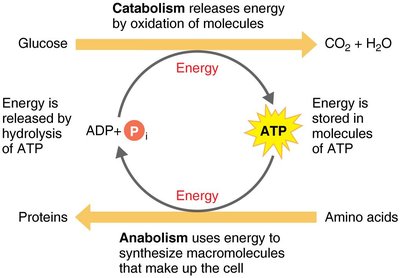
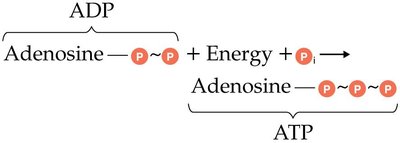
ATP (adenosine triphosphate) is the primary energy carrier in cells. It stores energy released from catabolic reactions and supplies it for anabolic reactions.
Energy is released by hydrolysis of ATP to ADP and inorganic phosphate ().
Energy is stored in ATP during catabolic reactions and used in anabolic reactions.
Enzymes and Their Function
Enzyme Basics
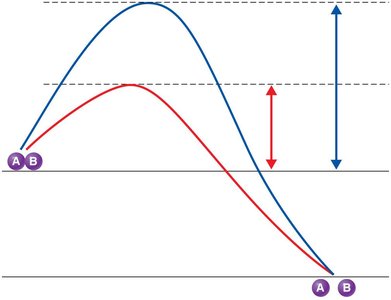
Enzymes are biological catalysts that speed up chemical reactions without being consumed. They lower the activation energy required for reactions to proceed.
Collision theory: Chemical reactions occur when molecules collide with sufficient energy.
Activation energy: The minimum energy required for a reaction to occur. Enzymes lower this barrier.
Reaction rate: Increased by enzymes, temperature, pressure, or concentration.
Mechanism of Enzyme Action
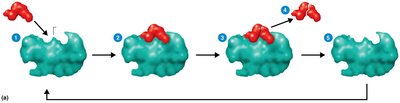
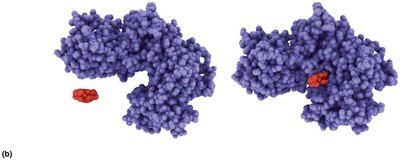
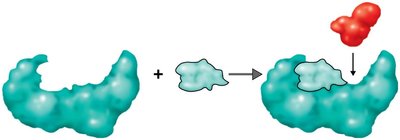
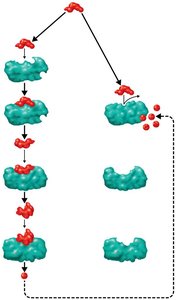
Enzymes act on specific substrates, forming an enzyme-substrate complex. The substrate is converted to product, and the enzyme is released unchanged.
Enzyme specificity is determined by the active site.
Turnover number: Number of substrate molecules converted per second (typically 1–10,000, up to 500,000).
Enzyme Structure and Classification
Apoenzyme: Protein portion, inactive alone.
Cofactor: Nonprotein component (e.g., metal ions like Fe).
Coenzyme: Organic cofactor (e.g., vitamins, NAD+, FAD).
Holoenzyme: Apoenzyme plus cofactor, the active form.
Factors Influencing Enzyme Activity
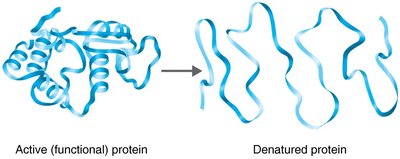
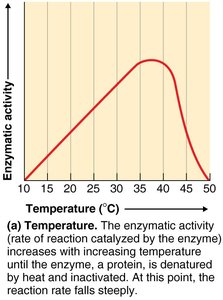
Temperature: Enzyme activity increases with temperature up to an optimum, then decreases due to denaturation.
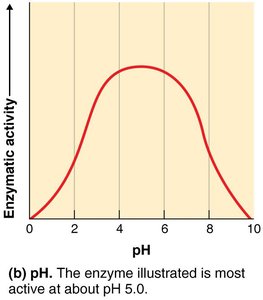
pH: Each enzyme has an optimal pH; extreme pH denatures enzymes.
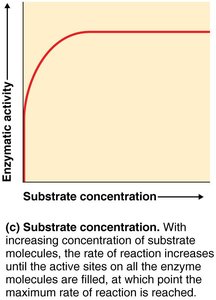
Substrate concentration: Activity increases with substrate concentration until saturation is reached.
Enzyme Inhibition
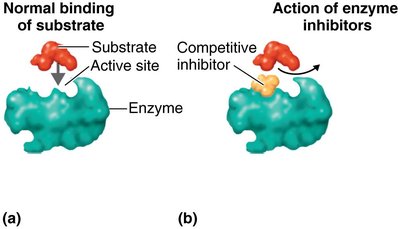
Competitive inhibitors: Compete with substrate for the active site.
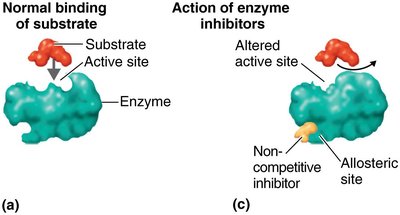
Noncompetitive inhibitors: Bind to an allosteric site, changing the enzyme's shape and function.
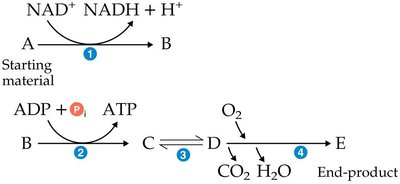
Feedback inhibition: End-product of a pathway inhibits an enzyme early in the pathway, regulating metabolic flux.
Ribozymes
Ribozymes are RNA molecules with catalytic activity, involved in RNA processing and protein synthesis.
Energy Production and Redox Reactions
Oxidation-Reduction (Redox) Reactions
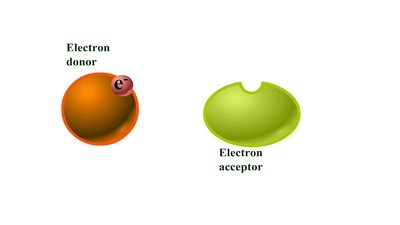
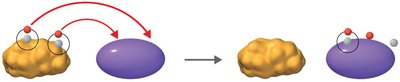
Energy production in cells involves redox reactions, where electrons are transferred from one molecule (oxidation) to another (reduction).
Oxidation: Loss of electrons (often as hydrogen atoms).
Reduction: Gain of electrons.
Redox reactions are coupled; biological oxidations are often dehydrogenations.

ATP Generation Mechanisms
Substrate-level phosphorylation: Direct transfer of a phosphate group to ADP from a phosphorylated intermediate.
Oxidative phosphorylation: Electrons are transferred through an electron transport chain, generating ATP via chemiosmosis.
Photophosphorylation: Light energy is used to generate ATP in photosynthetic organisms.
Metabolic Pathways of Energy Production
Carbohydrate Catabolism
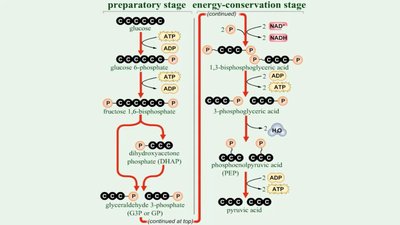
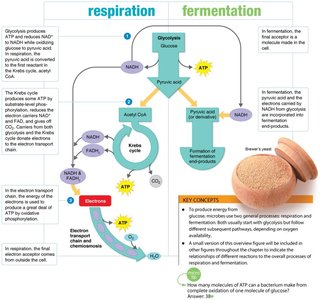
Carbohydrate catabolism is the breakdown of carbohydrates to release energy, primarily through glycolysis, the Krebs cycle, and the electron transport chain.
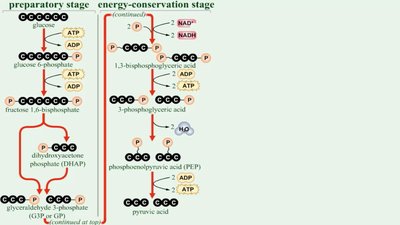
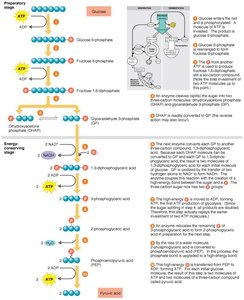
Glycolysis: Glucose is oxidized to pyruvic acid, producing ATP and NADH.
Krebs cycle: Pyruvic acid is further oxidized, generating NADH, FADH2, ATP, and CO2.
Electron transport chain: Electrons from NADH and FADH2 are transferred through a series of carriers, generating ATP.
Alternate Pathways
Pentose phosphate pathway (PPP): Generates NADPH and pentoses for biosynthesis; operates alongside glycolysis.
Entner-Doudoroff pathway: Alternative to glycolysis, producing NADPH and ATP, found in some bacteria.
Cellular Respiration
Cellular respiration involves the complete oxidation of substrates with the transfer of electrons to a final electron acceptor, generating ATP.
Aerobic respiration: Oxygen is the final electron acceptor.
Anaerobic respiration: Inorganic molecules other than oxygen (e.g., nitrate, sulfate) serve as final electron acceptors.
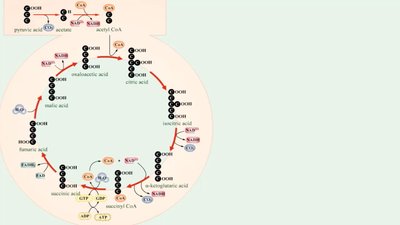
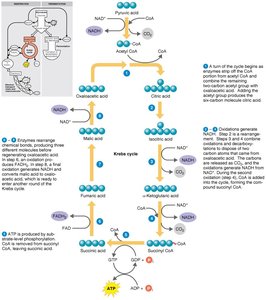
Krebs Cycle (Citric Acid Cycle)
Pyruvic acid is converted to acetyl-CoA, which enters the cycle, producing NADH, FADH2, ATP, and CO2.
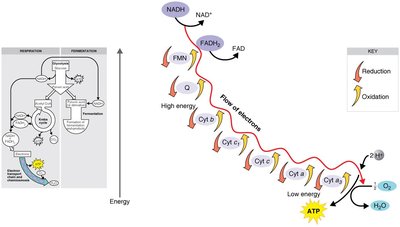
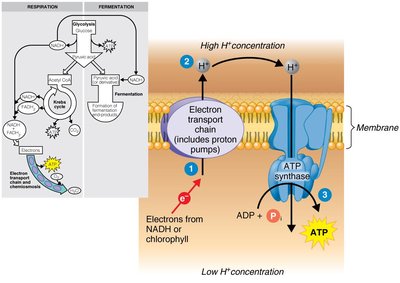
Electron Transport Chain and Chemiosmosis
Electrons from NADH and FADH2 pass through the electron transport chain, driving proton pumps that generate a proton gradient. ATP synthase uses this gradient to produce ATP (chemiosmosis).
ATP Yield in Aerobic Respiration
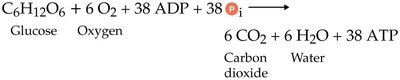
In prokaryotes, aerobic respiration of one glucose molecule yields up to 38 ATP.
Source | ATP Yield (Method) |
|---|---|
Glycolysis | 2 ATP (substrate-level), 6 ATP (oxidative phosphorylation) |
Preparatory Step | 6 ATP (oxidative phosphorylation) |
Krebs Cycle | 2 ATP (substrate-level), 18 ATP (oxidative phosphorylation from NADH), 4 ATP (oxidative phosphorylation from FADH2) |
Total | 38 ATP |
Anaerobic Respiration and Fermentation
Anaerobic respiration: Final electron acceptor is not O2; yields less ATP.
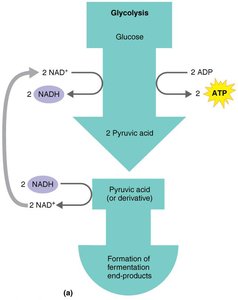
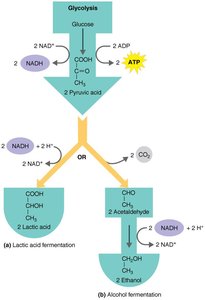
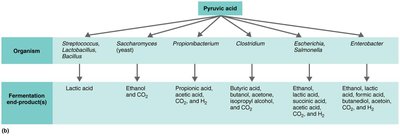
Fermentation: Only glycolysis is used; organic molecules serve as final electron acceptors; produces small amounts of ATP.
Industrial Uses of Fermentation
Fermentation End-Product(s) | Industrial or Commercial Use | Starting Material | Microorganism |
|---|---|---|---|
Ethanol | Beer, wine | Starch, sugar | Saccharomyces cerevisiae |
Lactic Acid | Cheese, yogurt | Milk | Lactobacillus, Streptococcus |
Acetic Acid | Vinegar | Ethanol | Acetobacter |
Propionic Acid, CO2 | Swiss cheese | Lactic acid | Propionibacterium |
Methane | Fuel | Acetic acid | Methanobacterium |
Sorbose | Vitamin C | Sorbitol | Gluconobacter |
Lipid and Protein Catabolism
Lipids and proteins can also be catabolized for energy. Lipases break down lipids into fatty acids and glycerol, which enter glycolysis or the Krebs cycle. Proteases and peptidases degrade proteins into amino acids, which are deaminated and enter the Krebs cycle.
Photosynthesis
Light-Dependent Reactions
Photosynthetic organisms convert light energy into chemical energy (ATP and NADPH) via cyclic and noncyclic photophosphorylation.
Cyclic photophosphorylation: Only ATP is produced; electrons return to chlorophyll.
Noncyclic photophosphorylation: Both ATP and NADPH are produced; electrons are transferred to NADP+.
Light-Independent Reactions (Calvin-Benson Cycle)
ATP and NADPH from the light reactions are used to fix CO2 into organic molecules (sugars).
Carbon fixation: RuBisCO enzyme incorporates CO2 into ribulose bisphosphate (RuBP).
Reduction: ATP and NADPH reduce 3-phosphoglycerate to glyceraldehyde-3-phosphate (G3P).
Regeneration: Some G3P is used to regenerate RuBP, allowing the cycle to continue.
Metabolic Diversity Among Organisms
Microorganisms display diverse metabolic strategies based on their energy and carbon sources.
Nutritional Type | Energy Source | Carbon Source | Example |
|---|---|---|---|
Photoautotroph | Light | CO2 | Cyanobacteria, plants |
Photoheterotroph | Light | Organic compounds | Green/purple nonsulfur bacteria |
Chemoautotroph | Inorganic chemicals | CO2 | Iron-oxidizing bacteria |
Chemoheterotroph | Chemicals | Organic compounds | Animals, fungi, most bacteria |
Metabolic Pathways of Energy Use
Microbes use energy for biosynthesis of macromolecules:
Polysaccharide biosynthesis
Lipid biosynthesis
Amino acid biosynthesis
Nucleotide biosynthesis
Amphibolic pathways: Pathways that function in both anabolism and catabolism, sharing common intermediates.
