 Back
BackMicrobial Regulatory Systems and Genetic Control in Microorganisms
Study Guide - Smart Notes
 Tailored notes based on your materials, expanded with key definitions, examples, and context.
Microbial Regulatory Systems
Introduction to Microbial Regulatory Systems
Microbial regulatory systems are essential for the adaptation and survival of microorganisms in changing environments. These systems control gene expression at multiple levels, ensuring that proteins and enzymes are produced only when needed. Regulation occurs through DNA-binding proteins, transcription factors, effectors, and global control mechanisms.
DNA-Binding Proteins and Transcriptional Regulation
Gene Arrangement and Promoters in Bacteria and Archaea
Operons: Clusters of genes transcribed together under the control of a single promoter, common in bacteria and archaea but rare in eukaryotes.
Promoters: Specific DNA sequences upstream of genes where RNA polymerase binds to initiate transcription.
Bacterial and archaeal promoters are recognized by DNA-binding proteins, which regulate transcription initiation.
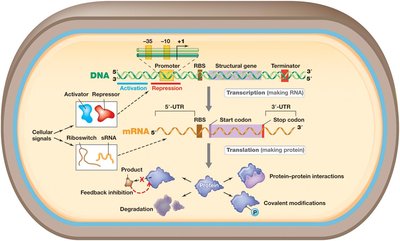
Protein–Nucleic Acid Interactions
DNA-binding proteins interact with DNA in a sequence-specific or nonspecific manner, primarily at the major groove of the DNA helix.
Specificity is determined by interactions between amino acid side chains and the chemical groups of DNA bases and backbone.
Inverted repeats in DNA often serve as binding sites for regulatory proteins, which are frequently homodimers (two identical subunits).
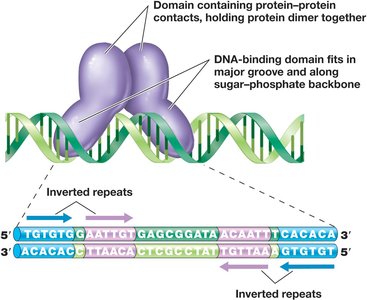
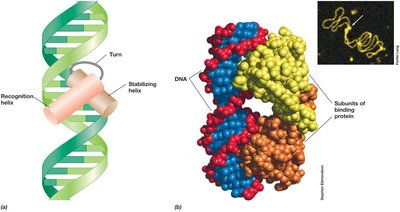
Structural Motifs of DNA-Binding Proteins
Helix-Turn-Helix (HTH): Two α-helices connected by a short turn; one helix recognizes DNA, the other stabilizes the structure. Common in bacterial repressors (e.g., lac and trp repressors).
Zinc Finger: Found mainly in eukaryotes; binds zinc ions to stabilize the fold.
Leucine Zipper: Contains regularly spaced leucines that facilitate dimerization and DNA binding.
Transcription Factors and Effectors
Mechanisms of Transcription Factors
Transcription factors are proteins that regulate the rate of transcription by binding to specific DNA sequences.
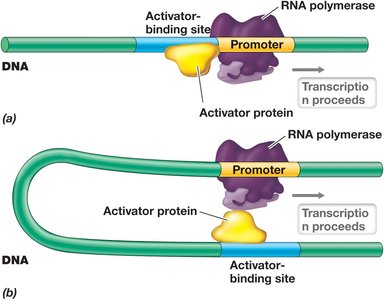
Activator proteins enhance transcription by recruiting RNA polymerase to the promoter.
i
gma fa
Role of Effectors and Allosteric Regulation (effectors binds to activators and repressors)
Effectors: Small molecules (e.g., metabolites) that bind transcription factors, causing conformational changes that alter DNA binding.
Inducers activate transcription; corepressors inhibit transcription.
Allosteric proteins change shape upon effector binding, modulating their regulatory activity. (gene expresson)
Example: Allolactose (inducer) in the lac operon.
Repression and Activation of Gene Expression
Enzyme Repression and Induction
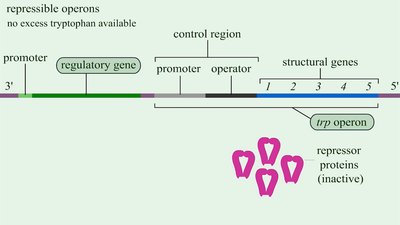
Enzyme repression: Synthesis of an enzyme is prevented when the end product is abundant (e.g., arginine operon). (genes code for protiens (eg: enzymes)
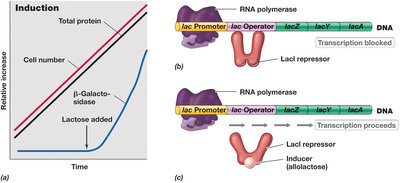
Enzyme induction: Enzyme is produced only in the presence of a substrate (e.g., lactose operon).
These mechanisms conserve energy and resources by producing proteins only when needed. (enzyme for lactose breaks lactose, while enzyme for argenine males more argenine)
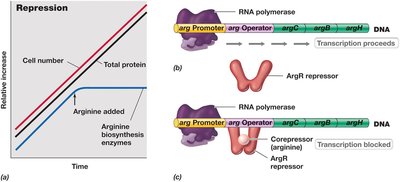
Mechanisms of Repression and Derepression
Repressors can require effectors (corepressors or inducers) to bind or release DNA.
Example: Arginine acts as a corepressor for the arginine operon; allolactose acts as an inducer for the lac operon.
Negative control: Repressor proteins inhibit transcription.
Mechanisms of Activation
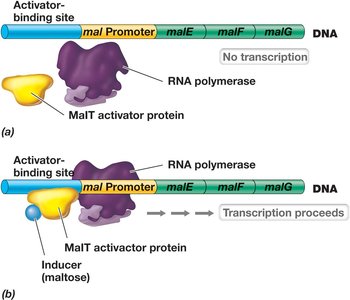
Activator proteins facilitate RNA polymerase binding to weak promoters, enabling transcription (positive control).
Example: Maltose activator protein (MalT) in E. coli requires maltose to bind DNA and activate transcription.
Operons versus Regulons
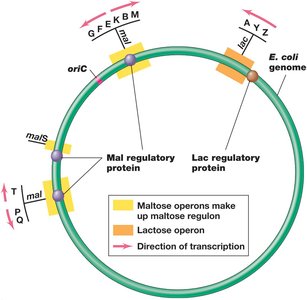
Operon: A group of genes transcribed from a single promoter.
Regulon: Multiple operons controlled by the same regulatory protein, allowing coordinated regulation of dispersed genes.
Example: Maltose regulon in E. coli.
Global Control Systems
Overview of Global Control
Global control systems regulate the expression of multiple genes and operons in response to environmental changes. These systems allow microorganisms to coordinate complex responses, such as nutrient utilization, stress adaptation, and pathogenesis.
Examples of Global Control Systems in Escherichia coli
System | Signal | Regulatory Protein | Genes Regulated |
|---|---|---|---|
Aerobic respiration | O2 presence | Repressor (ArcA) | >50 |
Anaerobic respiration | Lack of O2 | Activator (FNR) | >70 |
Catabolite repression | Cyclic AMP level | Activator (CRP) | >300 |
Heat shock | Temperature | Alternative sigma factors (RpoH, RpoE) | >36 |
Nitrogen utilization | NH3 limitation | Activator (NRI)/sigma factor (RpoN) | >12 |
Oxidative stress | Oxidizing agents | Activator (OxyR) | >30 |
SOS response | Damaged DNA | Repressor (LexA) | >20 |
General stress response | Stress conditions | Alternative sigma factor (RpoS) | >400 |
The lac Operon and Catabolite Repression
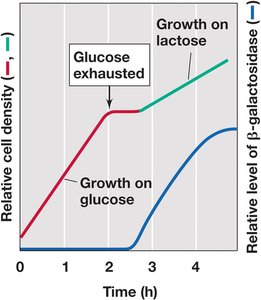
Catabolite repression: Ensures the preferred carbon source (glucose) is used first when multiple sources are available.
When glucose is present, the synthesis of enzymes for other sugars (e.g., lactose, maltose) is repressed.
Results in diauxic growth: two distinct exponential growth phases when two energy sources are present.
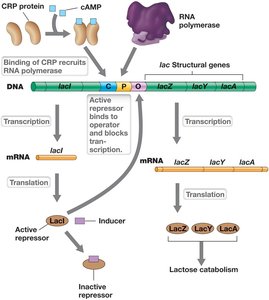
Cyclic AMP and CRP in Catabolite Repression
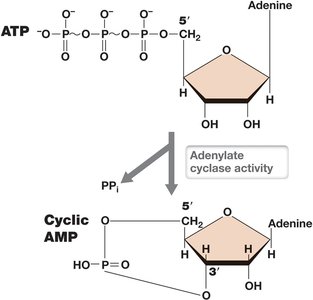
Cyclic AMP (cAMP): A regulatory nucleotide synthesized from ATP by adenylate cyclase.
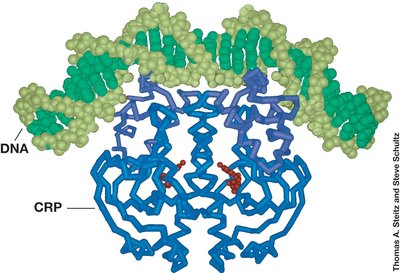
CRP (cAMP receptor protein): An allosteric activator that binds DNA only when complexed with cAMP, facilitating transcription of catabolic operons.
High cAMP levels (low glucose) allow CRP to activate transcription of the lac operon.
The Phosphate (Pho) Regulon
Regulation of Phosphate Uptake and Metabolism
Phosphate is essential for nucleic acids, membranes, and energy metabolism.
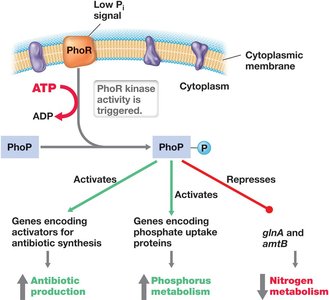
The Pho regulon is a two-component system (PhoR sensor kinase and PhoP response regulator) that responds to phosphate limitation.
Low phosphate triggers PhoR to phosphorylate PhoP, which then activates genes for phosphate uptake and, in some bacteria, antibiotic production.
PhoP-P can also repress genes, such as those involved in nitrogen metabolism.
The Heat Shock Response
Heat Shock Proteins and Alternative Sigma Factors
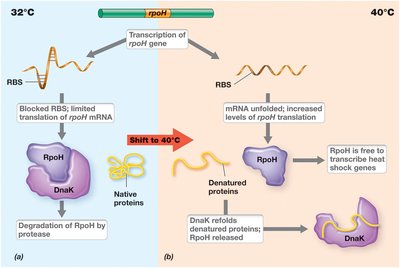
Heat shock response protects cells from protein denaturation due to heat, solvents, osmotic stress, or UV light.
Heat shock proteins (Hsp): Include chaperones (Hsp70/DnaK, Hsp60/GroEL, Hsp10/GroES) and proteases (Hsp100) that refold or degrade damaged proteins.
Controlled by alternative sigma factor RpoH, (which turn on genes for hsp protiens by helping RNA polymerza start transcription of specifc genes) which is stabilized during stress, increasing transcription of heat shock genes.
Regulation of Enzymes and Other Proteins
Feedback Inhibition
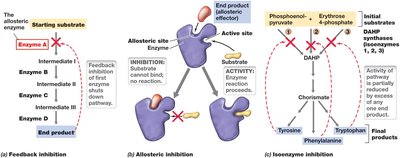
Feedback inhibition: End product of a biosynthetic pathway inhibits an early enzyme, shutting down the pathway when product is abundant.
Enzymes have active (substrate-binding) and allosteric (regulatory) sites; binding at the allosteric site changes enzyme conformation and activity.
Isoenzymes: Multiple enzymes catalyzing the same reaction but regulated differently, allowing fine-tuned control.
Post-Translational Regulation
Enzyme activity can be regulated by covalent modifications such as phosphorylation, methylation, adenylylation, and uridylylation.
PII proteins regulate nitrogen metabolism by sensing glutamine levels and modifying target proteins (e.g., glutamine synthetase) to adjust ammonia assimilation.
Anti-sigma factors can inactivate sigma factors, controlling the timing of gene expression (e.g., RpoE and RseA in membrane stress).
Summary Table: Key Regulatory Mechanisms
Mechanism | Key Feature | Example |
|---|---|---|
Negative control | Repressor protein inhibits transcription | Arginine operon, lac operon |
Positive control | Activator protein enhances transcription | Maltose operon |
Global control | Coordinates multiple genes/operons | Catabolite repression, heat shock response |
Feedback inhibition | End product inhibits pathway enzyme | Amino acid biosynthesis |
Post-translational regulation | Covalent modification of proteins | Phosphorylation, uridylylation |
Key Terms and Definitions
Operon: A cluster of genes under the control of a single promoter and regulatory region, transcribed as a single mRNA.
Regulon: A collection of operons or genes controlled by the same regulatory protein but located at different sites in the genome.
Transcription factor: Protein that binds DNA to regulate transcription.
Effector: Small molecule that modulates the activity of a regulatory protein.
Allosteric protein: Protein whose function is regulated by binding of an effector at a site other than the active site.
Global control system: Regulatory system that coordinates the expression of multiple genes in response to environmental signals.
