 Back
BackMicrobiology Chapter 11 Review – Study Guidance
Study Guide - Smart Notes
 Tailored notes based on your materials, expanded with key definitions, examples, and context.
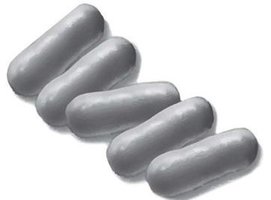
Q1. What type of arrangement is this?
Background
Topic: Bacterial Morphology and Arrangements
This question tests your ability to recognize and name the arrangement of bacterial cells based on their physical grouping.
Key Terms:
Bacterial arrangement: The pattern in which bacterial cells group together after cell division.
Bacillus: Rod-shaped bacteria.
Arrangement names: Strepto- (chains), Diplo- (pairs), Staphylo- (clusters), etc.
Step-by-Step Guidance
Observe the shape of the cells in the image. Are they rod-shaped, spherical, or spiral?
Notice how the cells are grouped. Are they in chains, clusters, pairs, or single?
Recall the terminology for arrangements: for rods in chains, the prefix is often 'strepto-'.
Think about how this arrangement might affect bacterial identification in a clinical setting.
Try solving on your own before revealing the answer!
Final Answer: Streptobacillus arrangement
This arrangement is called 'streptobacillus', which refers to rod-shaped bacteria arranged in chains.
Recognizing arrangements helps in identifying bacterial species in laboratory diagnostics.
Q2. Contamination with ________ is a concern because they are highly resistant to killing.
Background
Topic: Microbial Resistance and Sterilization
This question is about organisms or structures that are difficult to eliminate during sterilization processes.
Key Terms:
Endospores: Dormant, tough, non-reproductive structures produced by certain bacteria.
Resistance: The ability to withstand adverse conditions, including heat, chemicals, and radiation.
Step-by-Step Guidance
Recall which microbial forms are known for their extreme resistance to environmental stresses.
Think about which structures are a major concern in hospital and food industry sterilization.
Consider why these forms are so hard to kill—what features make them resistant?
Try solving on your own before revealing the answer!
Final Answer: Endospores
Endospores are highly resistant to killing, making contamination with them a major concern.
They can survive extreme heat, desiccation, and chemical disinfectants.
Q3. Characteristics of endospores:
Background
Topic: Bacterial Endospores
This question asks you to recall the unique features of endospores and their biological significance.
Key Terms:
Endospore: A dormant, tough structure formed by some bacteria for survival.
Resistance: Endospores are resistant to heat, radiation, chemicals, and desiccation.
Germination: The process by which an endospore returns to a vegetative state.
Step-by-Step Guidance
List the environmental conditions endospores can survive.
Recall the structural features (e.g., thick coat, dipicolinic acid) that contribute to their resistance.
Think about the role of endospores in bacterial life cycles and disease transmission.
Try solving on your own before revealing the answer!
Final Answer: Endospores are highly resistant structures formed by some bacteria; they survive extreme conditions and can germinate when favorable conditions return.
Key features include a tough outer coat, presence of dipicolinic acid, and resistance to heat, chemicals, and radiation.
Q19. This shape of bacteria is called _____
Background
Topic: Bacterial Shapes (Morphology)
This question tests your ability to identify the basic shapes of bacteria, which is fundamental in microbiology.
Key Terms:
Bacillus: Rod-shaped bacteria.
Coccus: Spherical bacteria.
Spirillum: Spiral-shaped bacteria.
Vibrio: Comma-shaped bacteria.

Step-by-Step Guidance
Observe the shape in the image. Is it straight, curved, spiral, or spherical?
Recall the terminology for bacterial shapes: bacillus (rod), coccus (sphere), spirillum (spiral), vibrio (comma-shaped).
Think about which shape matches the image—a curved rod.
Try solving on your own before revealing the answer!
Final Answer: Vibrio
This shape is called 'vibrio', which refers to bacteria with a curved rod shape, resembling a comma.
Vibrio species include important pathogens like Vibrio cholerae.
