 Back
BackMicrobiology Exam Study Guide: Control of Microbial Growth
Study Guide - Smart Notes
 Tailored notes based on your materials, expanded with key definitions, examples, and context.
Q1. What is the main difference between sterilization and commercial sterilization?
Background
Topic: Microbial Control Terminology
This question tests your understanding of the definitions and practical applications of sterilization versus commercial sterilization, especially in food safety and laboratory settings.
Key Terms:
Sterilization: The process of destroying or removing all forms of microbial life, including endospores.
Commercial Sterilization: A process used in the food industry to kill Clostridium botulinum endospores, but not necessarily all microbes.
Step-by-Step Guidance
Recall the definition of sterilization and its goal (complete destruction of all microorganisms).
Consider the purpose of commercial sterilization, especially in canned foods, and why it targets only certain microbes.
Think about the practical differences: sterilization is absolute, while commercial sterilization is selective for safety.
Identify which process is used in laboratory settings versus food industry settings.
Try solving on your own before revealing the answer!
Q2. Which disease may Clostridium botulinum cause? How does it cause this disease?
Background
Topic: Pathogenic Microbes and Mechanisms of Pathogenicity
This question tests your knowledge of bacterial pathogens, specifically Clostridium botulinum, and the mechanism by which it causes disease.
Key Terms:
Clostridium botulinum: A spore-forming bacterium that produces botulinum toxin.
Botulinum toxin: A neurotoxin that blocks neurotransmitter release, causing paralysis.
Endospore germination: The process by which dormant spores become active bacteria.
Step-by-Step Guidance
Recall the disease associated with Clostridium botulinum (think about foodborne illnesses).
Review how endospores can survive harsh conditions and germinate under favorable conditions.
Consider the mechanism of action of botulinum toxin (how it affects nerve cells).
Think about the symptoms caused by the toxin and why it is dangerous.
Try solving on your own before revealing the answer!
Q3. What is the meaning of the suffixes -cide/-cidal, -lytic, and -static? How do bacteriocidal, bacteriolytic, and bacteriostatic compounds affect bacteria?
Background
Topic: Microbial Control Agents
This question tests your understanding of terminology used to describe the effects of antimicrobial agents on bacteria.
Key Terms:
-cide/-cidal: Indicates killing of microbes.
-lytic: Indicates lysis (breaking apart) of cells.
-static: Indicates inhibition of growth, not killing.
Step-by-Step Guidance
Define each suffix and relate it to microbial control.
Describe how bacteriocidal agents affect bacteria (do they kill or inhibit?).
Explain the action of bacteriolytic agents (do they cause cell rupture?).
Discuss the effect of bacteriostatic agents (do they stop growth or kill?).
Try solving on your own before revealing the answer!
Q4. What is the difference between antiseptics and disinfectants? Which ones can you apply on living tissue?
Background
Topic: Chemical Methods of Microbial Control
This question tests your knowledge of the practical use and safety of chemical agents used to control microbes.
Key Terms:
Antiseptics: Chemical agents safe for use on living tissue.
Disinfectants: Chemical agents used on inanimate objects.
Step-by-Step Guidance
Recall the definitions and typical uses of antiseptics and disinfectants.
Think about examples of each (alcohol, bleach, soap, lysol).
Identify which agents are safe for skin and which are not.
Consider why some chemicals are not suitable for living tissue.
Try solving on your own before revealing the answer!
Q5. What is degerming? How is it different from sanitization?
Background
Topic: Microbial Control Terminology
This question tests your understanding of the processes used to reduce microbial numbers on surfaces and skin.
Key Terms:
Degerming: Removal of microbes from a limited area, often by mechanical means.
Sanitization: Reduction of microbial numbers to safe levels, usually on objects.
Step-by-Step Guidance
Define degerming and describe how it is performed (e.g., hand washing).
Define sanitization and its purpose in public health.
Compare the scope and methods of each process.
Think about examples where each method is used.
Try solving on your own before revealing the answer!
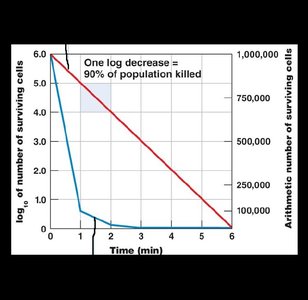
Q6. Which line in the graph depicts microbial growth plotted in logarithmic scale?
Background
Topic: Rate of Microbial Death
This question tests your ability to interpret graphs showing microbial death or growth, especially using logarithmic scales.
Key Terms:
Logarithmic scale: A scale used to represent large ranges of values, often used for microbial counts.
Microbial death curve: Shows decrease in viable cells over time.
Step-by-Step Guidance
Examine the axes of the graph to identify which one uses a logarithmic scale.
Look for the line that shows a straight decrease, which is typical for log plots.
Compare the lines to see which best fits the expected log pattern.
Relate the graph to the mathematical expressions: , , .
Try solving on your own before revealing the answer!
Q7. If curve a and b represent the number of microbial organisms in two instruments being removed by heat, why does line a take longer to be sterile?
Background
Topic: Rate of Microbial Death
This question tests your understanding of factors affecting microbial death during sterilization.
Key Terms:
Initial number of microbes: More microbes require longer time to achieve sterility.
Sterility: Complete absence of viable microbes.
Step-by-Step Guidance
Compare the starting points of curves a and b to see which has more microbes initially.
Consider how the initial microbial load affects the time needed for sterilization.
Think about the rate of microbial death and how it relates to the slope of the curve.
Relate this to practical sterilization procedures.
Try solving on your own before revealing the answer!
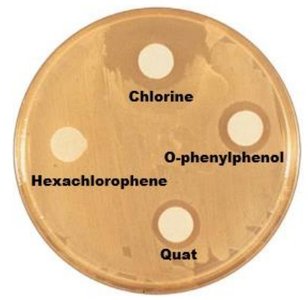
Q8. Analyze the disk-diffusion test using the zone of inhibition. Which antiseptic would you use to clean a spill of bacteria A?
Background
Topic: Chemical Methods of Microbial Control
This question tests your ability to interpret disk-diffusion tests, which measure the effectiveness of antimicrobial agents.
Key Terms:
Zone of inhibition: The area around a disk where bacteria do not grow, indicating effectiveness.
Disk-diffusion test: A method to compare antimicrobial agents.
Step-by-Step Guidance
Examine the disk-diffusion plate for the size of the clear zones around each agent.
Compare the zones to determine which agent is most effective against bacteria A.
Consider practical factors (safety, application) when choosing an antiseptic.
Think about which agents are suitable for spills and which for skin.
Try solving on your own before revealing the answer!
Q9. You spilled a culture of Bacillus anthracis on your hand. In the lab, you only have bleach or soap. What should you do?
Background
Topic: Practical Application of Microbial Control
This question tests your ability to choose appropriate antimicrobial agents for different situations, considering safety and effectiveness.
Key Terms:
Bacillus anthracis: A spore-forming pathogen.
Bleach: A strong disinfectant, not safe for skin.
Soap: Used for degerming, safe for skin.
Step-by-Step Guidance
Consider the properties of Bacillus anthracis (spore-forming, dangerous).
Evaluate the safety of bleach versus soap for skin application.
Think about the effectiveness of soap in removing spores.
Consider what additional steps you might take after initial cleaning.
Try solving on your own before revealing the answer!
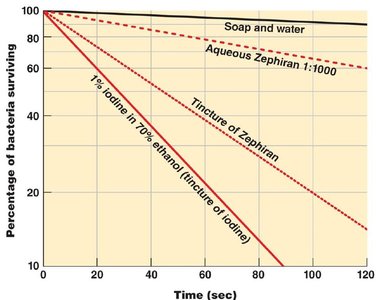
Q10. You went to ask help in the next lab. Luckily, they have a solution of 1% iodine in 70% ethanol, and two formulations with Zephiran (a quat detergent). Which should you use on your hand? And on the floor?
Background
Topic: Chemical Methods of Microbial Control
This question tests your ability to select the most effective and safe antimicrobial agent for different surfaces and situations.
Key Terms:
Iodine in ethanol: An antiseptic, effective for skin.
Zephiran: A quaternary ammonium compound, effective for surfaces.
Step-by-Step Guidance
Review the effectiveness of each agent as shown in the graph.
Consider which agents are safe for skin and which are best for surfaces.
Compare the rate of bacterial reduction for each agent.
Think about practical application and safety.
Try solving on your own before revealing the answer!
