 Back
BackMicrobiology Study Guide: Media Types, Growth Curves, and Environmental Effects
Study Guide - Smart Notes
 Tailored notes based on your materials, expanded with key definitions, examples, and context.
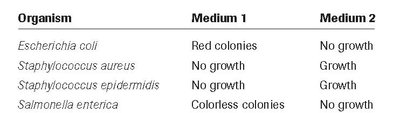
Q1. Two culture media were inoculated with four different bacteria. After incubation, the following results were obtained:
Background
Topic: Types of Culture Media (Selective, Differential, Both)
This question tests your understanding of how different types of media can be used to distinguish and select for specific bacteria based on their growth and colony appearance.
Key Terms:
Selective Media: Inhibits the growth of some organisms while allowing others to grow.
Differential Media: Allows multiple organisms to grow but distinguishes them based on colony appearance or color changes.
Colony Color: Indicates metabolic differences (e.g., fermentation of sugars).
Step-by-Step Guidance
Examine which organisms grow on each medium and note any color changes in colonies.
For Medium 1, observe that only Escherichia coli and Salmonella enterica grow, but their colonies are different colors. Consider what this suggests about the medium's properties.
For Medium 2, only Staphylococcus aureus and Staphylococcus epidermidis grow, with no color differences noted. Think about what this means for selectivity and differentiation.
Recall that selective media suppress unwanted microbes, while differential media show visible differences among growing organisms.
Try solving on your own before revealing the answer!
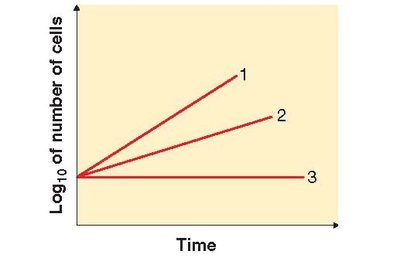
Q2. Which of the lines in the graph below best depicts the log phase of a thermophile incubated at room temperature?
Background
Topic: Microbial Growth Curves and Temperature Effects
This question tests your ability to interpret a bacterial growth curve and understand how environmental temperature affects the growth rate of thermophiles.
Key Terms:
Log Phase (Exponential Phase): Period of rapid cell division and population increase.
Thermophile: Organism that grows best at high temperatures (typically above 45°C).
Room Temperature: Usually around 20–25°C, which is below the optimal range for thermophiles.
Step-by-Step Guidance
Recall that the log phase is represented by the steepest upward slope on a growth curve, indicating rapid cell division.
Consider how a thermophile would grow at room temperature—would it grow rapidly, slowly, or not at all?
Compare the three lines: one is steep, one is moderate, and one is flat (no increase in cell number).
Think about which line best represents the expected growth pattern for a thermophile under suboptimal temperature conditions.
Try solving on your own before revealing the answer!
