 Back
BackChapter Six and Seven
Study Guide - Smart Notes
 Tailored notes based on your materials, expanded with key definitions, examples, and context.
Central Dogma of Molecular Biology
Overview of Genetic Information Flow
The central dogma of molecular biology describes the directional flow of genetic information within a cell. It outlines the processes by which genetic information encoded in DNA is transcribed into RNA and then translated into proteins, which perform essential cellular functions.
Replication: The process by which DNA makes a copy of itself.
Transcription: The synthesis of RNA from a DNA template.
Translation: The synthesis of proteins using the information encoded in messenger RNA (mRNA).
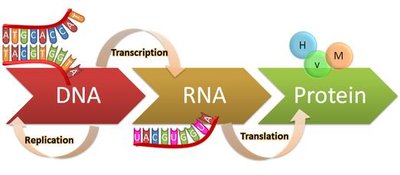
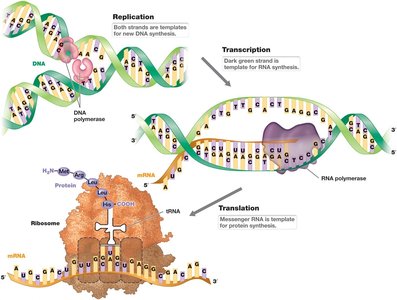
Additional info: This flow of information is fundamental to all living organisms and is conserved across Bacteria, Archaea, and Eukarya.
Structure of DNA and RNA
Nucleotides and Nucleic Acid Structure
DNA and RNA are polymers of nucleotides, each consisting of a pentose sugar, a nitrogenous base, and a phosphate group. The sequence of these nucleotides encodes genetic information.
DNA: Contains deoxyribose sugar; bases include adenine (A), thymine (T), cytosine (C), and guanine (G).
RNA: Contains ribose sugar; bases include adenine (A), uracil (U), cytosine (C), and guanine (G).
Phosphodiester bonds: Link nucleotides together in a strand.
Base pairing: A pairs with T (or U in RNA), and G pairs with C via hydrogen bonds.
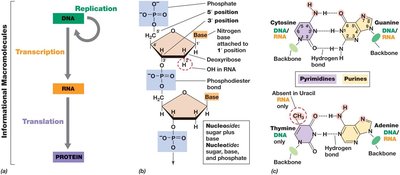
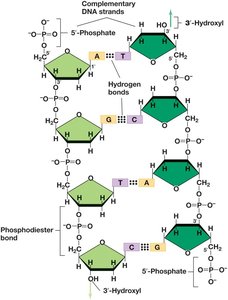
Additional info: The double helix structure of DNA is stabilized by hydrogen bonds and hydrophobic interactions between stacked bases.
Double Helix and Supercoiling
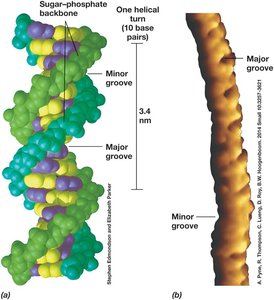
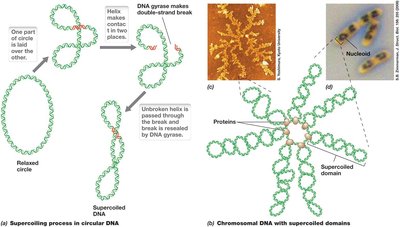
DNA exists as a double helix with two antiparallel strands. The helix has major and minor grooves, which are important for protein binding and regulation. In prokaryotes, DNA is often supercoiled to fit within the cell.
Antiparallel orientation: One strand runs 5' to 3', the other 3' to 5'.
Major and minor grooves: Sites for protein-DNA interactions.
Supercoiling: Introduced by enzymes such as DNA gyrase to compact DNA.
Genetic Elements: Chromosomes and Plasmids
Types of Genetic Elements
Genetic information in microorganisms is organized into chromosomes, plasmids, and other elements. These structures vary in size, shape, and function across different domains of life.
Organism | Element | Type of Nucleic Acid | Description |
|---|---|---|---|
Virus | Virus genome | Single- or double-stranded DNA or RNA | Short, circular or linear |
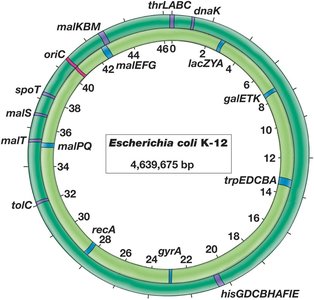
Bacteria, Archaea | Chromosome | Double-stranded DNA | Long, usually circular |
Eukarya | Chromosome | Double-stranded DNA | Long, linear |
Mitochondrion/Chloroplast | Organellar genome | Double-stranded DNA | Medium length, usually circular |
All organisms | Plasmid | Double-stranded DNA | Short, circular or linear, extrachromosomal |
All organisms | Transposable element | Double-stranded DNA | Inserted into another DNA molecule |
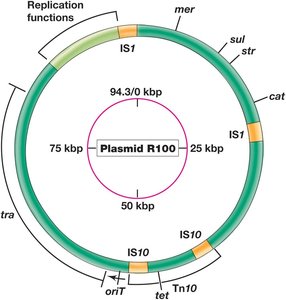
Additional info: Plasmids often carry genes for antibiotic resistance or other adaptive traits.
DNA Replication
Mechanism of DNA Replication
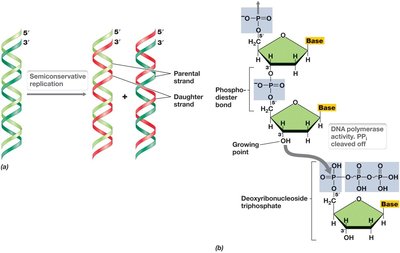
DNA replication is semiconservative, meaning each daughter DNA molecule contains one parental and one newly synthesized strand. Replication proceeds in the 5' to 3' direction and involves a complex set of enzymes.
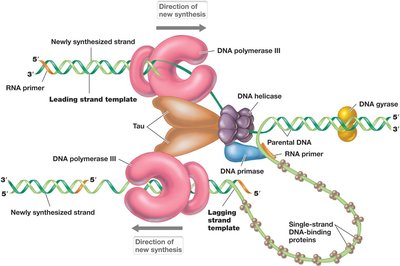
DNA polymerase: Synthesizes new DNA strands.
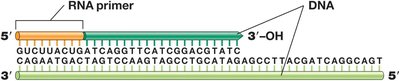
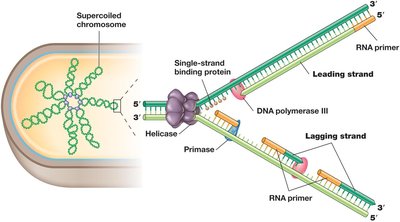
Primase: Synthesizes RNA primers to initiate DNA synthesis.
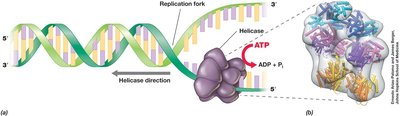
Helicase: Unwinds the DNA double helix.
Single-strand binding proteins: Stabilize unwound DNA.
DNA ligase: Seals nicks in the DNA backbone.
Okazaki Fragments and Lagging Strand Synthesis
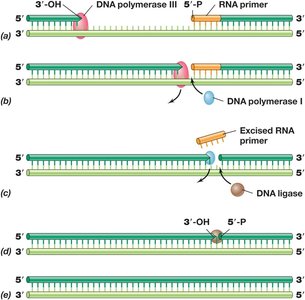
On the lagging strand, DNA is synthesized discontinuously as short Okazaki fragments, which are later joined by DNA ligase.
Okazaki fragments: Short DNA segments synthesized on the lagging strand.
DNA polymerase I: Removes RNA primers and fills in gaps.
DNA ligase: Joins Okazaki fragments to form a continuous strand.
Bidirectional Replication and the Replisome
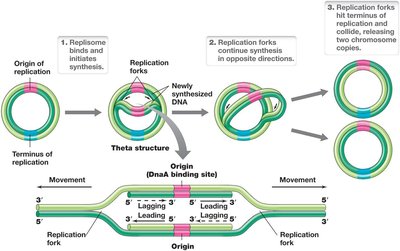
Replication in circular chromosomes (e.g., bacteria) is typically bidirectional, forming a theta structure. The replisome is a multi-enzyme complex that coordinates DNA synthesis at the replication fork.
Origin of replication (oriC): Site where replication begins.
Replisome: Complex of enzymes responsible for DNA synthesis.
Proofreading
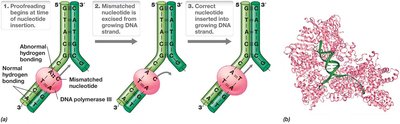
DNA polymerases possess proofreading activity to ensure high fidelity during DNA replication. Mismatched nucleotides are excised and replaced with the correct base.
3' to 5' exonuclease activity: Removes incorrectly paired nucleotides.
Transcription in Bacteria
Mechanism of Transcription
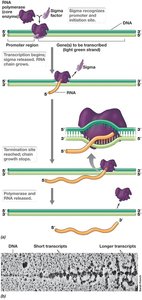
Transcription is the process by which RNA is synthesized from a DNA template. In bacteria, a single RNA polymerase carries out this process, assisted by sigma factors that recognize promoter sequences.
Promoter: DNA sequence where RNA polymerase binds to initiate transcription.
Sigma factor: Protein that directs RNA polymerase to specific promoters.
Termination: Occurs when RNA polymerase reaches a terminator sequence.
Operons and Polycistronic mRNA
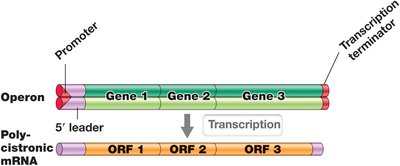
In bacteria, genes are often organized into operons, allowing coordinated expression of multiple genes from a single promoter. The resulting mRNA is polycistronic, encoding several proteins.
Operon: Cluster of genes under control of a single promoter.
Polycistronic mRNA: Single mRNA molecule encoding multiple proteins.
Termination of Transcription
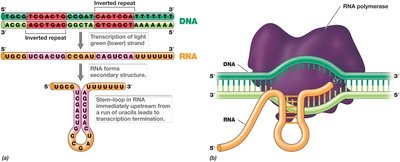
Transcription termination in bacteria can occur via intrinsic (rho-independent) or rho-dependent mechanisms. Intrinsic termination involves the formation of a stem-loop structure in the RNA, causing RNA polymerase to dissociate.
Transcription in Archaea and Eukarya
RNA Polymerases and Promoter Recognition
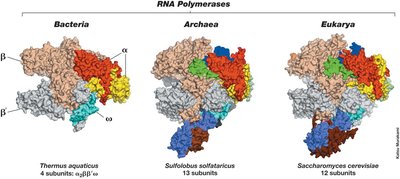
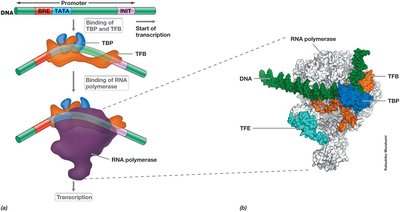
Archaea and eukaryotes have more complex transcription machinery, with multiple RNA polymerases and additional transcription factors. Promoter recognition involves TATA-binding proteins and other factors.
Archaea: Single RNA polymerase, similar to eukaryotic RNA polymerase II.
Eukarya: Three main RNA polymerases (I, II, III), each transcribing different types of genes.
Processing of Eukaryotic mRNA
mRNA Maturation
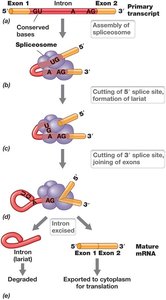
Eukaryotic mRNA undergoes extensive processing before translation. This includes addition of a 5' cap, polyadenylation at the 3' end, and removal of introns via splicing.
5' capping: Addition of a methylated guanine nucleotide to the 5' end.
Polyadenylation: Addition of a poly(A) tail to the 3' end.
Splicing: Removal of non-coding introns and joining of exons.
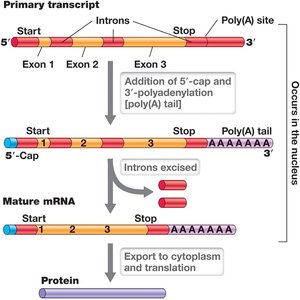
Additional info: These modifications are essential for mRNA stability, export from the nucleus, and efficient translation.
