 Back
BackPrinciples of Disease and Epidemiology: Mini-Textbook Study Notes
Study Guide - Smart Notes
 Tailored notes based on your materials, expanded with key definitions, examples, and context.
Principles of Disease and Epidemiology
Symbiotic Relationships
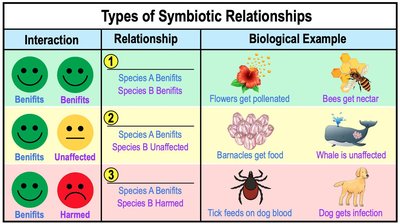
Symbiotic relationships describe the interactions between two different organisms living together. These relationships are fundamental in microbiology, as they explain how microbes interact with their hosts and environment.
Mutualism: Both organisms benefit from the relationship. Example: Flowers get pollinated while bees obtain nectar.
Commensalism: One organism benefits, and the other is unaffected. Example: Barnacles get food, while the whale is unaffected.
Parasitism: One organism benefits at the expense of the other, which is harmed. Example: Ticks feed on dog blood, causing infection in the dog.
The Human Microbiome
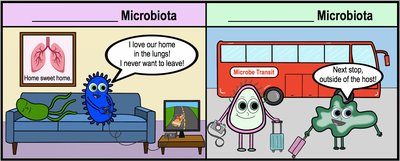
The human microbiome consists of communities of microbes that inhabit various parts of the human body. These microbes play essential roles in health and disease.
Resident Microbiota: Microbes that persist on/in the host for extended periods.
Transient Microbiota: Microbes that are only temporarily found in the body, often including pathogens.
Factors Influencing the Microbiome
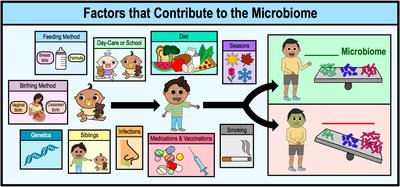
Many factors contribute to the composition and function of the human microbiome, including genetics, diet, environment, and medical interventions.
Feeding method (breastfeeding vs. formula)
Birth method (vaginal vs. cesarean)
Diet, medications, and vaccinations
Exposure to siblings, daycare, and infections
Environmental factors such as seasons and smoking
Microbiome and Immunity
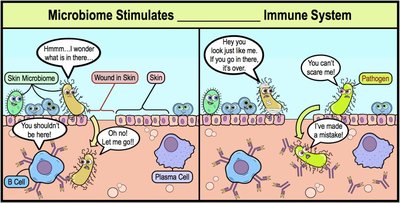
The microbiome stimulates both innate and adaptive immune responses, helping the body recognize and respond to pathogens.
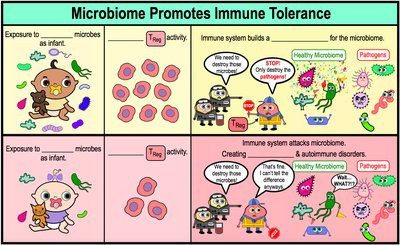
Microbiome exposure trains the immune system to distinguish between harmless and harmful microbes.
Early exposure to diverse microbes increases regulatory T cell (TReg) activity, promoting immune tolerance and reducing risk of allergies and autoimmune disorders.
Microbiome Protection and Digestion
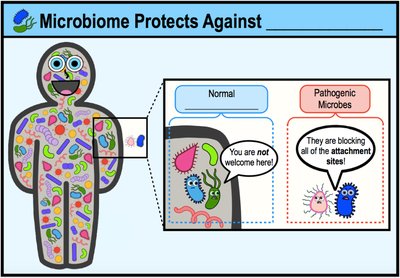
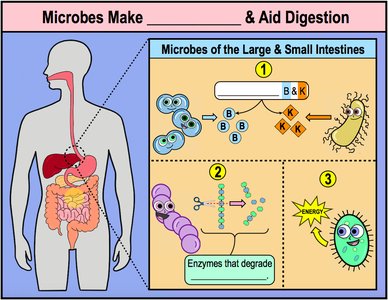
The microbiome protects against infection by outcompeting pathogens for resources and blocking their attachment sites. It also aids in digestion and nutrient production.
Microbes produce vitamins (e.g., B and K) and enzymes that degrade complex carbohydrates.
Fermenting bacteria provide energy sources for epithelial cells.
Characteristics of Infectious Disease
Definitions and Types
Infectious diseases are caused by pathogenic microbes and can be classified based on their ability to spread and the nature of their symptoms.
Disease: Condition where normal structure and function are impaired.
Infection: Colonization and replication of a pathogen in a host.
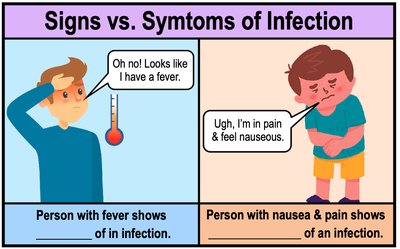
Signs: Objective evidence observable by others (e.g., fever).
Symptoms: Subjective evidence reported by the patient (e.g., pain, nausea).
Asymptomatic Disease: Infection without observable signs or symptoms.
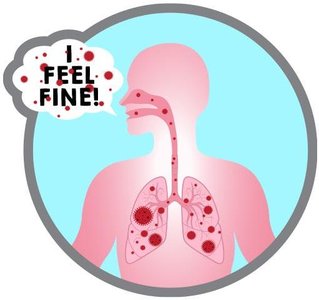
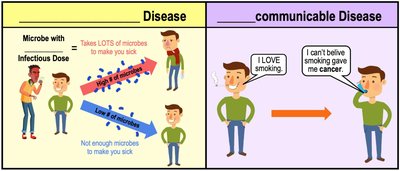
Communicable vs. Noncommunicable Diseases
Diseases are classified based on their ability to spread between hosts.
Communicable Diseases: Infectious diseases that spread between hosts.
Noncommunicable Diseases: Diseases that do not spread between hosts (e.g., cancer).
Infectious Dose: The number of microbes required to establish infection.
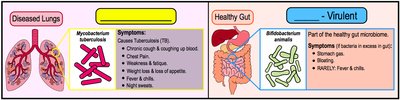
Virulence and Pathogenicity
Virulence refers to the degree of pathogenicity of an organism. Virulence factors are traits that enable pathogens to cause disease.
Examples of virulence factors: adhesins, capsules, endotoxins, proteases.
Highly virulent organisms are more likely to cause infection.
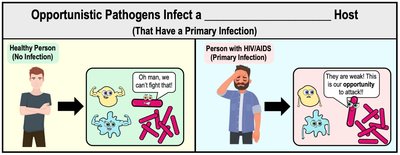
Primary vs. Secondary Infections
Primary infections are caused by primary pathogens in healthy individuals, while secondary infections are caused by opportunistic pathogens in compromised hosts.
Opportunistic Pathogens: Infect hosts with weakened immune systems or primary infections.
Stages of Infectious Disease Progression
Acute, Chronic, and Latent Infections
The progression of infectious diseases involves several stages, which vary depending on the type of infection.
Incubation Period: Time between exposure and onset of symptoms.
Prodromal Period: Early, vague symptoms.
Period of Illness: Most severe signs and symptoms.
Period of Decline: Symptoms begin to resolve.
Period of Convalescence: Recovery and elimination of pathogen.
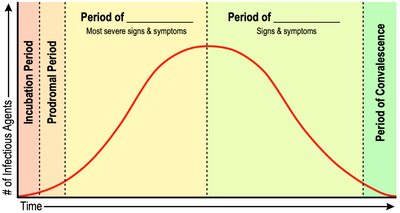
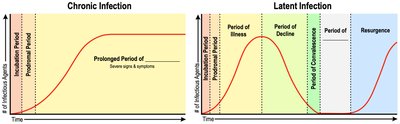
Chronic Infection: Prolonged period of illness.
Latent Infection: Periods of latency and resurgence.
Koch’s Postulates
Classical Koch’s Postulates
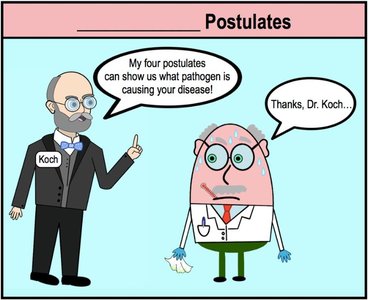
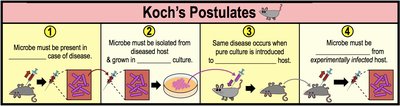
Koch’s postulates are a set of criteria used to establish a causal relationship between a microbe and a disease.
1. Microbe must be present in every case of disease.
2. Microbe must be isolated and grown in pure culture.
3. Pure culture must cause disease when introduced to a healthy host.
4. Microbe must be re-isolated from experimentally infected host.
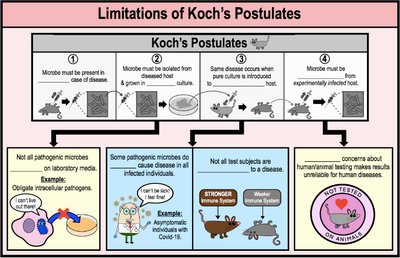
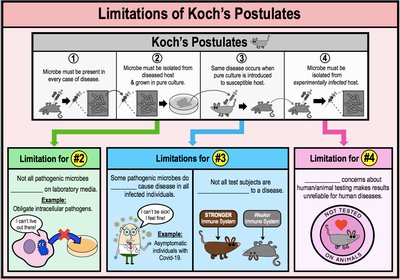
Limitations of Koch’s Postulates
There are several limitations to Koch’s postulates, including inability to culture certain microbes, asymptomatic carriers, and ethical concerns regarding animal testing.
Not all pathogens can be cultured in laboratory media.
Some pathogens cause disease only in certain individuals.
Not all test subjects are susceptible to disease.
Ethical concerns with animal testing.
Epidemiology
Introduction to Epidemiology
Epidemiology is the study of the distribution, patterns, and determinants of health and disease in populations. It is essential for understanding and controlling infectious diseases.
Public Health: Practice of protecting and improving population health.
Etiology: Study of the cause or origin of a disease.
Scope of Diseases
Diseases are classified based on their frequency and geographic spread.
Endemic: Consistently present in a population.
Epidemic: Unusually high number of cases in a population.
Pandemic: Epidemic that spreads worldwide.
Sporadic Disease: Occasional cases in isolated groups.
Outbreak: Localized, rapid increase in cases.
Morbidity: Incidence vs. Prevalence
Morbidity refers to the state of having a disease. Incidence and prevalence are key measures in epidemiology.
Incidence: Number of new cases during a specific time period.
Prevalence: Total number of cases (new and existing) at a specific time.
Incidence Proportion Formula:
Prevalence Proportion Formula:
Mortality & Case-Fatality Rates
Mortality rate and case-fatality rate are used to assess the severity and impact of diseases.
Mortality Rate: Proportion of deaths among the entire population.
Case-Fatality Rate (CFR): Proportion of deaths among diagnosed individuals.
Mortality Rate Formula:
Case-Fatality Rate Formula:
Chain of Infection
Steps in the Chain of Infection
The spread of infectious disease follows a series of steps known as the chain of infection.
1. Pathogen in its natural habitat (reservoir)
2. Portal of exit
3. Transmission
4. Portal of entry
5. Colonization of susceptible host
Reservoirs of Infection
Reservoirs are the natural habitats where pathogens persist long-term. They can be human, animal, or environmental.
Human Reservoirs: Includes carriers (active and passive, symptomatic or asymptomatic).
Non-Human Reservoirs: Animals, water, soil.
Zoonoses: Diseases originating in animals and transmitted to humans.
Disease Transmission
Vertical vs. Horizontal Transmission
Pathogens are transmitted either vertically (mother to child) or horizontally (any other method).
Vertical Transmission: Occurs during pregnancy, birth, or breastfeeding.
Horizontal Transmission: Direct or indirect transfer between individuals.
Direct and Indirect Transmission
Horizontal transmission can be direct (contact, droplets) or indirect (airborne, vehicle-borne, vector-borne).
Direct Contact: Physical contact with reservoir.
Droplet Transmission: Respiratory droplets from sneezing, coughing, talking.
Airborne Transmission: Microscopic droplet nuclei remain suspended in air.
Vehicle-Borne Transmission: Through contaminated objects (fomites), food, water.
Vector-Borne Transmission: Through living organisms (mechanical or biological vectors).
Mechanical vs. Biological Vectors
Vectors are living organisms that transmit pathogens. Mechanical vectors transport pathogens without replication, while biological vectors allow pathogens to replicate within them.
Mechanical Vector: Passive transport (e.g., fly landing on food).
Biological Vector: Active transport with replication (e.g., mosquito transmitting malaria).
Colonization of Susceptible Host
Colonization is the establishment of a pathogen within a host, often through specific portals of entry (e.g., respiratory tract, gastrointestinal tract, skin wounds).
Respiratory pathogens: Enter via nose or mouth.
Intestinal pathogens: Enter via ingestion.
Fecal-oral transmission: Ingestion of fecal pathogens.
Factors Influencing Epidemiology
Several factors influence the spread and impact of diseases, including host-microbe interactions, dose, incubation period, host population characteristics, environment, and herd immunity.
Herd Immunity: When a large percentage of the population is immune, protecting non-immune individuals.
Antigenic Variation: Pathogens change surface antigens to evade immune response.
Emerging and Re-Emerging Infectious Diseases
Emerging diseases are new or increasing in incidence, while re-emerging diseases are previously controlled but now prevalent again. Factors include microbe evolution, population increase, food production, misuse of antibiotics, climate change, and societal changes.
Healthcare-Associated Infections (HAIs)
HAIs are infections acquired in healthcare settings. Risk factors include other patients, hospital environment, healthcare workers, patient visitors, and invasive procedures. Prevention involves infection control committees and practitioners.
Epidemiological Studies
Epidemiological studies are classified as descriptive (who, where, when), analytical (why, how), and experimental (what works to prevent/control disease).
Type of Study | Purpose |
|---|---|
Descriptive | Finds patterns, generates hypotheses |
Analytical | Observationally compares groups to find associations |
Experimental | Tests interventions to determine effectiveness |
