 Back
BackStreak Plate Technique for Isolating Pure Cultures
Study Guide - Smart Notes
 Tailored notes based on your materials, expanded with key definitions, examples, and context.
Streak Plate Technique for Isolating Pure Cultures
Introduction to Pure Culture Isolation
The streak plate technique is a fundamental microbiological method used to separate individual bacterial species from a mixed sample, resulting in the growth of pure colonies. This technique is essential in clinical, environmental, and industrial microbiology for identifying and studying specific microorganisms.
Pure culture: A population of cells derived from a single parent cell, free from contamination by other species.
Application: Used for diagnostic testing of clinical samples (e.g., blood, urine, sputum), environmental samples (soil, water), and industrial processes.
Principle: Relies on the physical dilution of cells across the surface of an agar plate to obtain isolated colonies.
Quadrant Streak Method
The quadrant streak method is a systematic approach to streaking an agar plate, dividing it into four sections to progressively dilute the sample and achieve isolated colonies.
Step 1: Label the bottom of the agar plate and position it upside down on the bench.
Step 2: Resuspend the mixed culture by gently agitating the tube.
Step 3: Using aseptic technique, transfer a loopful of the culture to Area 1 of the plate.
Step 4: Flame the loop, cool it, and streak from Area 1 into Area 2. Rotate the plate 90°.
Step 5: Repeat flaming, cooling, and streaking from Area 2 into Area 3. Rotate the plate 90°.
Step 6: Without flaming, streak from Area 3 into Area 4 using a wider pattern.
Step 7: Incubate the plate inverted to prevent condensation from disturbing the colonies.
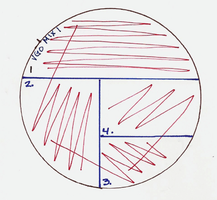
Example: In this experiment, two mixed cultures are used: Mix #1 (Escherichia coli & Serratia marcescens) and Mix #2 (Escherichia coli & Micrococcus luteus). Each mix is streaked to observe the formation of distinct colonies based on pigment and morphology.
Key Concepts and Best Practices
Aseptic technique: Essential to prevent contamination of the culture and the environment.
Colony morphology: Different species often produce colonies with unique colors, shapes, and textures, aiding in identification.
Incubation: Plates are incubated at room temperature or 40°C, depending on the experimental design.
Result interpretation: Well-isolated colonies in the final quadrant indicate successful dilution and separation of species.
Summary Table: Steps in the Quadrant Streak Plate Technique
Step | Description |
|---|---|
1 | Label and position plate; resuspend culture |
2 | Streak Area 1 with loopful of mixed culture |
3 | Flame loop, streak Area 2 from Area 1 |
4 | Flame loop, streak Area 3 from Area 2 |
5 | Streak Area 4 from Area 3 (no flaming) |
6 | Incubate inverted at appropriate temperature |
Additional info:
Proper streaking technique is critical for obtaining isolated colonies, which are necessary for further biochemical testing and identification.
Different incubation temperatures may favor the growth of certain species, aiding in their differentiation.
