 Back
BackViruses and Prions: Structure, Classification, Replication, and Clinical Relevance
Study Guide - Smart Notes
 Tailored notes based on your materials, expanded with key definitions, examples, and context.
Viruses and Prions
Introduction to Viruses
Viruses are submicroscopic, acellular infectious agents that require a host cell to replicate. They are considered nonliving because they lack cellular structure and metabolism. Virology is the study of viruses, which can infect all forms of life, including bacteria (bacteriophages), animals, and plants.
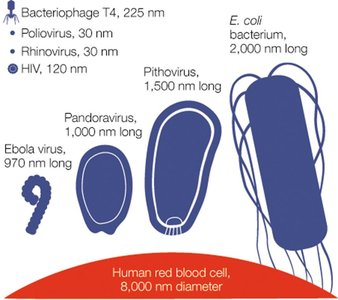
Size: Viruses are extremely small (20–400 nm), much smaller than prokaryotic and eukaryotic cells.
Obligate Intracellular Pathogens: Viruses must infect a host cell to reproduce.
Host Range: Viruses can infect every branch in the tree of life.
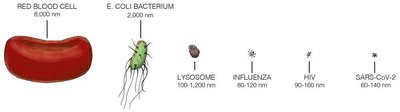
Comparison of Viruses, Prokaryotes, and Eukaryotes
Viruses differ fundamentally from prokaryotic and eukaryotic cells in structure, replication, and metabolism.
Characteristic | Viruses | Prokaryotes | Eukaryotes |
|---|---|---|---|
Cells? | No | Yes | Yes |
Considered alive? | No | Yes | Yes |
Relative size | Smaller than prokaryotes | Bigger than viruses, smaller than eukaryotes | Bigger than prokaryotes and viruses |
Filterable | Yes | Not usually | No |
Structure | Protein capsid, nucleic acid | Cells without nuclei | Cells with nuclei |
Replication | Hijack host machinery | Binary fission | Mitosis/Meiosis |
Metabolism | No | Yes | Yes |
Genome | DNA or RNA | DNA | DNA |
Viral Structure and Genomic Features
Virion Structure
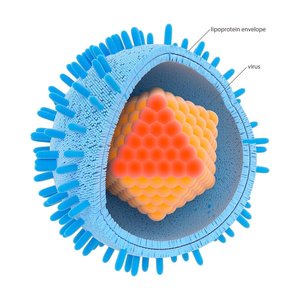
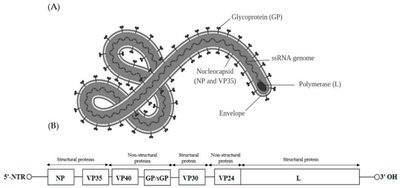
A virion is a single, infectious virus particle. It consists of genetic material (DNA or RNA) enclosed in a protein shell called a capsid. Some viruses also possess an outer lipid envelope derived from the host cell membrane.
Capsid: Protein shell made of capsomere subunits; protects the genome and accounts for most of the virion's mass.
Envelope: Lipid-based membrane present in some viruses, acquired from the host cell during budding.
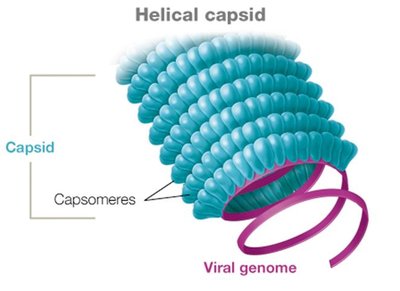
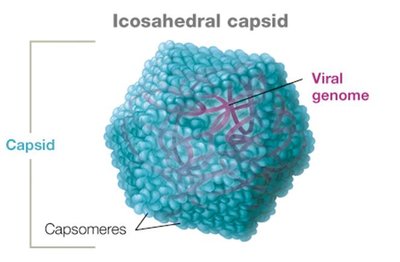
Capsid Symmetry
Viral capsids can have different shapes, which are important for classification and function.
Helical: Hollow tube-like structure (e.g., tobacco mosaic virus).
Icosahedral: Three-dimensional polygonal structure (e.g., adenovirus, coronavirus).
Complex: More elaborate structures, often seen in bacteriophages (e.g., T4 phage).
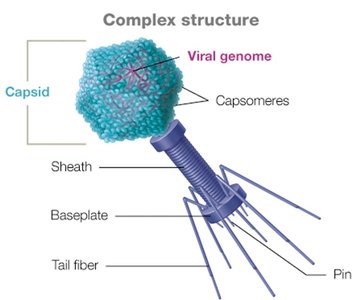
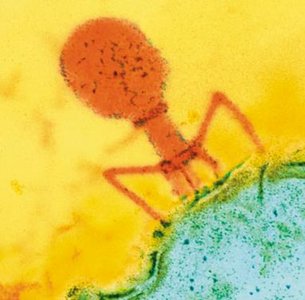
Bacteriophage Capsids
Bacteriophages typically have complex capsids with icosahedral heads and additional structures (e.g., tails) for injecting their genome into bacterial cells.
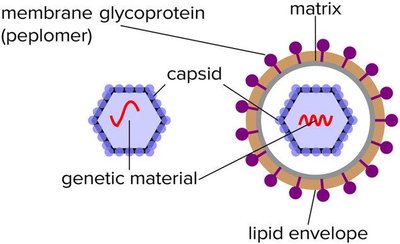
Viral Envelopes and Spikes
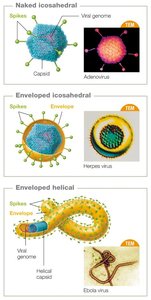
Some viruses are enveloped, possessing a lipid membrane with embedded glycoprotein spikes (peplomers) that facilitate attachment to host cells. Nonenveloped (naked) viruses lack this envelope and are released by lysing the host cell.
Enveloped viruses: e.g., coronaviruses, herpesviruses, influenza.
Naked viruses: e.g., human papillomavirus, poliovirus, all bacteriophages.
Spikes (peplomers): Glycoprotein extensions for host cell recognition and entry; highly specific to host cell receptors.
Viral Genome Organization
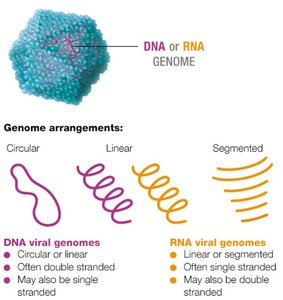
Viral genomes are highly variable and can be composed of DNA or RNA, which may be single- or double-stranded, linear, circular, or segmented. Most viruses have fewer than 300 genes, encoding structural proteins, enzymes for replication, and other factors.
DNA or RNA: Never both in the same virion.
Genome arrangements: Circular, linear, or segmented.
Making mRNA from Viral Genomes
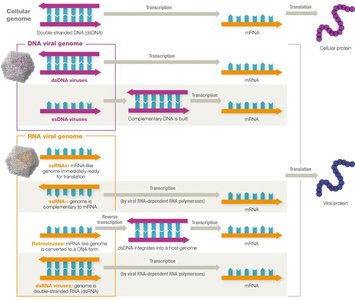
The ultimate goal of all viruses is to direct the host cell to produce viral proteins and assemble new virions. The process of generating mRNA from viral genomes varies depending on the type of nucleic acid present.
Viral Evolution and Genetic Change
Mutation and Reassortment
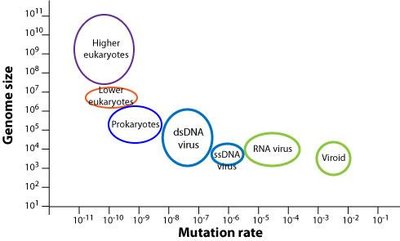
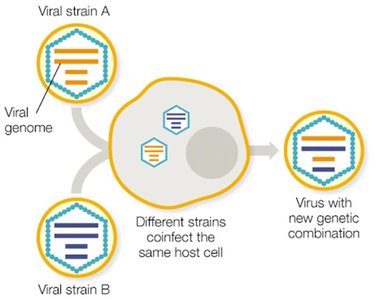
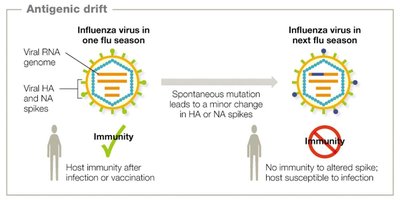
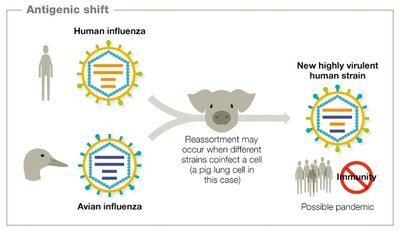
Viruses, especially those with RNA genomes, mutate rapidly due to high replication rates and lack of proofreading by RNA polymerases. Genetic changes can be neutral, beneficial, or detrimental. Reassortment occurs when two different viral strains coinfect a host cell, leading to new viral strains.
Antigenic drift: Minor changes in viral antigens due to mutation (e.g., influenza HA and NA spikes).
Antigenic shift: Major genetic reassortment, often resulting in new, highly infectious strains and potential pandemics.
Classification and Taxonomy of Viruses
Classification Criteria
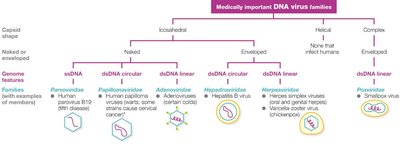
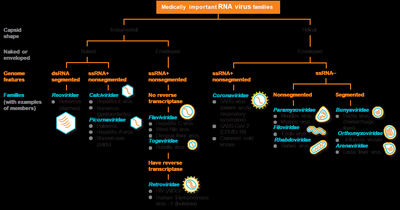
Viruses are classified based on their nucleic acid type, capsid symmetry, presence or absence of an envelope, and genome architecture (e.g., ssDNA, dsRNA).
DNA viruses: Families include Parvoviridae, Papillomaviridae, Adenoviridae, Hepadnaviridae, Herpesviridae, Poxviridae.
RNA viruses: Families include Reoviridae, Picornaviridae, Flaviviridae, Retroviridae, Orthomyxoviridae, etc.
Naming Conventions
Taxon | Example | Notes |
|---|---|---|
Order | Herpesvirales | Italicized, capitalized, ends in 'virales' |
Family | Herpesviridae | Italicized, capitalized, ends in 'viridae' |
Subfamily | Alphaherpesvirinae | Italicized, capitalized, ends in 'virinae' |
Genus | Simplexvirus | Italicized, capitalized, ends in 'virus' |
Species | Human herpesvirus-1 | Italicized, proper nouns capitalized |
Common name | human herpes virus-1 (HHV-1) | Not italicized, may be abbreviated |
Host Range and Tropism
Host Range
Host range is the spectrum of species a virus can infect. Some viruses are species-specific (e.g., measles virus infects only humans), while others have a broad host range (e.g., avian influenza can infect birds and humans after reassortment).
Tropism
Tropism refers to the specificity of a virus for particular host tissues or cell types, determined by viral surface factors and host cell receptors.
Broad tropism: Ebola virus infects many cell types.
Narrow tropism: Hepatitis viruses infect primarily liver cells.
Viral Replication
Bacteriophage Replication
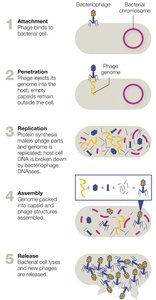
Bacteriophages replicate via the lytic or lysogenic cycle. The lytic cycle results in immediate production of new virions and lysis of the host cell. The lysogenic cycle involves integration of the phage genome into the host chromosome as a prophage, which can later reactivate and enter the lytic cycle.
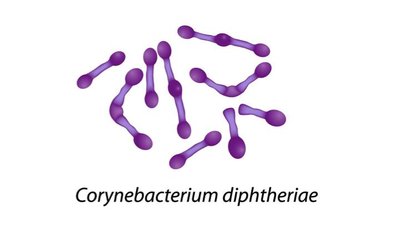
Phage conversion: Prophages can confer new pathogenic properties to bacteria (e.g., toxin production in Corynebacterium diphtheriae and Clostridium botulinum).
Animal Virus Replication
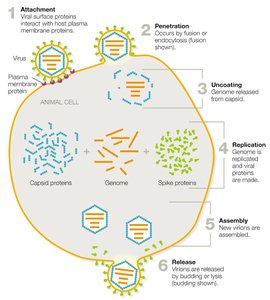
Animal viruses follow a generalized replication cycle: attachment, penetration, uncoating, replication, assembly, and release. Enveloped viruses are released by budding, while naked viruses typically lyse the host cell.
Persistent and Oncogenic Viral Infections
Types of Persistent Infections
Chronic: Continuous release of virions (e.g., HIV).
Latent: Periods of dormancy with intermittent flare-ups (e.g., herpesviruses).
Oncogenic Viruses
Oncogenic viruses can cause cancer by stimulating uncontrolled cell division or inhibiting cell death. Examples include human papillomavirus (HPV), Epstein–Barr virus, and hepatitis B and C viruses.
Virus | Genome | Integrates? | Cancer Link | Mechanism |
|---|---|---|---|---|
HPV | DNA | Yes | Cervical, oropharyngeal, anal, etc. | Uncontrolled cell division |
Human herpesvirus-8 | DNA | No | Kaposi sarcoma | Uncontrolled cell division |
Epstein–Barr virus | DNA | No | Lymphomas, Hodgkin’s disease | Uncontrolled cell division |
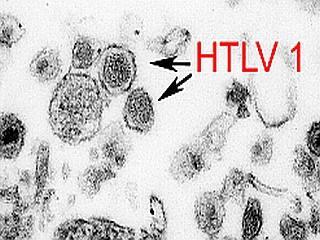
HTLV | RNA | Yes | Adult T-cell leukemia | Uncontrolled cell division |
Hepatitis B | DNA | No | Liver cancer | Chronic inflammation, DNA damage |
Hepatitis C | RNA | No | Liver cancer | Chronic inflammation, DNA damage |
Virus Detection and Cultivation
Plaque Assays
Plaque assays are used to quantify bacteriophages. Each plaque represents a zone of lysed cells, corresponding to a single infectious phage in the original sample. The number of plaque-forming units (PFUs) indicates viral titer.
Growing Animal Viruses
Animal viruses are cultivated using tissue culture, embryonated eggs, or live animal hosts. Tissue culture is the most common method for laboratory propagation.
Diagnostic Tests
Diagnostic tests for viruses include molecular methods (PCR, sequencing), antigen detection (ELISA, latex agglutination), and antibody detection. Tests must be specific (no false positives) and sensitive (no false negatives).
ELISA: Detects viral antigens or antibodies; color change indicates binding.
Latex agglutination: Antigen-antibody binding causes visible clumping.
Nucleic acid detection: PCR, fluorescent probes, sequencing.
Antiviral Drugs and Vaccines
Antiviral Drug Mechanisms
Antiviral drugs target various stages of the viral replication cycle, including attachment, penetration, uncoating, replication, assembly, and release. Most antivirals limit infection rather than cure it.
Entry inhibitors: Block viral attachment or fusion (e.g., docosanol, palivizumab).
Nucleoside analogs: Mimic nucleotides, inhibit replication (e.g., acyclovir, ribavirin, AZT).
Antisense antivirals: Bind viral RNA, inhibit translation (e.g., Vitravene).
Interferons: Signal uninfected cells to mount antiviral defenses.
Neuraminidase inhibitors: Prevent influenza virion release (e.g., oseltamivir/Tamiflu).
Vaccines are crucial for preventing viral diseases by training the immune system to recognize and respond to specific viruses.
Prions
Prion Structure and Disease
Prions are infectious proteins that lack nucleic acids. They cause transmissible spongiform encephalopathies (TSEs), which are fatal neurodegenerative diseases. Prions induce misfolding of normal proteins in the brain, leading to tissue degeneration and characteristic sponge-like holes.
Diagnosis: Detection of spongiform changes in brain tissue post-mortem.
Prion-like diseases: Some neurodegenerative diseases (e.g., Alzheimer's, Parkinson's, ALS) may involve prion-like mechanisms of protein misfolding and aggregation.
Clinical Application: Case Study Questions
Screening old blood samples for new viruses: Use molecular techniques (PCR, sequencing) to detect unknown viral genetic material.
Classifying a new virus: Determine nucleic acid type, capsid structure, envelope presence, and genome architecture using laboratory analysis.
Isolating and growing a virus: Inoculate susceptible cell cultures or animal models with patient blood, monitor for cytopathic effects, and confirm viral presence with molecular assays.
Antivirals for RNA viruses: Nucleoside analogs, reverse transcriptase inhibitors, and antisense drugs may be prescribed; these inhibit viral replication by interfering with RNA synthesis or function.
Shared genes and immune response: Strong immune reaction in vaccinated animals suggests antigenic similarity between the new virus and hepatitis C, likely due to shared epitopes.
Low viral titers and infection: Persistent low titers suggest a chronic or latent infection with limited viral replication and low pathogenicity.
Oncogenic potential: The absence of cancer in most infected individuals does not rule out oncogenicity; other factors (host genetics, co-infections, immune status) may influence cancer development.
