 Back
BackViruses, Viroids, and Prions: Foundations of Viral Biology
Study Guide - Smart Notes
 Tailored notes based on your materials, expanded with key definitions, examples, and context.
Viral Foundations: Viruses, Viroids, and Prions
Introduction to Viruses
Viruses are acellular infectious agents that require living host cells to replicate. They are fundamentally different from cellular life forms and occupy a unique position in biology due to their structure, replication strategies, and evolutionary impact.
Viruses are small, acellular obligate parasites of living hosts.
They contain either DNA or RNA as their genetic material, but never both.
Viruses are considered non-living because they lack cellular organization and metabolism.
Universal Characteristics of Life
Defining Life
Living organisms share several universal characteristics, which are used to distinguish them from non-living entities such as viruses.
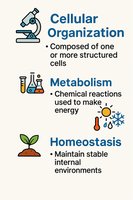
Cellular Organization: Composed of one or more structured cells.
Metabolism: Chemical reactions used to make energy.
Homeostasis: Maintain stable internal environments.
Growth & Development: Increase in size and undergo regulated changes.
Response to Stimuli: React to environmental changes.
Adaptation & Evolution: Populations evolve over generations through natural selection.

The Cell as a Factory
Cellular Organization and Function
Cells function like complex factories with specialized departments (organelles) that coordinate gene expression and protein synthesis.
Control Center: Nucleus (contains DNA)
Production Plant: Ribosomes (protein synthesis)
Energy Plant: Mitochondria (ATP production)
Processing/Finishing: Endoplasmic reticulum & Golgi apparatus
Storage Warehouse: Vesicles
Delivery/Shipping: Secretory pathways/exocytosis
Quality Control: Protein folding and degradation systems

The Central Dogma of Molecular Biology
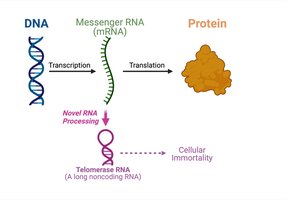
The central dogma describes the flow of genetic information: DNA is transcribed into RNA, which is then translated into protein.
Transcription: DNA → mRNA
Translation: mRNA → Protein
Viruses as Abandoned Factories
Viruses vs. Cells
Viruses lack the cellular machinery found in living cells and instead hijack host cell systems to replicate.
Viruses do not have organelles or metabolic pathways.
They carry only genetic instructions and a protein shell.
Viruses cannot make proteins or reproduce without a host cell.
What is a Virus?
Basic Properties
Viruses are small, acellular, and obligate intracellular parasites.
They possess either a DNA or RNA genome, surrounded by a protein coat (capsid).
Viruses are considered non-living because they cannot carry out metabolism or reproduce independently.
Basic Structure of All Viruses
Capsid and Nucleic Acid
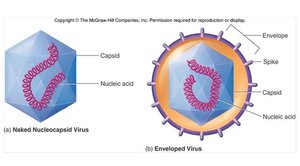
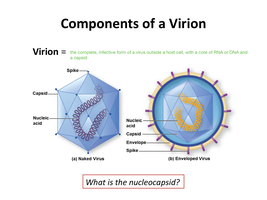
All viruses have a capsid (protein shell) that houses their genetic material. The combination of capsid and nucleic acid is called the nucleocapsid.
Capsid: Protects the viral genome and aids in host cell attachment.
Nucleic Acid: Can be DNA or RNA, single- or double-stranded, linear, circular, or segmented.
Nucleocapsid: Capsid + nucleic acid.
Additional Structures in Some Viruses
Some viruses possess extra components that aid in infection and survival.
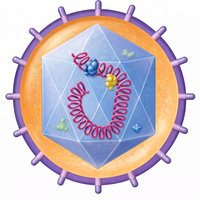
Spikes (glycoproteins): Attach to host cell receptors.
Envelope: Phospholipid membrane derived from the host cell, covering the capsid.
Enzymes & Proteins: Facilitate genome replication, host entry, and immune evasion.
Components of a Virion
Definition and Structure
A virion is the complete, infectious form of a virus outside a host cell, consisting of a nucleic acid genome enclosed in a protein capsid, and sometimes an envelope.
Virion: Complete infectious particle.
Naked Virus: Only nucleocapsid (capsid + nucleic acid).
Enveloped Virus: Nucleocapsid plus lipid envelope and spikes.
Viral Genomes
Types and Replication
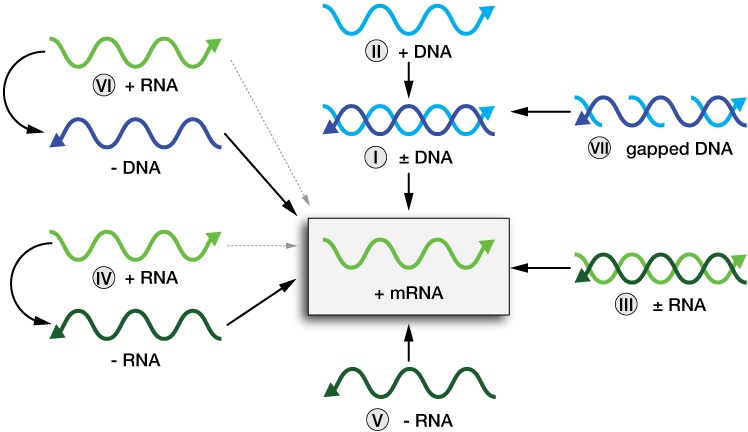
Viral genomes are highly diverse and influence replication strategies.
Contain either DNA or RNA, never both.
May be single-stranded (ss) or double-stranded (ds), linear, circular, or segmented.
Genome type determines how the virus replicates and evolves.
All viruses must generate mRNA for host ribosomes to translate into proteins.
Are Viruses Alive?
Debate on Life Status
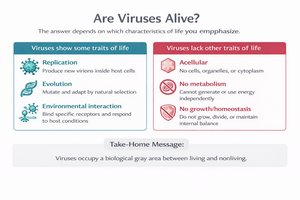
Viruses occupy a gray area between living and nonliving entities. They exhibit some traits of life but lack others.
Arguments for Life: Replicate inside host cells, evolve, interact with environment.
Arguments Against Life: Acellular, no metabolism, no independent growth or homeostasis.
Diversity in Virus Morphology
Major Virus Shapes
Viruses exhibit a variety of shapes, which are important for classification and function.
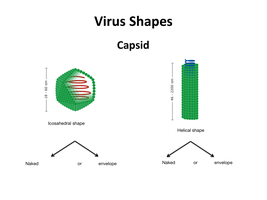
Icosahedral: 20 faces, 12 vertices, 30 edges; common in animal viruses.
Helical: Rod-shaped; common in plant viruses.
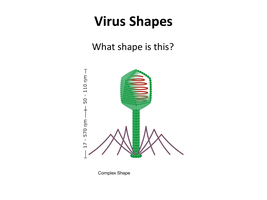
Complex: Combination of shapes, often seen in bacteriophages.
Viruses can be naked (no envelope) or enveloped (with lipid membrane).
Viral Capsids
Capsids protect viral genetic material and determine virus shape.
Composed of protein subunits called capsomeres.
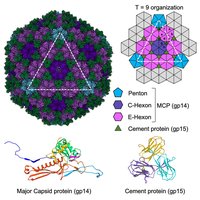
Icosahedral capsids have 20 faces and are highly efficient for genome packaging.
Attachment proteins (spikes) are often located at vertices.
Examples of Virus Morphologies
Helical – Naked: Tobacco mosaic virus (TMV), rigid rod-shaped, ssRNA genome.
Icosahedral – Naked: Adenovirus, dsDNA genome, causes respiratory infections.
Icosahedral – Enveloped: Herpes simplex virus (HSV), dsDNA genome, causes herpes infections.
Helical – Enveloped: Rabies virus, −ssRNA genome, causes rabies.
Complex: Bacteriophages, infect prokaryotes, have icosahedral heads and helical tails.
Virus Types by Host
Host Specificity
Viruses are classified by the type of host they infect: bacteria (bacteriophages), plants, or animals.
Bacteriophages: Infect bacteria, most abundant viruses on Earth.
Plant Viruses: Infect plants, often transmitted by insects or mechanical damage.
Animal Viruses: Infect animals and humans, require specific receptor interactions for entry.
Host specificity is determined by viral attachment proteins and host cell receptors.
Viral Host Range & Tropism
Definitions
Tissue Tropism: Tissues/organs a virus can infect.
Cellular Tropism: Specific cell types within tissues a virus can infect.
Host Range: Range of hosts a virus can infect and complete its lifecycle.
Viral Virulence Factors
Mechanisms of Immune Evasion
Viruses possess proteins that help them evade host immune responses, replicate efficiently, and persist in the host.
Disrupt innate and adaptive immune detection.
Block immune signaling pathways (e.g., interferon inhibition).
Evade detection through antigenic variation or latency.
Examples of Viral Immune Evasion
Influenza NS1 Protein: Suppresses host antiviral signaling by sequestering viral dsRNA and blocking interferon responses.
HIV Nef Protein: Removes MHC I from the cell surface, preventing cytotoxic T lymphocyte (CTL) recognition and promoting viral persistence.
General Viral Lifecycle
Steps of Viral Replication
All viruses follow a core replication strategy:
Attachment
Entry
Uncoating
Replication
Assembly
Release
Bacteriophage Lifecycle: Lytic vs Lysogenic
Lytic Cycle
Phage attaches to host, injects DNA, replicates, assembles new phages, and lyses the host cell to release progeny.
Lysogenic Cycle
Phage DNA integrates into the host genome as a prophage, replicates with the host, and can later enter the lytic cycle upon induction.
Transduction: Mechanism for Antibiotic Resistance
Definition and Types
Transduction is the transfer of bacterial genetic material by a bacteriophage.
Generalized Transduction: Random bacterial DNA is packaged during the lytic cycle.
Specialized Transduction: Specific bacterial genes near the prophage site are transferred during the lysogenic cycle.
Viral Entry Mechanisms
Endocytic and Non-Endocytic Entry
Endocytic Entry: Virus binds to receptor, is internalized into an endosome, and fusion/uncoating is triggered by low pH or receptor changes.
Non-Endocytic Entry: Virus fuses directly with the plasma membrane at the cell surface.
Direct Entry (Phages): Phages inject their genome into host cells via a needle-like protein.
Other Infectious Particles: Viroids and Prions
Viroids
Viroids are small, circular RNA molecules that infect plants and do not encode proteins. They cause disease by interfering with host gene expression.
Processed into small interfering RNAs (vsRNA) that hijack host RNA silencing machinery.
Prions
Prions are infectious proteins that cause neurodegenerative diseases by inducing misfolding of normal host proteins.
Do not contain nucleic acids.
Cause diseases such as Creutzfeldt-Jakob disease and mad cow disease.
