Ch. 1 - A Brief History of Microbiology
Bauman - Microbiology with Diseases by Taxonomy 6th Edition
Bauman6th EditionMicrobiology with Diseases by TaxonomyISBN: 9780134832302Not the one you use?Change textbook
Chapter 1, Problem 1

On the following photos, label cilium, flagellum, nucleus, and pseudopod.
<IMAGE>

Verified step by step guidance
1
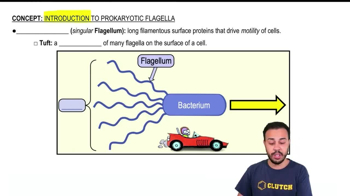
Step 1: Understand the structures you need to identify. A cilium is a short, hair-like projection used for movement or sensing, usually numerous on the cell surface. A flagellum is a longer, whip-like tail used for propulsion, typically one or a few per cell.
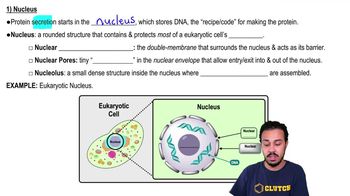
Step 2: Locate the nucleus, which is the membrane-bound organelle containing the cell's genetic material. It is usually a large, round or oval structure within the cell body.
Step 3: Identify the pseudopod, which is a temporary, arm-like projection of the cell membrane and cytoplasm used for movement or engulfing particles. It often appears irregular and extends outward from the cell.
Step 4: On the image, find the short, hair-like structures on the cell surface and label them as cilia. Then, find the longer, whip-like structure and label it as the flagellum.
Step 5: Mark the large central structure inside the cell as the nucleus, and label any irregular, temporary extensions of the cell membrane as pseudopods.

Verified video answer for a similar problem:

This video solution was recommended by our tutors as helpful for the problem above.
Video duration:
2m
Was this helpful?

Key Concepts

Here are the essential concepts you must grasp in order to answer the question correctly.

Cilium

Cilia are short, hair-like projections on the surface of some eukaryotic cells. They beat rhythmically to move fluid, mucus, or the cell itself. In microorganisms, cilia aid in locomotion or feeding by creating water currents.

Flagellum

A flagellum is a long, whip-like appendage that protrudes from the cell body of certain cells and microorganisms. It enables movement by rotating or undulating, allowing the organism to swim through liquid environments.
Recommended video:
Guided course
02:07
Introduction to Prokaryotic Flagella

Pseudopod and Nucleus

Pseudopods are temporary, arm-like extensions of the cytoplasm used by some cells for movement and engulfing food. The nucleus is a membrane-bound organelle containing genetic material, controlling cell activities and reproduction.
Recommended video:
Related Practice
Textbook Question

Which of the following microorganisms are not eukaryotic?

a) Bacteria

b) Yeasts

c) Molds

d) Protozoa

1590
views
1
rank

Textbook Question

Show where microbes ended up in Pasteur’s experiment.

1372
views
Textbook Question

Why was the theory of spontaneous generation a hindrance to the development of the field of microbiology?

1560
views
Textbook Question

Match each of the following descriptions with the person it best describes more than once or not at all. An answer may be used more than once.

1. Developed smallpox immunization

2. First photomicrograph of bacteria

3. Used mathematical data to improve nursing

4. Germs cause disease

5. Sought a “magic bullet” to destroy pathogens

6. Early epidemiologist

7. Father of Microbiology

8. Classification system

9. Discoverer of bacteria

10. Discoverer of protozoa

11. Founder of antiseptic surgery

12. Developed the most widely used bacterial staining technique


A. John Snow

B. Paul Ehrlich

C. Louis Pasteur

D. Antoni van Leeuwenhoek

E. Carolus Linnaeus

F. John Needham

G. Eduard Buchner

H. Robert Koch

I. Joseph Lister

J. Edward Jenner

K. Girolamo Fracastoro

L. Hans Christian Gram

M. Florence Nightingale

1874
views
Textbook Question

Which microorganisms are used to make microbiological growth media?

a. Bacteria

b. Fungi

c. Algae

d. Protozoa

1704
views
Textbook Question

Fill in the blanks with the name(s) of the scientist(s) whose investigations led to the following fields of study in microbiology.

Environmental microbiology ___________ and _____________            

1656
views