Ch. 13 - Characterizing and Classifying Viruses, Viroids, and Prions
Bauman - Microbiology with Diseases by Taxonomy 6th Edition
Bauman6th EditionMicrobiology with Diseases by TaxonomyISBN: 9780134832302Not the one you use?Change textbook
Chapter 13, Problem 1

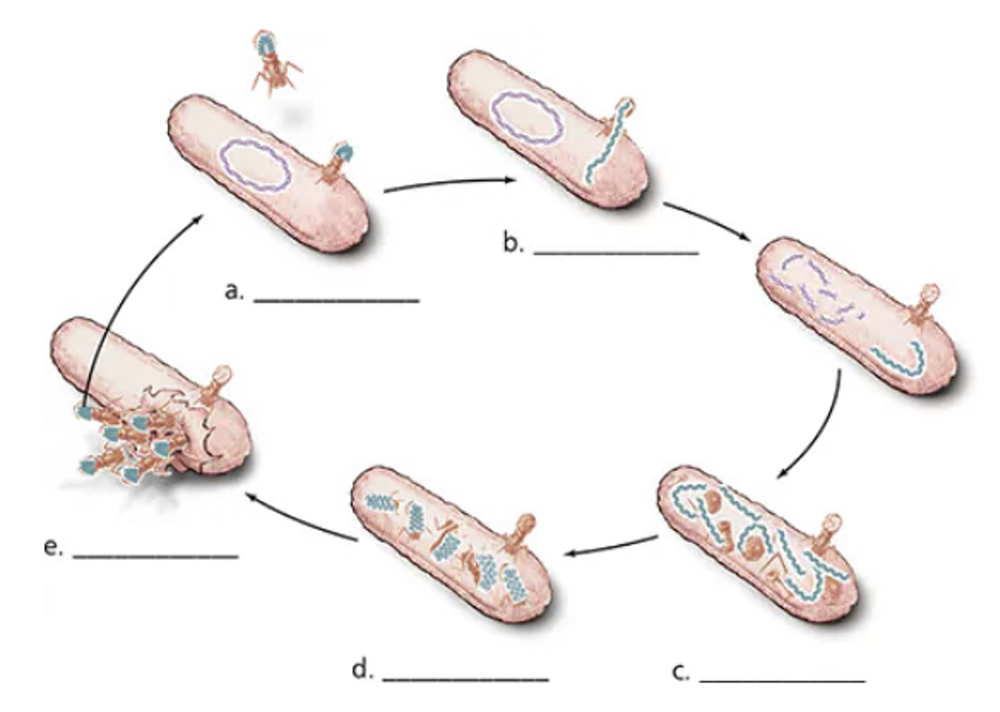
Label each step in the bacteriophage replication cycle below.
Diagram showing the bacteriophage replication cycle with five labeled steps from attachment to release.

Verified step by step guidance
1
Step 1: Identify the first stage of the bacteriophage replication cycle, which is typically the attachment (or adsorption) phase where the phage binds to specific receptors on the bacterial cell surface.
Step 2: Recognize the second stage as penetration, where the bacteriophage injects its genetic material (DNA or RNA) into the host bacterial cell, leaving the capsid outside.
Step 3: Determine the third stage, which is biosynthesis. During this phase, the phage DNA directs the host cell's machinery to replicate phage nucleic acids and synthesize phage proteins.
Step 4: Identify the fourth stage as maturation (or assembly), where newly synthesized phage components are assembled into complete virions inside the host cell.
Step 5: Label the final stage as release, where the host cell lyses (breaks open), releasing new phage particles to infect other bacterial cells.

Verified video answer for a similar problem:

This video solution was recommended by our tutors as helpful for the problem above.
Video duration:
4m
Was this helpful?

Key Concepts

Here are the essential concepts you must grasp in order to answer the question correctly.

Bacteriophage Replication Cycle Stages

The bacteriophage replication cycle includes distinct stages: attachment, penetration, biosynthesis, maturation, and release. Each step describes how the virus attaches to a bacterial cell, injects its genetic material, replicates components, assembles new phage particles, and finally lyses the host to release progeny.
Recommended video:

Attachment and Penetration

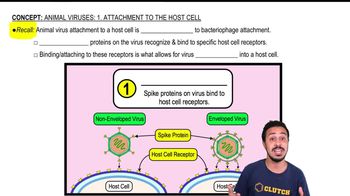
Attachment is the initial step where the bacteriophage binds specifically to receptors on the bacterial surface. Penetration follows, involving injection of phage DNA or RNA into the host cell, leaving the protein coat outside, which is critical for initiating infection.
Recommended video:
Guided course
03:12
Animal Viruses: 1. Attachment to the Host Cell

Lytic vs Lysogenic Cycles

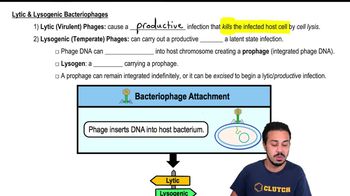
Bacteriophages can undergo a lytic cycle, leading to host cell destruction and phage release, or a lysogenic cycle, where phage DNA integrates into the host genome and replicates passively. Understanding these pathways is essential to label replication steps correctly.
Recommended video:
Guided course
04:34
Lytic & Lysogenic Bacteriophages