Ch. 13 - Characterizing and Classifying Viruses, Viroids, and Prions
Bauman - Microbiology with Diseases by Taxonomy 6th Edition
Bauman6th EditionMicrobiology with Diseases by TaxonomyISBN: 9780134832302Not the one you use?Change textbook
Chapter 13, Problem 1

Which of the following is not an acellular agent?
a. Viroid
b. Virus
c. Rickettsia
d. Prion

Verified step by step guidance
1
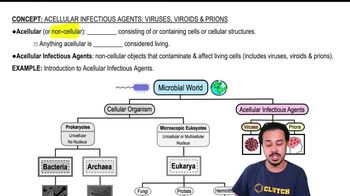
Step 1: Understand the term 'acellular agent'. Acellular agents are infectious entities that lack cellular structure, meaning they do not have cell membranes, cytoplasm, or organelles, and cannot carry out metabolic processes independently.
Step 2: Review each option to determine if it is acellular or cellular. Viroids are small infectious RNA molecules without a protein coat, making them acellular.
Step 3: Viruses consist of nucleic acid enclosed in a protein coat and lack cellular components, so they are also acellular agents.
Step 4: Prions are infectious proteins without nucleic acids or cellular structure, classifying them as acellular agents.
Step 5: Rickettsia are bacteria, which are cellular organisms with cell membranes and metabolic activity, so they are not acellular agents.

Verified video answer for a similar problem:

This video solution was recommended by our tutors as helpful for the problem above.
Video duration:
1m
Was this helpful?

Key Concepts

Here are the essential concepts you must grasp in order to answer the question correctly.

Acellular Agents

Acellular agents are infectious entities that lack cellular structure and cannot carry out metabolic processes independently. Examples include viruses, viroids, and prions, which require host cells to replicate and do not have cellular components like membranes or organelles.
Recommended video:
Guided course
02:54
Acellular Infectious Agents: Viruses, Viroids & Prions

Viruses, Viroids, and Prions

Viruses are acellular particles composed of genetic material (DNA or RNA) enclosed in a protein coat. Viroids are smaller, consisting solely of circular RNA without a protein coat, mainly infecting plants. Prions are infectious proteins that cause neurodegenerative diseases by inducing misfolding of normal proteins.
Recommended video:
Guided course
02:54
Acellular Infectious Agents: Viruses, Viroids & Prions

Rickettsia as Cellular Organisms

Rickettsia are obligate intracellular bacteria, meaning they are cellular organisms with a cell membrane and cytoplasm. Unlike acellular agents, they can carry out metabolic functions and reproduce by binary fission, although they require a host cell for survival and replication.
Recommended video:
Guided course
05:22
Scientific Naming of Organisms