Ch. 2 - The Chemistry of Microbiology
Bauman - Microbiology with Diseases by Taxonomy 6th Edition
Bauman6th EditionMicrobiology with Diseases by TaxonomyISBN: 9780134832302Not the one you use?Change textbook
Chapter 2, Problem 3

The principal short-term energy storage molecule in cells is __________ .

Verified step by step guidance
1
Understand that the question is asking for the main molecule cells use to store energy for short-term use.
Recall that cells store energy in different forms, but the principal short-term energy storage molecule is a high-energy compound that can be quickly mobilized.
Consider common energy storage molecules such as ATP (adenosine triphosphate), glycogen, and fats, and identify which one is primarily used for immediate energy needs.
Recognize that ATP is the molecule that stores and transfers energy in cells for short-term use because it can release energy quickly by breaking its high-energy phosphate bonds.
Conclude that the answer is ATP, which stands for adenosine triphosphate, the principal short-term energy storage molecule in cells.

Verified video answer for a similar problem:

This video solution was recommended by our tutors as helpful for the problem above.
Video duration:
2m
Was this helpful?

Key Concepts

Here are the essential concepts you must grasp in order to answer the question correctly.

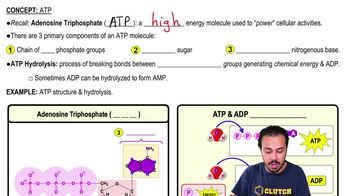
ATP as the Primary Energy Currency

Adenosine triphosphate (ATP) is the main molecule cells use to store and transfer energy in the short term. It releases energy when its high-energy phosphate bonds are broken, powering various cellular processes.
Recommended video:

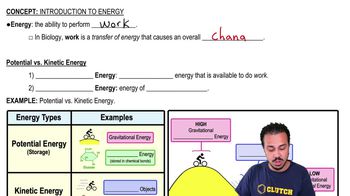
Energy Storage and Transfer in Cells

Cells require molecules that can quickly store and release energy to support metabolism. Short-term energy storage molecules like ATP provide immediate energy, unlike long-term storage molecules such as fats or glycogen.
Recommended video:
Guided course
05:04
Introduction to Energy

Phosphorylation and Energy Release

The process of phosphorylation involves adding or removing phosphate groups from molecules like ATP. Breaking the bond between phosphate groups in ATP releases energy that cells harness for activities like muscle contraction and biosynthesis.
Recommended video:
Guided course
01:06
Types of Phosphorylation