Ch. 2 - The Chemistry of Microbiology
Bauman - Microbiology with Diseases by Taxonomy 6th Edition
Bauman6th EditionMicrobiology with Diseases by TaxonomyISBN: 9780134832302Not the one you use?Change textbook
Chapter 2, Problem 2

The type of chemical bond between atoms with nearly equal electronegativities is called a(n) _____________ bond.

Verified step by step guidance
1
Understand that electronegativity is a measure of an atom's ability to attract and hold onto electrons in a chemical bond.
Recall that when two atoms have nearly equal electronegativities, they share electrons more or less equally.
Identify that the type of bond formed by equal or nearly equal sharing of electrons is called a covalent bond.
Recognize that covalent bonds can be nonpolar if the electronegativities are almost identical, leading to an even distribution of electron density.
Conclude that the correct term for a bond between atoms with nearly equal electronegativities is a nonpolar covalent bond.

Verified video answer for a similar problem:

This video solution was recommended by our tutors as helpful for the problem above.
Video duration:
2m
Was this helpful?

Key Concepts

Here are the essential concepts you must grasp in order to answer the question correctly.

Electronegativity

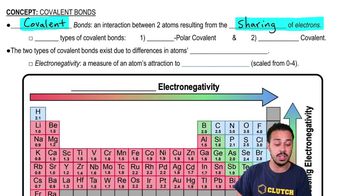
Electronegativity is the measure of an atom's ability to attract and hold electrons in a chemical bond. Atoms with similar electronegativities share electrons more equally, influencing the type of bond formed between them.
Recommended video:
Guided course
04:28
Covalent Bonds

Types of Chemical Bonds

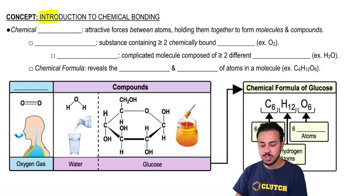
Chemical bonds are classified based on electron sharing or transfer: ionic bonds involve electron transfer between atoms with large electronegativity differences, covalent bonds involve electron sharing, and metallic bonds involve a sea of shared electrons.
Recommended video:
Guided course
06:53
Introduction to Chemical Bonding

Nonpolar Covalent Bond

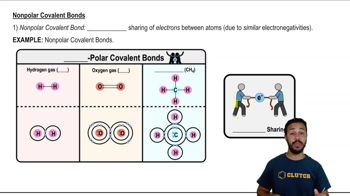
A nonpolar covalent bond occurs when two atoms with nearly equal electronegativities share electrons equally, resulting in a balanced distribution of electrical charge and no partial charges on the atoms.
Recommended video:
Guided course
05:58
Nonpolar Covalent Bonds