
Ch. 25 - Pathogenic RNA Viruses
Bauman - Microbiology with Diseases by Taxonomy 6th Edition
Bauman6th EditionMicrobiology with Diseases by TaxonomyISBN: 9780134832302Not the one you use?Change textbook
Chapter 25, Problem 3

_____Postpolio syndrome is due to latent polioviruses that become active 30 to 40 years after the initial infection.

Verified step by step guidance
1
Understand the nature of postpolio syndrome: it is a condition that affects polio survivors years after recovery from the initial poliovirus infection.
Recognize that postpolio syndrome is not caused by latent polioviruses reactivating, but rather by the gradual deterioration of motor neurons that were initially damaged during the acute poliovirus infection.
Recall that poliovirus is an RNA virus that does not establish latency like some DNA viruses (e.g., herpesviruses), so the concept of latent polioviruses reactivating is incorrect.
Identify that the correct cause of postpolio syndrome involves the overuse and aging of surviving motor neurons, leading to new muscle weakness and fatigue decades after the initial infection.
Conclude that the blank in the statement should be filled with a phrase indicating that postpolio syndrome is due to the degeneration of motor neurons rather than reactivation of latent virus.

Verified video answer for a similar problem:

This video solution was recommended by our tutors as helpful for the problem above.
Video duration:
2m
Was this helpful?

Key Concepts

Here are the essential concepts you must grasp in order to answer the question correctly.

Poliovirus and Initial Infection

Poliovirus is an enterovirus that primarily infects motor neurons, causing poliomyelitis. The initial infection can lead to paralysis by damaging nerve cells, but many recover as the virus is cleared. Understanding the nature of the initial infection is crucial to grasping later complications.
Recommended video:
Guided course
04:16
Initiation of Transcription

Postpolio Syndrome (PPS)

Postpolio syndrome is a condition affecting polio survivors years after recovery, characterized by new muscle weakness and fatigue. It is not caused by reactivation of the virus but is believed to result from the gradual deterioration of motor neurons that were initially damaged.
Recommended video:

Latency and Viral Reactivation

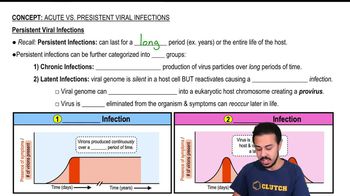
Latency refers to a virus remaining dormant within the host and reactivating later. Poliovirus does not establish latency; thus, PPS is not due to latent virus reactivation but rather to long-term nerve damage. This distinction is key to understanding the pathogenesis of PPS.
Recommended video:
Guided course
05:12
Persistent Viral Infections