Ch. 25 - Pathogenic RNA Viruses
Bauman - Microbiology with Diseases by Taxonomy 6th Edition
Bauman6th EditionMicrobiology with Diseases by TaxonomyISBN: 9780134832302Not the one you use?Change textbook
Chapter 25, Problem 2

What do viruses in the families Picornaviridae, Caliciviridae, Astroviridae, Coronaviridae, Togaviridae, Flaviviridae, and Retroviridae have in common?


a. They are arboviruses.
b. They are nonpathogenic.
c. They have positive single-stranded RNA genomes.
d. They have negative single-stranded RNA genomes.

Verified step by step guidance
1
Step 1: Identify the key characteristic to compare among the virus families Picornaviridae, Caliciviridae, Astroviridae, Coronaviridae, Togaviridae, Flaviviridae, and Retroviridae. The question asks what they have in common regarding their genome type or other features.
Step 2: Recall that viruses are classified based on their genome type: DNA or RNA, single-stranded or double-stranded, and if RNA, whether it is positive-sense (+ssRNA) or negative-sense (-ssRNA).
Step 3: Review the genome type of each virus family: Picornaviridae, Caliciviridae, Astroviridae, Coronaviridae, Togaviridae, Flaviviridae, and Retroviridae are all known to have single-stranded RNA genomes. Specifically, most of these families have positive-sense single-stranded RNA genomes.
Step 4: Understand the terms: 'arboviruses' are viruses transmitted by arthropods (like mosquitoes), 'nonpathogenic' means they do not cause disease, and 'positive' or 'negative' single-stranded RNA refers to the polarity of the RNA genome, which affects how the virus replicates.
Step 5: Conclude that the common feature among these virus families is that they all have positive single-stranded RNA genomes, which corresponds to option (c).

Verified video answer for a similar problem:

This video solution was recommended by our tutors as helpful for the problem above.
Video duration:
3m
Was this helpful?

Key Concepts

Here are the essential concepts you must grasp in order to answer the question correctly.

Virus Genome Types

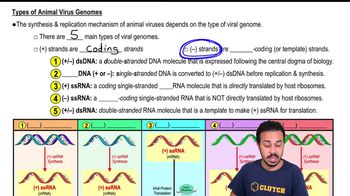
Viruses can have different types of genetic material, including DNA or RNA, which can be single-stranded or double-stranded, and positive-sense or negative-sense. Positive single-stranded RNA (+ssRNA) viruses have genomes that can directly serve as mRNA for protein synthesis, while negative single-stranded RNA (-ssRNA) viruses must first be transcribed into positive-sense RNA.
Recommended video:
Guided course
10:46
Types of RNA Virus Genomes

Families of RNA Viruses

The virus families Picornaviridae, Caliciviridae, Astroviridae, Coronaviridae, Togaviridae, Flaviviridae, and Retroviridae are all known to contain viruses with positive-sense single-stranded RNA genomes. This commonality influences their replication strategies and pathogenic mechanisms.
Recommended video:
Guided course
04:36
Replication of (-) Single Strand RNA Viruses

Arboviruses and Pathogenicity

Arboviruses are viruses transmitted by arthropods like mosquitoes and ticks, but not all viruses in the listed families are arboviruses. Additionally, these viruses are generally pathogenic, causing diseases in humans or animals, so the options stating they are all arboviruses or nonpathogenic are incorrect.
Recommended video:
Guided course
03:40
Introduction to Pathogenic Toxins