
Ch. 25 - Pathogenic RNA Viruses
Bauman - Microbiology with Diseases by Taxonomy 6th Edition
Bauman6th EditionMicrobiology with Diseases by TaxonomyISBN: 9780134832302Not the one you use?Change textbook
Chapter 25, Problem 2

Young Luis has skin lesions. His mother knows from microbiology class that five childhood diseases can produce spots. Name those five diseases and the viruses that cause each. List some questions to ask to determine which of these viruses Luis has.

Verified step by step guidance
1
Identify the five common childhood diseases known to cause skin lesions or spots. These typically include measles, rubella, chickenpox, fifth disease, and roseola.
For each disease, note the virus responsible: measles is caused by the measles virus (a paramyxovirus), rubella by the rubella virus (a togavirus), chickenpox by varicella-zoster virus (a herpesvirus), fifth disease by parvovirus B19, and roseola by human herpesvirus 6 (HHV-6).
Understand the characteristic features of the rash or spots for each disease, such as the pattern, progression, and associated symptoms (e.g., fever, cough, conjunctivitis for measles; mild rash and lymphadenopathy for rubella; vesicular rash for chickenpox).
Formulate questions to ask Luis or his mother that help differentiate these diseases, such as: Has Luis had a fever? When did the rash start and how has it progressed? Are there any other symptoms like cough, runny nose, or sore throat? Has Luis been vaccinated against measles, mumps, and rubella? Has he been exposed to anyone with similar symptoms?
Use the answers to these questions along with the clinical presentation to narrow down the likely virus causing the skin lesions, which can then guide further diagnostic testing or treatment.

Verified video answer for a similar problem:

This video solution was recommended by our tutors as helpful for the problem above.
Video duration:
2m
Was this helpful?

Key Concepts

Here are the essential concepts you must grasp in order to answer the question correctly.

Common Childhood Exanthematous Diseases

These are five viral infections that commonly cause skin rashes or spots in children: measles, rubella, chickenpox, fifth disease, and roseola. Each disease has characteristic rash patterns and associated symptoms that help in clinical diagnosis.
Recommended video:
Guided course
04:57
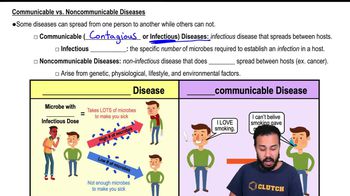
Communicable vs. Noncommunicable Diseases

Causative Viruses of Childhood Rash Diseases

Each childhood rash disease is caused by a specific virus: measles by measles virus, rubella by rubella virus, chickenpox by varicella-zoster virus, fifth disease by parvovirus B19, and roseola by human herpesvirus 6 or 7. Identifying the virus aids in understanding transmission and treatment.
Recommended video:
Guided course
05:09
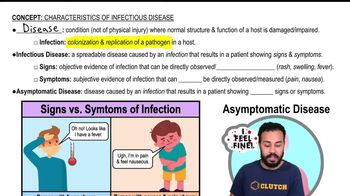
Intro to Characteristics of Infectious Disease

Clinical History and Symptom Assessment

Asking targeted questions about symptom onset, fever, rash progression, exposure history, vaccination status, and associated symptoms (e.g., cough, conjunctivitis) helps differentiate among these viral infections. This clinical approach guides diagnosis before laboratory confirmation.
Recommended video:
Guided course
03:56
History of Spontaneous Generation Summarized
Related Practice
Textbook Question

The patient in room 519 exhibits yellowing skin and eyes, and it is suspected among the nursing staff that the diagnosis will be some kind of viral hepatitis. Make a chart of five kinds of hepatitis mentioned in this chapter, the infecting pathogen, how the patient might have become infected, and the relative degree of seriousness.

749
views
Textbook Question

What viral family causes each of these diseases? (A family may be used more than once.)


1. _____Myocarditis

2. _____Colorado tick fever

3. _____Rabies

4. _____Influenza

5. _____Dengue fever

6. _____German measles

7. _____Acute gastroenteritis

8. _____Ebola virus

9. _____RSV

10. _____Western equine encephalitis

11. _____No known disease


A. Rhabdoviridae

B. Paramyxoviridae

C. Reoviridae

D. Coronaviridae

E. Togaviridae

F. Flaviviridae

G. Orthomyxoviridae

H. Orphan virus

I. Caliciviridae

J. Filoviridae

K. Picornaviridae

1126
views
Textbook Question

_____All infections of polio are crippling.

1348
views
Textbook Question

Label the flu epidemics. How can you best explain the biennial fluctuation in the number of cases? How can you explain the epidemics?

1072
views
Textbook Question

_____A single virion is sufficient to cause a cold.

1381
views
Textbook Question

What do viruses in the families Picornaviridae, Caliciviridae, Astroviridae, Coronaviridae, Togaviridae, Flaviviridae, and Retroviridae have in common?


a. They are arboviruses.

b. They are nonpathogenic.

c. They have positive single-stranded RNA genomes.

d. They have negative single-stranded RNA genomes.

1269
views