Ch. 9 - Controlling Microbial Growth in the Environment
Bauman - Microbiology with Diseases by Taxonomy 6th Edition
Bauman6th EditionMicrobiology with Diseases by TaxonomyISBN: 9780134832302Not the one you use?Change textbook
Chapter 9, Problem 16

Which of the following chemicals is active against bacterial endospores?
a. Copper ions
b. Ethylene oxide
c. Ethanol
d. Triclosan

Verified step by step guidance
1
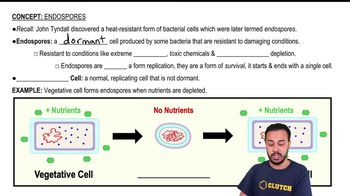
Understand what bacterial endospores are: they are highly resistant dormant structures formed by some bacteria to survive extreme conditions, including chemical disinfectants.
Recall that many common disinfectants are ineffective against endospores due to their tough protective layers.
Evaluate each chemical's mode of action and spectrum of activity: Copper ions mainly disrupt cell membranes but are not sporicidal; Ethanol is effective against vegetative cells but not endospores; Triclosan targets bacterial fatty acid synthesis but does not kill spores.
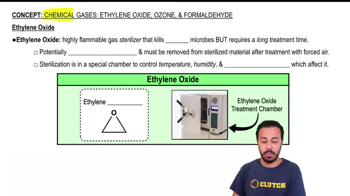
Recognize that Ethylene oxide is a gaseous sterilizing agent known for its ability to penetrate and destroy bacterial endospores by alkylating DNA and proteins.
Conclude that among the options, Ethylene oxide is the chemical active against bacterial endospores due to its sporicidal properties.

Verified video answer for a similar problem:

This video solution was recommended by our tutors as helpful for the problem above.
Video duration:
3m
Was this helpful?

Key Concepts

Here are the essential concepts you must grasp in order to answer the question correctly.

Bacterial Endospores

Bacterial endospores are highly resistant, dormant structures formed by some bacteria to survive extreme conditions. They have tough protective layers that make them resistant to heat, chemicals, and radiation, requiring specialized agents for effective inactivation.
Recommended video:

Chemical Agents and Their Spectrum of Activity

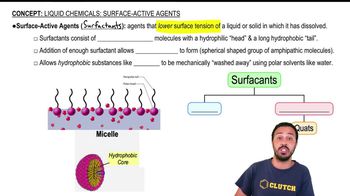
Different chemical disinfectants vary in their ability to kill microorganisms. Some, like ethanol and triclosan, are effective against vegetative bacteria but not endospores, while others, such as ethylene oxide, can penetrate spores and destroy them.
Recommended video:
Guided course
04:14
Liquid Chemicals: Surface-Active Agents

Ethylene Oxide as a Sporicide

Ethylene oxide is a gaseous sterilizing agent that can penetrate bacterial endospores and disrupt DNA and proteins, effectively killing spores. It is widely used for sterilizing heat-sensitive medical equipment due to its sporicidal properties.
Recommended video:
Guided course
03:22
Chemical Gases: Ethylene Oxide