Ch. 10 - Host Microbe Interactions and Pathogenesis
Norman-McKay- Microbiology: Basic and Clinical Principles 2nd Edition
Norman-McKay2nd EditionMicrobiology: Basic and Clinical PrinciplesISBN: 9780137661619Not the one you use?Change textbook
Chapter 10, Problem 20

Place the following steps for infection in order from first to last:
  • Invade tissues and obtain nutrients
  • Adhere to host tissues
  • Enter the host
  • Exit the host
  • Evade immune defenses

Verified step by step guidance
1
Step 1: Identify the initial point of infection, which is when the microorganism gains access to the host. This corresponds to 'Enter the host'.
Step 2: Once inside, the microorganism must attach itself to the host cells to establish infection. This is 'Adhere to host tissues'.
Step 3: After adherence, the microorganism invades host tissues and obtains nutrients necessary for survival and multiplication. This step is 'Invade tissues and obtain nutrients'.
Step 4: To maintain infection, the microorganism must avoid being destroyed by the host's immune system. This is 'Evade immune defenses'.
Step 5: Finally, to spread the infection to new hosts, the microorganism must leave the current host. This is 'Exit the host'.

Verified video answer for a similar problem:

This video solution was recommended by our tutors as helpful for the problem above.
Video duration:
4m
Was this helpful?

Key Concepts

Here are the essential concepts you must grasp in order to answer the question correctly.

Stages of Microbial Infection

Infection progresses through distinct stages: entry into the host, adherence to host tissues, invasion and nutrient acquisition, evasion of immune defenses, and finally exit to spread. Understanding this sequence helps clarify how pathogens establish and maintain infection.
Recommended video:
Guided course
03:16
Stages of Photosynthesis

Adherence Mechanisms

Adherence is the process by which microbes attach to host cells using structures like pili or adhesins. This step is crucial for colonization and prevents pathogens from being washed away, enabling subsequent invasion and infection.
Recommended video:
Guided course
01:59
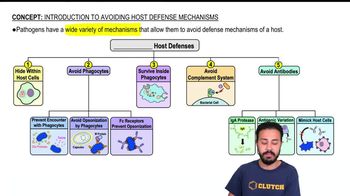
Introduction to Avoiding Host Defense Mechanisms

Immune Evasion Strategies

Pathogens employ various tactics to evade the host immune system, such as producing capsules, altering surface antigens, or secreting immune-modulating factors. This allows them to survive, multiply, and cause disease within the host.
Recommended video:
Guided course
03:19
Immune Tolerance