Ch. 11 - Innate Immunity
Norman-McKay- Microbiology: Basic and Clinical Principles 2nd Edition
Norman-McKay2nd EditionMicrobiology: Basic and Clinical PrinciplesISBN: 9780137661619Not the one you use?Change textbook
Chapter 11, Problem 7

Which of the following would you not expect to see in the first stage of inflammation?
a. Histamine
b. Kinins
c. Macrophages
d. Increased blood vessel permeability
e. Eicosanoids

Verified step by step guidance
1
Understand the stages of inflammation: The first stage, often called the vascular stage, involves immediate responses such as vasodilation and increased blood vessel permeability to allow immune cells and molecules to reach the site of injury or infection.
Identify the roles of the listed components: Histamine and kinins are chemical mediators released early to cause vasodilation and increase permeability. Eicosanoids are also involved early as signaling molecules that promote inflammation.
Consider the timing of macrophage involvement: Macrophages are immune cells that typically arrive after the initial vascular changes, during the cellular stage, to phagocytize pathogens and debris.
Recognize that increased blood vessel permeability is a hallmark of the first stage, facilitating the movement of immune components into tissues.
Conclude that among the options, macrophages are not expected to be present in the first stage of inflammation because their recruitment and activation occur later.

Verified video answer for a similar problem:

This video solution was recommended by our tutors as helpful for the problem above.
Video duration:
3m
Was this helpful?

Key Concepts

Here are the essential concepts you must grasp in order to answer the question correctly.

Stages of Inflammation

Inflammation occurs in stages: the initial or acute phase involves vascular changes like vasodilation and increased permeability, followed by cellular responses. Understanding which mediators and cells appear early versus later is key to identifying what is expected in the first stage.
Recommended video:
Guided course
03:09
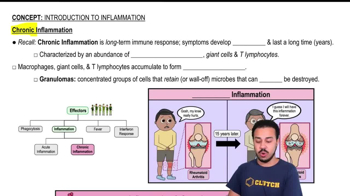
Chronic Inflammation

Role of Inflammatory Mediators

Mediators such as histamine, kinins, and eicosanoids are released early during inflammation to promote vasodilation and increase blood vessel permeability, facilitating immune cell access to tissues. Their timing and function help distinguish early from late inflammatory events.
Recommended video:
Guided course
02:15
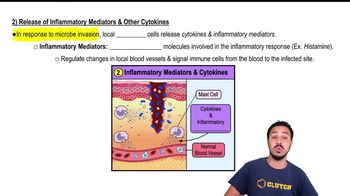
2) Release of Inflammatory Mediators & Other Cytokines

Function and Timing of Macrophages

Macrophages are immune cells involved in phagocytosis and cytokine release, but they typically arrive after the initial vascular changes, during the later stages of inflammation. Recognizing their delayed recruitment helps differentiate them from early mediators.
Recommended video:
Guided course
05:18
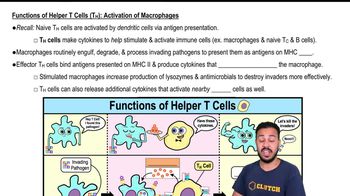
Functions of Helper T Cells (TH):Activation of Macrophages