Ch. 16 - Respiratory System Infections
Norman-McKay- Microbiology: Basic and Clinical Principles 2nd Edition
Norman-McKay2nd EditionMicrobiology: Basic and Clinical PrinciplesISBN: 9780137661619Not the one you use?Change textbook
Chapter 16, Problem 12

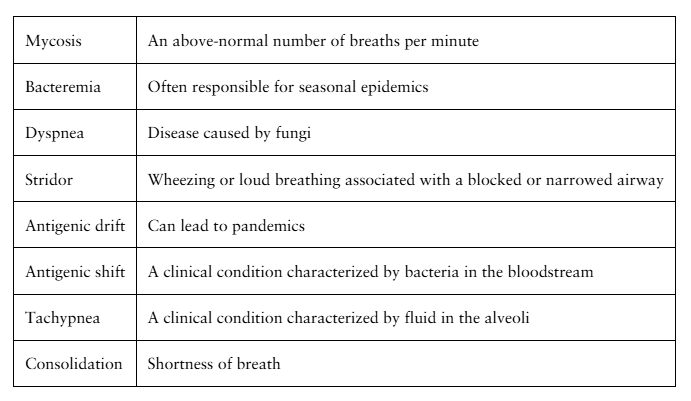
Match the following:
Table matching infectious disease terms with their definitions, including symptoms and causes like fungi, bacteria, and breathing issues.

Verified step by step guidance
1
Step 1: Understand each term's definition and clinical relevance. For example, 'Mycosis' refers to a disease caused by fungi, so match it with 'Disease caused by fungi'.
Step 2: Identify terms related to breathing and respiratory symptoms. 'Dyspnea' means shortness of breath, 'Tachypnea' is an above-normal number of breaths per minute, and 'Stridor' is wheezing or loud breathing due to airway obstruction.
Step 3: Match terms related to infectious diseases and their epidemiology. 'Bacteremia' is bacteria in the bloodstream, 'Antigenic drift' can lead to pandemics, and 'Antigenic shift' is often responsible for seasonal epidemics.
Step 4: For 'Consolidation', recognize it as a clinical condition characterized by fluid in the alveoli, which affects lung function and can be detected in pneumonia.
Step 5: Pair each term with the most appropriate definition based on the above clarifications, ensuring that each term is matched to a unique and correct description.

Verified video answer for a similar problem:

This video solution was recommended by our tutors as helpful for the problem above.
Video duration:
2m
Was this helpful?

Key Concepts

Here are the essential concepts you must grasp in order to answer the question correctly.

Infectious Disease Terminology

Understanding specific terms like mycosis, bacteremia, and dyspnea is essential. Mycosis refers to fungal infections, bacteremia is the presence of bacteria in the bloodstream, and dyspnea means shortness of breath. These definitions help in correctly matching diseases with their symptoms or causes.
Recommended video:
Guided course
05:09
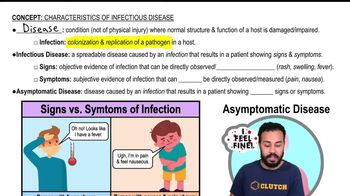
Intro to Characteristics of Infectious Disease

Respiratory Symptoms and Conditions

Terms such as tachypnea, stridor, and consolidation describe respiratory issues. Tachypnea is rapid breathing, stridor is a wheezing sound from airway obstruction, and consolidation refers to fluid-filled alveoli in the lungs. Recognizing these helps link symptoms to underlying pathologies.
Recommended video:
Guided course
05:09
Intro to Characteristics of Infectious Disease

Antigenic Variation in Infectious Agents

Antigenic drift and antigenic shift describe changes in pathogens, especially viruses. Drift involves small mutations causing seasonal epidemics, while shift is a major change that can lead to pandemics. These concepts explain how infectious diseases evolve and spread.
Recommended video:
Guided course
02:54
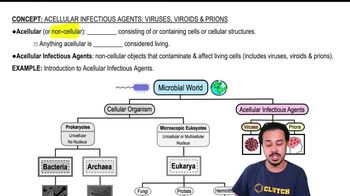
Acellular Infectious Agents: Viruses, Viroids & Prions
Related Practice
Textbook Question

List the three stages of pertussis, and provide some general characteristics of each stage.

879
views
Textbook Question

Indicate the true statements, and then correct the false statements so that they are true.

a. The most common viruses that cause human respiratory system infections are cold viruses.

b. Viruses can be treated with antibiotics.

c. People who have been exposed to cold and/or wet conditions are statistically more likely to develop a cold.

d. Many respiratory illnesses that are not caused by influenza viruses have flu-like symptoms.

e. The flu vaccine is not recommended for children under 2 years of age.

f. Pneumonia is a rare healthcare-acquired infection.

823
views
Textbook Question

Select the true statements about SARS-CoV-2. (Select all that apply.)

a. It causes COVID-19.

b. It is vaccine preventable.

c. The FDA has approved hydroxychloroquine to treat infections with this virus.

d. It is considered a zoonotic infection.

e. It causes a form of viral pneumonia.

1213
views
Textbook Question

Give two reasons why the bacillus Calmette–Guérin (BCG) vaccine is not routinely recommended in the United States to prevent tuberculosis.

1249
views
Textbook Question

From the following list, select all of the diseases that antibiotics do not directly cure.

a. Hanta pulmonary syndrome

b. Streptococcus pneumoniae

c. Colds

d. Influenza

e. Haemophilus influenzae

f. COVID-19

g. Legionellosis

h. Tularemia

1097
views
Textbook Question

Choose the general agent of the disease (select ONE choice of agent from the options after each illness):

a. Pneumococcal pneumonia is caused by a (virus, bacterium, fungus).

b. Pneumocystis pneumonia is caused by a (virus, bacterium, fungus).

c. Tuberculosis is caused by a (virus, bacterium, fungus).

d. Histoplasmosis is caused by a (virus, bacterium, fungus).

e. Influenza is caused by a (virus, bacterium, fungus).

f. Colds are caused by (viruses, bacteria, fungi).

g. Coccidioidomycosis is caused by a (virus, bacterium, fungus).

h. Diphtheria is caused by a (virus, bacterium, fungus).

i. Pertussis is caused by a (virus, bacterium, fungus).

j. Scarlet fever is caused by a (virus, bacterium, fungus).

k. Legionellosis is caused by a (virus, bacterium, fungus).

l. Q fever is caused by a (virus, bacterium, fungus).

m. Hanta pulmonary syndrome is caused by a (virus, bacterium, fungus).

n. Streptococcal pharyngitis is caused by a (virus, bacterium, fungus).

26
views