
Ch. 21 - Cardiovascular and Lymphatic Infections
Norman-McKay- Microbiology: Basic and Clinical Principles 2nd Edition
Norman-McKay2nd EditionMicrobiology: Basic and Clinical PrinciplesISBN: 9780137661619Not the one you use?Change textbook
Chapter 21, Problem 14

Identify the zoonotic disease:
a. HTLV lymphoma
b. Systemic candidiasis
c. Mucormycosis
d. Plague
e. Endocarditis

Verified step by step guidance
1
Understand the definition of a zoonotic disease: it is an infectious disease that can be transmitted from animals to humans.
Review each option to determine if it is known to be transmitted from animals to humans.
HTLV lymphoma is caused by the Human T-lymphotropic virus and is not zoonotic; it is transmitted between humans.
Systemic candidiasis and mucormycosis are fungal infections caused by opportunistic fungi and are not typically transmitted from animals to humans.
Plague is caused by the bacterium Yersinia pestis, which is transmitted to humans from infected animals (such as rodents and fleas), making it a zoonotic disease.

Verified video answer for a similar problem:

This video solution was recommended by our tutors as helpful for the problem above.
Video duration:
2m
Was this helpful?

Key Concepts

Here are the essential concepts you must grasp in order to answer the question correctly.

Zoonotic Diseases

Zoonotic diseases are infections that are naturally transmitted between animals and humans. These diseases can be caused by bacteria, viruses, fungi, or parasites, and often involve animal reservoirs or vectors. Understanding zoonoses is crucial for identifying diseases that originate from animals.
Recommended video:
Guided course
04:57
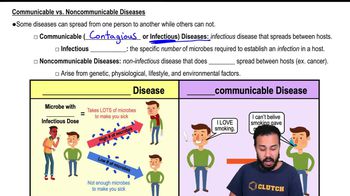
Communicable vs. Noncommunicable Diseases

Plague as a Zoonotic Disease

Plague is a classic example of a zoonotic disease caused by the bacterium Yersinia pestis. It is primarily transmitted to humans through flea bites from infected rodents, making it a key zoonosis. Recognizing plague’s animal origin helps differentiate it from non-zoonotic infections.
Recommended video:
Guided course
04:57
Communicable vs. Noncommunicable Diseases

Non-Zoonotic Diseases in the List

Diseases like HTLV lymphoma, systemic candidiasis, mucormycosis, and endocarditis are generally not zoonotic. They arise from human-specific pathogens or opportunistic infections without animal reservoirs, which helps exclude them when identifying zoonotic diseases.
Recommended video:
Guided course
03:57
Non-Cyclic Photophosphorylation