Ch. 7 - Fundamentals of Microbial Growth
Norman-McKay- Microbiology: Basic and Clinical Principles 2nd Edition
Norman-McKay2nd EditionMicrobiology: Basic and Clinical PrinciplesISBN: 9780137661619Not the one you use?Change textbook
Chapter 7, Problem 1

A Salmonella species is grown for 8 hours. In this time, each cell divides about four times. What is the generation time?

Verified step by step guidance
1
Identify the total time of growth, which is given as 8 hours.
Determine the number of generations (cell divisions) that occurred, which is 4 in this case.
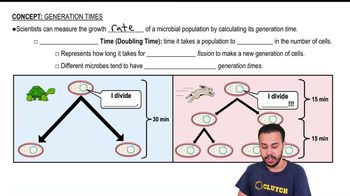
Recall that generation time (g) is the time it takes for the bacterial population to double once.
Use the formula for generation time: \(g = \frac{\text{total time}}{\text{number of generations}}\).
Substitute the known values into the formula: \(g = \frac{8 \text{ hours}}{4}\), then simplify to find the generation time.

Verified video answer for a similar problem:

This video solution was recommended by our tutors as helpful for the problem above.
Video duration:
2m
Was this helpful?

Key Concepts

Here are the essential concepts you must grasp in order to answer the question correctly.

Generation Time

Generation time is the period required for a bacterial population to double in number. It reflects the time taken for one complete cell division cycle, which is crucial for understanding bacterial growth rates.
Recommended video:
Guided course
02:54
Generation Times

Binary Fission and Cell Division

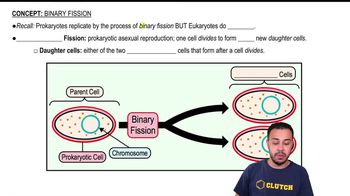
Bacteria reproduce by binary fission, where one cell divides into two identical daughter cells. The number of divisions directly relates to the increase in cell number and helps calculate growth parameters like generation time.
Recommended video:
Guided course
02:16
Binary Fission

Exponential Growth in Bacteria

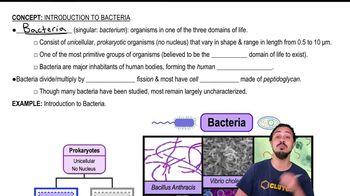
Bacterial populations grow exponentially during the log phase, doubling at regular intervals. Knowing the total growth time and number of divisions allows calculation of generation time using the formula: generation time = total time ÷ number of generations.
Recommended video:
Guided course
06:18
Introduction to Bacteria