Ch. 1 - The Microbial World and You
Tortora - Microbiology: An Introduction 14th Edition
Tortora14th EditionMicrobiology: An IntroductionISBN: 9780138200398Not the one you use?Change textbook
Chapter 1, Problem 8

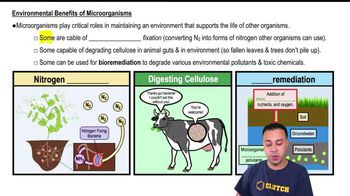
Which of the following is an example of bioremediation?
a. Application of oil-degrading bacteria to an oil spill
b. Application of bacteria to a crop to prevent frost damage
c. Fixation of gaseous nitrogen into usable nitrogen
d. Production by bacteria of a human protein such as interferon
e. All of the above

Verified step by step guidance
1
Step 1: Understand the definition of bioremediation. Bioremediation is the process of using microorganisms, such as bacteria, to remove or neutralize pollutants from a contaminated site, restoring the environment to a cleaner state.
Step 2: Analyze each option to see if it fits the definition of bioremediation. Option (a) involves applying oil-degrading bacteria to an oil spill, which directly uses bacteria to clean up a pollutant.
Step 3: Evaluate option (b), which is applying bacteria to a crop to prevent frost damage. This is more related to plant protection or agriculture, not pollutant removal.
Step 4: Consider option (c), fixation of gaseous nitrogen into usable nitrogen. This is a natural biological process important for nutrient cycling but not specifically for cleaning pollutants.
Step 5: Review option (d), production by bacteria of a human protein such as interferon. This is an example of genetic engineering or biotechnology, not bioremediation.

Verified video answer for a similar problem:

This video solution was recommended by our tutors as helpful for the problem above.
Video duration:
2m
Was this helpful?

Key Concepts

Here are the essential concepts you must grasp in order to answer the question correctly.

Bioremediation

Bioremediation is the use of living organisms, especially microbes, to remove or neutralize pollutants from a contaminated site. It often involves bacteria that can degrade harmful substances like oil, heavy metals, or pesticides, making the environment cleaner and safer.
Recommended video:
Guided course
04:27
Environmental Benefits of Microorganisms

Nitrogen Fixation

Nitrogen fixation is a biological process where certain bacteria convert atmospheric nitrogen gas (N2) into ammonia (NH3), a form usable by plants. This natural process enriches soil fertility and supports plant growth but is distinct from pollutant degradation.
Recommended video:
Guided course
07:21
5 Nitrogenous Bases

Microbial Biotechnology Applications

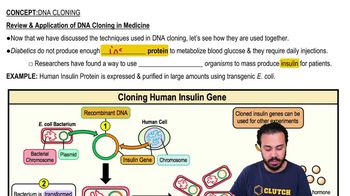
Microbial biotechnology involves using bacteria for beneficial purposes such as producing human proteins (e.g., interferon) or protecting crops. These applications improve health and agriculture but do not directly involve cleaning environmental pollutants.
Recommended video:
Guided course
03:07
Review & Application of DNA Cloning in Medicine
Related Practice
Textbook Question

Show where airborne microbes ended up in Pasteur’s experiment.

1479
views

Textbook Question

What type of microorganism has a peptidoglycan cell wall, has DNA that is not contained in a nucleus, and has flagella?

1798
views
Textbook Question

Spallanzani’s conclusion about spontaneous generation was challenged because Antoine Lavoisier had just shown that oxygen was the vital component of air. Which of the following statements is true?

a. All life requires air.

b. Only disease-causing organisms require air.

c. Some microbes do not require air.

d. Pasteur kept air out of his biogenesis experiments.

e. Lavoisier was mistaken.

1105
views
Textbook Question

It is possible to purchase the following microorganisms in a retail store. Provide a reason for buying each.

a. Bacillus thuringiensis

b. Saccharomyces

1482
views
Textbook Question

Which of the following statements about E. coli is false?

a. E. coli was the first disease-causing bacterium identified by Koch.

b. E. coli is part of the normal microbiome of humans.

c. E. coli is beneficial in human intestines.

d. E. coli gets nutrients from intestinal contents.

e. None of the above; all the statements are true.

1635
views
Textbook Question

It has been said that bacteria are essential for the existence of life on Earth. Which of the following is the essential function performed by bacteria?

a. Control insect populations

b. Directly provide food for humans

c. Decompose organic material and recycle elements

d. Cause disease

e. Produce human hormones such as insulin

1969
views