
Ch. 10 - Classification of Microorganisms
Tortora - Microbiology: An Introduction 14th Edition
Tortora14th EditionMicrobiology: An IntroductionISBN: 9780138200398Not the one you use?Change textbook
Chapter 10, Problem 3

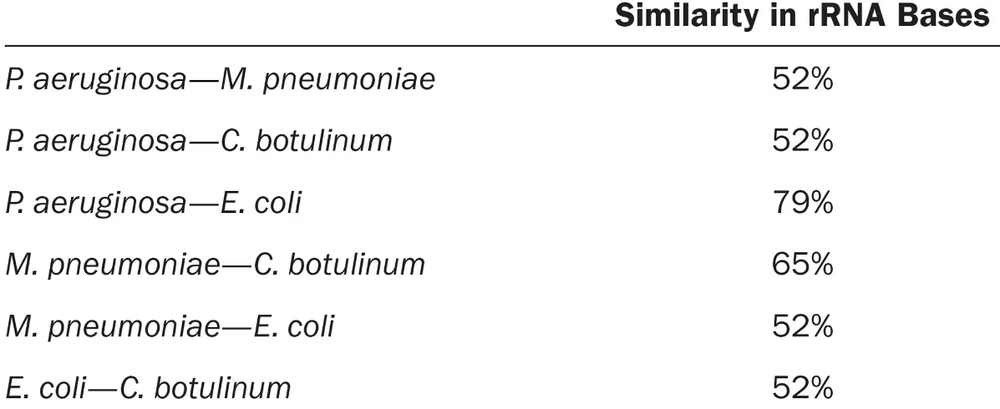
DRAW IT Use the following rRNA information to construct a cladogram for some of the organisms used in question 4. What is the purpose of a cladogram? How does your cladogram differ from a dichotomous key for these organisms?
Table showing rRNA base similarity percentages between six pairs of bacterial species for cladogram construction.

Verified step by step guidance
1
Step 1: Understand the purpose of a cladogram. A cladogram is a diagram that shows the evolutionary relationships among different organisms based on shared derived characteristics, such as similarities in rRNA sequences. It helps visualize how closely related organisms are through common ancestry.
Step 2: Analyze the rRNA information provided for the organisms. Identify similarities and differences in their rRNA sequences, which serve as molecular markers to infer evolutionary relationships.
Step 3: Group organisms by shared rRNA characteristics. Organisms with more similar rRNA sequences are placed closer together on the cladogram, indicating a more recent common ancestor.
Step 4: Construct the cladogram by connecting organisms with branches that represent evolutionary divergence points. Each branch point (node) represents a common ancestor, and the length or arrangement reflects the degree of relatedness based on rRNA data.
Step 5: Compare the cladogram to a dichotomous key. Note that a cladogram shows evolutionary relationships and ancestry, while a dichotomous key is a tool for identifying organisms based on a series of choices about observable traits, not necessarily reflecting evolutionary history.

Verified video answer for a similar problem:

This video solution was recommended by our tutors as helpful for the problem above.
Video duration:
2m
Was this helpful?

Key Concepts

Here are the essential concepts you must grasp in order to answer the question correctly.

Cladogram

A cladogram is a branching diagram that shows the evolutionary relationships among organisms based on shared derived characteristics, such as rRNA sequences. It illustrates common ancestry and divergence, helping to visualize how species are related through evolution.

rRNA in Phylogenetics

Ribosomal RNA (rRNA) sequences are highly conserved genetic markers used to determine evolutionary relationships. Differences and similarities in rRNA sequences among organisms provide data to construct cladograms, reflecting their genetic relatedness and evolutionary history.
Recommended video:
Guided course
08:39
Structure of Prokaryotic Ribosomes

Dichotomous Key vs. Cladogram

A dichotomous key is a tool for identifying organisms based on a series of choices about observable traits, leading to species identification. Unlike a cladogram, it does not show evolutionary relationships but focuses on classification through physical characteristics.
Recommended video:
Guided course
05:56
Needham vs. Spallanzani
Related Practice
Textbook Question

Bacillus and Lactobacillus are not in the same order. This indicates that which one of the following is not sufficient to assign an organism to a taxon?

a. Biochemical characteristics

b. Amino acid sequencing

c. Phage typing

d. Serology

e. Morphological characteristics

1478
views
Textbook Question

Which of the following is false about scientific nomenclature?

a. Each name is specific.

b. Names vary with geographical location.

c. The names are standardized.

d. Each name consists of a genus and specific epithet.

e. It was first designed by Linnaeus.

1652
views
Textbook Question

Which of the following is used to classify organisms into the Kingdom Fungi?

a. Ability to photosynthesize; possess a cell wall

b. Unicellular; possess cell wall; prokaryotic

c. Unicellular; lacking cell wall; eukaryotic

d. Absorptive; possess cell wall; eukaryotic

e. Ingestive; lacking cell wall; multicellular; prokaryotic

1602
views
Textbook Question

Use the key in the Clinical Focus box to identify the gram-negative, oxidase-positive rod causing pneumonia in a sea otter. It is H2S-positive, indole-negative, and urease-positive.

1452
views
Textbook Question

Here is some additional information on the organisms in question 1:

Which of these organisms are most closely related? Compare this answer with your response to review question 1.

1279
views
Textbook Question

Use the information in the following table to complete the dichotomous key to these organisms. What is the purpose of a dichotomous key? Look up each genus in Chapter 11, and provide an example of why this organism is of interest to humans.

1502
views