Ch. 13 - Viruses, Viroids, and Prions
Tortora - Microbiology: An Introduction 14th Edition
Tortora14th EditionMicrobiology: An IntroductionISBN: 9780138200398Not the one you use?Change textbook
Chapter 13, Problem 7

Recall from Chapter 1 that Koch's postulates are used to determine the etiology of a
disease. Why is it difficult to determine the etiology of
a. a viral infection, such as influenza?
b. cancer?

Verified step by step guidance
1
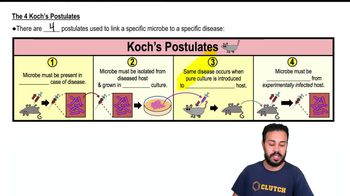
Step 1: Understand Koch's postulates, which are a set of criteria used to establish a causative relationship between a microbe and a disease. These include isolating the microorganism from a diseased organism, growing it in pure culture, causing the disease in a healthy organism by introducing the cultured microbe, and then re-isolating the same microbe from the newly diseased host.
Step 2: For part (a), consider why viral infections like influenza pose challenges to Koch's postulates. Viruses require host cells to replicate and cannot be grown in pure culture on standard media, which violates one of Koch's key criteria.
Step 3: Also for part (a), recognize that some viruses may cause disease only under certain conditions or in specific hosts, and asymptomatic carriers can harbor the virus without showing disease, complicating the direct cause-effect relationship.
Step 4: For part (b), analyze why cancer is difficult to attribute to a single causative agent using Koch's postulates. Cancer is a complex, multifactorial disease involving genetic mutations, environmental factors, and sometimes infectious agents, making it hard to isolate a single pathogen responsible for the disease.
Step 5: Additionally for part (b), note that cancer cells are derived from the host's own cells and are not infectious microorganisms, so the criteria of isolating and reintroducing a pathogen to cause disease do not apply in the same way as for infectious diseases.

Verified video answer for a similar problem:

This video solution was recommended by our tutors as helpful for the problem above.
Video duration:
3m
Was this helpful?

Key Concepts

Here are the essential concepts you must grasp in order to answer the question correctly.

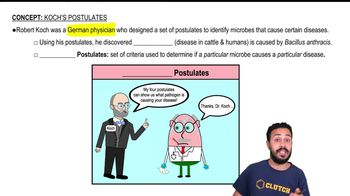
Koch's Postulates

Koch's postulates are a set of criteria used to establish a causative relationship between a microbe and a disease. They require isolating the pathogen from a diseased host, growing it in pure culture, reproducing the disease in a healthy host, and re-isolating the same pathogen. These steps help confirm the etiology of infectious diseases.
Recommended video:
Guided course
01:36
Koch's Postulates

Challenges in Applying Koch's Postulates to Viral Infections

Viruses cannot be grown in pure culture without host cells, making it difficult to fulfill Koch's postulates. Additionally, viral infections like influenza can vary in symptoms and severity, and some viruses may be present without causing disease, complicating the direct link between virus and illness.
Recommended video:
Guided course
03:31
The 4 Koch's Postulates

Complex Etiology of Cancer

Cancer is caused by multiple factors including genetic mutations, environmental influences, and sometimes infectious agents, making it a multifactorial disease. Unlike infectious diseases, cancer does not result from a single pathogen, so Koch's postulates cannot be directly applied to determine its cause.
Recommended video:
Guided course
02:59
Complex Media