Ch. 13 - Viruses, Viroids, and Prions
Tortora - Microbiology: An Introduction 14th Edition
Tortora14th EditionMicrobiology: An IntroductionISBN: 9780138200398Not the one you use?Change textbook
Chapter 13, Problem 7

Which of the following statements is false?
a. Viruses contain DNA or RNA.
b. The nucleic acid of a virus is surrounded by a protein coat.
c. Viruses multiply inside living cells using viral mRNA, tRNA, and ribosomes.
d. Viruses cause the synthesis of specialized infectious elements.
e. Viruses multiply inside living cells.

Verified step by step guidance
1
Step 1: Understand the basic structure of viruses. Viruses contain either DNA or RNA as their genetic material, but not both simultaneously. This supports statement (a).
Step 2: Recognize that the nucleic acid of a virus is enclosed within a protein coat called a capsid, which protects the viral genome. This confirms statement (b).
Step 3: Analyze how viruses replicate. Viruses rely on the host cell's machinery, including ribosomes and tRNA, to translate viral mRNA into proteins. However, viruses do not have their own tRNA or ribosomes; they use the host's. This means statement (c) is partially incorrect because viruses do not contain their own tRNA and ribosomes.
Step 4: Consider the meaning of statement (d). Viruses cause the synthesis of viral components (proteins and nucleic acids) but not 'specialized infectious elements' as a separate entity. This statement is ambiguous and likely false because viruses themselves are the infectious elements.
Step 5: Confirm that viruses multiply inside living cells by hijacking the host's cellular machinery, which supports statement (e).

Verified video answer for a similar problem:

This video solution was recommended by our tutors as helpful for the problem above.
Video duration:
1m
Was this helpful?

Key Concepts

Here are the essential concepts you must grasp in order to answer the question correctly.

Structure of Viruses

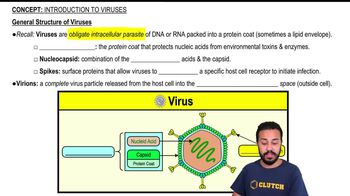
Viruses consist of genetic material, either DNA or RNA, enclosed within a protective protein coat called a capsid. This simple structure allows them to infect host cells and protect their nucleic acid from degradation.
Recommended video:
Guided course
04:47
General Structure of Viruses

Viral Replication Mechanism

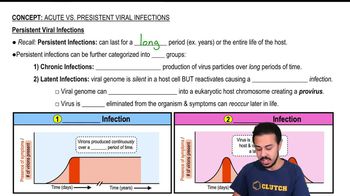
Viruses replicate by hijacking the host cell's machinery, using the host's ribosomes and enzymes to produce viral proteins and nucleic acids. However, viruses do not possess their own tRNA or ribosomes; they rely entirely on the host's components.
Recommended video:
Guided course
05:12
Persistent Viral Infections

Role of Viral mRNA and Infectious Elements

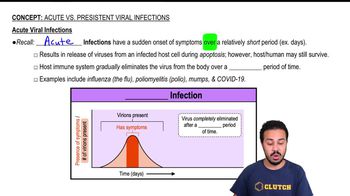
Viral mRNA is synthesized inside the host cell to direct the production of viral proteins. Viruses do not cause the synthesis of specialized infectious elements; rather, the virus itself is the infectious agent that assembles new viral particles within the host.
Recommended video:
Guided course
03:29
Acute Viral Infections