
Textbook Question
Differentiate the terms in each of the following pairs:
a. Etiology and pathogenesis
b. Infection and disease
c. Communicable disease and noncommunicable disease
1263
views

 Verified step by step guidance
 04:23
04:23
 02:33
02:33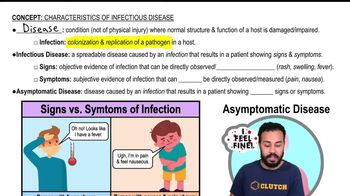 05:09
05:09Differentiate the terms in each of the following pairs:
a. Etiology and pathogenesis
b. Infection and disease
c. Communicable disease and noncommunicable disease
Which of the following statements is false?
a. E. coli never causes disease
b. E. coli provides vitamin K for its host
c. E. coli often exists in a mutualistic relationship with humans
d. A disease-causing strain of E. coli causes bloody diarrhea
Define symbiosis. Differentiate commensalism, mutualism, and parasitism, and give an example of each.
Among hospital patients who have infections, one-third did not enter the hospital with the infection but rather acquired it in the hospital. How do they acquire these infections? What is the method of transmission of these infections? What is the reservoir of infection?
The emergence of new infectious diseases is probably due to all of the following except:
a. The need of bacteria to cause disease
b. The ability of humans to travel by air
c. Changing environments (e.g., flood, drought, pollution)
d. A pathogen crossing the species barrier
e. The increasing human population
Indicate whether each of the following conditions is typical of subacute, chronic, or acute infections.
a. The patient experiences a rapid onset of malaise; symptoms last 5 days
b. The patient experiences cough and breathing difficulty for months
c. The patient has no apparent symptoms and is a known carrier