Ch. 15 - Microbial Mechanisms of Pathogenicity
Tortora - Microbiology: An Introduction 14th Edition
Tortora14th EditionMicrobiology: An IntroductionISBN: 9780138200398Not the one you use?Change textbook
Chapter 15, Problem 5

The ID₅₀ for Campylobacter sp. is 500 cells; the ID₅₀ for Cryptosporidium sp. is 100 cells. Which of the following statements is false?
a. Both microbes are pathogens.
b. Both microbes produce infections in 50% of the inoculated hosts.
c. Campylobacter is more virulent than Cryptosporidium.
d. Campylobacter and Cryptosporidium are equally virulent; they cause infections in the same number of test animals.
e. Cryptosporidium infections are acquired more easily than Campylobacter infections.

Verified step by step guidance
1
Understand the meaning of ID₅₀ (Infectious Dose 50): it is the number of microbial cells required to infect 50% of the host population. A lower ID₅₀ indicates higher virulence because fewer organisms are needed to cause infection.
Compare the given ID₅₀ values: Campylobacter sp. has an ID₅₀ of 500 cells, and Cryptosporidium sp. has an ID₅₀ of 100 cells. Since 100 < 500, Cryptosporidium is more virulent than Campylobacter.
Evaluate each statement based on the ID₅₀ values and definitions: (a) Both microbes are pathogens because they cause infections; (b) Both produce infections in 50% of inoculated hosts at their respective ID₅₀; (c) Campylobacter is more virulent than Cryptosporidium — this contradicts the ID₅₀ comparison; (d) They are equally virulent — this is false because their ID₅₀ values differ; (e) Cryptosporidium infections are acquired more easily due to the lower ID₅₀.
Identify the false statement by focusing on the virulence comparison: since Cryptosporidium has a lower ID₅₀, Campylobacter cannot be more virulent, and they are not equally virulent.
Conclude that the false statement is the one claiming Campylobacter is more virulent or that both are equally virulent, based on the ID₅₀ values provided.

Verified video answer for a similar problem:

This video solution was recommended by our tutors as helpful for the problem above.
Video duration:
4m
Was this helpful?

Key Concepts

Here are the essential concepts you must grasp in order to answer the question correctly.

Infectious Dose 50 (ID₅₀)

ID₅₀ is the number of microbial cells required to infect 50% of a test population. A lower ID₅₀ indicates that fewer organisms are needed to cause infection, reflecting higher infectivity or ease of transmission.
Recommended video:
Guided course
05:09
Intro to Characteristics of Infectious Disease

Virulence

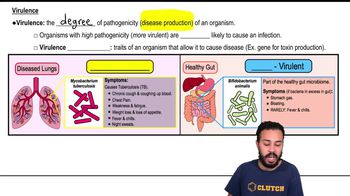
Virulence refers to the degree of pathogenicity or severity of disease caused by a microbe. It is distinct from infectivity; a microbe can be highly infectious (low ID₅₀) but cause mild disease, or less infectious but cause severe illness.
Recommended video:

Pathogen vs. Infection

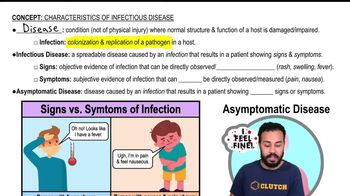
A pathogen is any microorganism capable of causing disease. Infection means the microbe has successfully invaded and multiplied in the host. Not all infections lead to disease, but pathogens are always capable of causing infection.
Recommended video:
Guided course
03:40
Introduction to Pathogenic Toxins