Ch. 15 - Microbial Mechanisms of Pathogenicity
Tortora - Microbiology: An Introduction 14th Edition
Tortora14th EditionMicrobiology: An IntroductionISBN: 9780138200398Not the one you use?Change textbook
Chapter 15, Problem 7

Describe the factors contributing to the pathogenicity of fungi, protozoa, and helminths.

Verified step by step guidance
1
Identify the concept of pathogenicity, which refers to the ability of an organism to cause disease in a host.
For fungi, consider factors such as the production of enzymes that degrade host tissues, the ability to evade the immune system, and the formation of spores that facilitate spread and infection.
For protozoa, focus on mechanisms like antigenic variation to avoid immune detection, the ability to invade and multiply within host cells, and the production of toxins or enzymes that damage host tissues.
For helminths, examine factors including their size and ability to physically damage tissues, secretion of immunomodulatory molecules to evade host defenses, and complex life cycles that enhance transmission and survival.
Summarize by comparing how these factors enable each group to establish infection, cause damage, and persist within the host, highlighting both unique and shared pathogenic strategies.

Verified video answer for a similar problem:

This video solution was recommended by our tutors as helpful for the problem above.
Video duration:
2m
Was this helpful?

Key Concepts

Here are the essential concepts you must grasp in order to answer the question correctly.

Pathogenicity and Virulence Factors

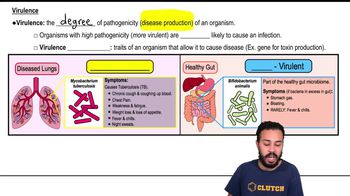
Pathogenicity refers to an organism's ability to cause disease, while virulence factors are specific traits that enhance this ability. These include enzymes, toxins, and mechanisms to evade the host immune system, enabling fungi, protozoa, and helminths to infect and damage host tissues.
Recommended video:

Host-Pathogen Interaction

This concept involves how pathogens interact with the host's immune defenses. Successful pathogens can adhere to host cells, invade tissues, and avoid immune detection or destruction, which is crucial for establishing infection and causing disease.
Recommended video:
Guided course
03:40
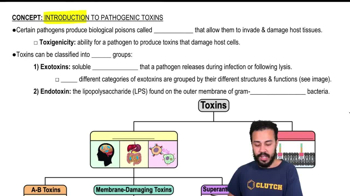
Introduction to Pathogenic Toxins

Life Cycle and Transmission Modes

Understanding the life cycles and transmission routes of fungi, protozoa, and helminths is essential, as these influence their pathogenicity. Complex life cycles often involve multiple hosts or environmental stages, affecting how these organisms infect humans and cause disease.
Recommended video:
Related Practice
Textbook Question

Label this diagram to show how the Shiga toxin enters and inhibits protein synthesis in a human cell.

1342
views
1
rank

Textbook Question

A drug that binds to mannose on human cells would prevent

a. the entrance of Vibrio enterotoxin.

b. the attachment of pathogenic E. coli.

c. the action of botulinum toxin.

d. streptococcal pneumonia.

e. the action of diphtheria toxin.

1246
views
Textbook Question

The earliest smallpox vaccines were infected tissue rubbed into the skin of a healthy

person. The recipient of such a vaccine usually developed a mild case of smallpox, recovered, and was immune thereafter. What is the most likely reason this vaccine did not kill more people?

a. Skin is the wrong portal of entry for smallpox.

b. The vaccine consisted of a mild form of the virus.

c. Smallpox is normally transmitted by skin-to-skin contact.

d. Smallpox is a virus.

e. The virus mutated.

1276
views
Textbook Question

Which of the following genera is the most infectious?

1165
views
Textbook Question

The ID₅₀ for Campylobacter sp. is 500 cells; the ID₅₀ for Cryptosporidium sp. is 100 cells. Which of the following statements is false?

a. Both microbes are pathogens.

b. Both microbes produce infections in 50% of the inoculated hosts.

c. Campylobacter is more virulent than Cryptosporidium.

d. Campylobacter and Cryptosporidium are equally virulent; they cause infections in the same number of test animals.

e. Cryptosporidium infections are acquired more easily than Campylobacter infections.

1278
views
Textbook Question

How can viruses and protozoa avoid being killed by the host’s immune response?

1325
views