


Ch. 15 - Microbial Mechanisms of Pathogenicity
Tortora - Microbiology: An Introduction 14th Edition
Tortora14th EditionMicrobiology: An IntroductionISBN: 9780138200398Not the one you use?Change textbook
Chapter 15, Problem 8

Which of the following genera is the most infectious?
Table comparing infectious doses of bacterial genera: Legionella (1 cell), Salmonella (100,000 cells), Shigella (200 cells), Treponema (52 cells).

Verified step by step guidance
1
Step 1: Understand the concept of infectiousness in microbiology, which refers to the ability of a microorganism to establish an infection in a host. This is often related to factors such as the infectious dose, virulence factors, and mode of transmission.
Step 2: Identify the genera listed in the problem (though the image is not visible here, typically genera like Mycobacterium, Salmonella, Shigella, or Neisseria might be options). Recall key characteristics of each genus, including their infectious dose and typical diseases caused.
Step 3: Compare the infectious doses of the genera. The genus with the lowest infectious dose (the smallest number of organisms required to cause infection) is generally considered the most infectious.
Step 4: Consider additional factors such as the ability to evade the immune system, modes of transmission (e.g., airborne, fecal-oral), and the presence of virulence factors that enhance infectivity.
Step 5: Based on the above comparisons, determine which genus is the most infectious by integrating knowledge of infectious dose, virulence, and transmission efficiency.

Verified video answer for a similar problem:

This video solution was recommended by our tutors as helpful for the problem above.
Video duration:
2m
Was this helpful?

Key Concepts

Here are the essential concepts you must grasp in order to answer the question correctly.

Infectious Dose

Infectious dose refers to the number of microbial cells or particles required to establish an infection in a host. Genera with a lower infectious dose are generally more infectious because fewer organisms are needed to cause disease.
Recommended video:
Guided course
05:09
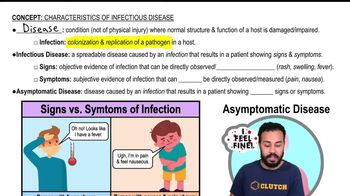
Intro to Characteristics of Infectious Disease

Virulence Factors

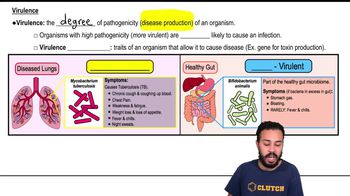
Virulence factors are molecules produced by pathogens that enhance their ability to cause disease. These include toxins, adhesion molecules, and enzymes that help evade the immune system, increasing the infectious potential of a genus.
Recommended video:

Pathogen Transmission and Host Interaction

The mode of transmission and how a pathogen interacts with the host's immune system influence its infectiousness. Genera that efficiently spread and evade immune defenses tend to be more infectious.
Recommended video:
Guided course
03:40
Introduction to Pathogenic Toxins
Related Practice
Textbook Question

Which of the following does not represent the same mechanism for avoiding host defenses as the others?

a. Rabies virus attaches to the receptor for the neurotransmitter acetylcholine.

b. Salmonella attaches to the receptor for epidermal growth factor.

c. Lymphocryptovirus (mononucleosis) virus binds to the host receptor for complement protein.

d. Surface protein genes in N. gonorrhoeae mutate frequently.

e. none of the above

1297
views
Textbook Question

Which of the following statements is true?

a. The primary goal of a pathogen is to kill its host.

b. Evolution selects for the most virulent pathogens.

c. A successful pathogen doesn't kill its host before it is transmitted.

d. A successful pathogen never kills its host.

1126
views
Textbook Question

A drug that binds to mannose on human cells would prevent

a. the entrance of Vibrio enterotoxin.

b. the attachment of pathogenic E. coli.

c. the action of botulinum toxin.

d. streptococcal pneumonia.

e. the action of diphtheria toxin.

1246
views
Textbook Question

Describe the factors contributing to the pathogenicity of fungi, protozoa, and helminths.

1310
views
Textbook Question

The earliest smallpox vaccines were infected tissue rubbed into the skin of a healthy

person. The recipient of such a vaccine usually developed a mild case of smallpox, recovered, and was immune thereafter. What is the most likely reason this vaccine did not kill more people?

a. Skin is the wrong portal of entry for smallpox.

b. The vaccine consisted of a mild form of the virus.

c. Smallpox is normally transmitted by skin-to-skin contact.

d. Smallpox is a virus.

e. The virus mutated.

1276
views
Textbook Question

How can viruses and protozoa avoid being killed by the host’s immune response?

1325
views