Ch. 18 - Practical Applications of Immunology
Tortora - Microbiology: An Introduction 14th Edition
Tortora14th EditionMicrobiology: An IntroductionISBN: 9780138200398Not the one you use?Change textbook
Chapter 18, Problem 6

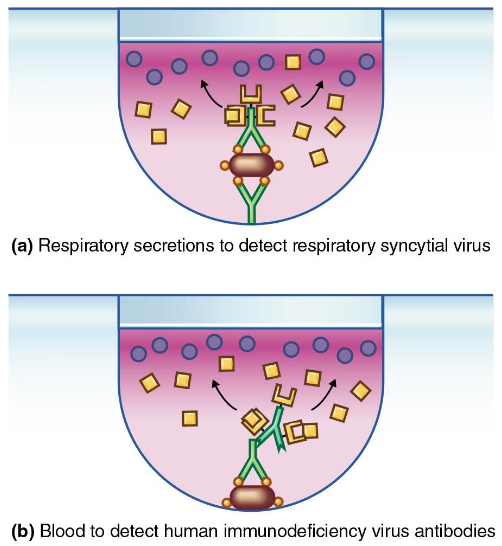
Label components of the direct and indirect ELISA tests in the following situations. Which test is direct? Which test provides definitive proof of disease?
Diagram showing antibody-antigen interactions in ELISA tests detecting respiratory virus and HIV antibodies.

Verified step by step guidance
1
Step 1: Understand the difference between direct and indirect ELISA. In a direct ELISA, the antigen is immobilized on the plate, and a labeled antibody specific to the antigen binds directly to it. In an indirect ELISA, the antigen is also immobilized, but an unlabeled primary antibody binds to the antigen first, followed by a labeled secondary antibody that binds to the primary antibody.
Step 2: For both ELISA types, start by drawing a solid horizontal line to represent the surface of the microtiter plate well where the antigen is attached.
Step 3: In the direct ELISA diagram, label the antigen bound to the plate surface, then draw and label a single enzyme-linked antibody that binds directly to the antigen.
Step 4: In the indirect ELISA diagram, label the antigen bound to the plate surface, then draw and label the primary antibody that binds to the antigen, followed by a secondary antibody that is enzyme-linked and binds to the primary antibody.
Step 5: To determine which test is direct, identify the one with only one antibody binding directly to the antigen. For definitive proof of disease, consider that indirect ELISA is generally more sensitive and specific because it uses two antibodies, reducing false positives and providing stronger evidence of the presence of antibodies against the antigen.

Verified video answer for a similar problem:

This video solution was recommended by our tutors as helpful for the problem above.
Video duration:
1m
Was this helpful?

Key Concepts

Here are the essential concepts you must grasp in order to answer the question correctly.

Direct ELISA

Direct ELISA involves an antigen immobilized on a surface and a labeled antibody that binds directly to the antigen. It is simpler and faster but less specific because only one antibody is used. This test detects the presence of antigens in a sample.
Recommended video:
Guided course
03:28
Direct Microscopic Cell Counts

Indirect ELISA

Indirect ELISA uses an antigen coated on a surface, a primary antibody specific to the antigen, and a labeled secondary antibody that binds to the primary antibody. This method is more sensitive and allows amplification of the signal, making it useful for detecting antibodies in a sample.
Recommended video:
Guided course
06:49
Mutant Detection

Definitive Proof of Disease in ELISA

Definitive proof of disease typically comes from detecting antibodies specific to a pathogen, indicating an immune response. Indirect ELISA is often more reliable for this because it detects antibodies, confirming exposure or infection, whereas direct ELISA detects antigens which may not always confirm active disease.
Recommended video:
Guided course
05:09
Intro to Characteristics of Infectious Disease