
Ch. 22 - Microbial Diseases of the Nervous System
Tortora - Microbiology: An Introduction 14th Edition
Tortora14th EditionMicrobiology: An IntroductionISBN: 9780138200398Not the one you use?Change textbook
Chapter 22, Problem 3

A 12-year-old child hospitalized for Guillain-Barré syndrome had a 4-day history of headache, dizziness, fever, sore throat, and weakness of legs. Seizures began 2 weeks later. Bacterial cultures were negative. The child died 3 weeks after hospitalization. An autopsy revealed inclusions in brain cells that tested positive in an immunofluorescence test. This patient probably had
a. Rabies.
b. Creutzfeldt-Jakob disease.
c. Botulism.
d. Tetanus.
e. Leprosy.

Verified step by step guidance
1
Step 1: Analyze the clinical presentation and timeline. The child had symptoms including headache, dizziness, fever, sore throat, and leg weakness, followed by seizures two weeks later, and died three weeks after hospitalization. This suggests a progressive neurological disease.
Step 2: Note that bacterial cultures were negative, which helps exclude bacterial infections such as tetanus, botulism, and leprosy, which are caused by bacteria and often detectable by culture or clinical signs.
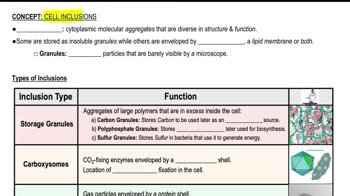
Step 3: Consider the autopsy findings: inclusions in brain cells that tested positive by immunofluorescence. This indicates the presence of viral antigens or proteins within neurons, which is characteristic of certain viral infections.
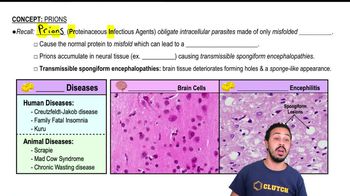
Step 4: Compare the options: rabies is a viral infection known for causing neuronal inclusions called Negri bodies, which are detectable by immunofluorescence. Creutzfeldt-Jakob disease is a prion disease and does not show viral inclusions. Botulism and tetanus are caused by bacterial toxins, and leprosy affects peripheral nerves but not brain cells with inclusions.
Step 5: Conclude that the most likely diagnosis is rabies, based on the clinical course, negative bacterial cultures, presence of neuronal inclusions, and positive immunofluorescence test.

Verified video answer for a similar problem:

This video solution was recommended by our tutors as helpful for the problem above.
Video duration:
1m
Was this helpful?

Key Concepts

Here are the essential concepts you must grasp in order to answer the question correctly.

Guillain-Barré Syndrome and Its Clinical Context

Guillain-Barré syndrome (GBS) is an acute autoimmune disorder causing rapid muscle weakness due to peripheral nerve inflammation. It often follows infections and can present with symptoms like weakness and sensory disturbances. Understanding GBS helps differentiate primary neurological autoimmune conditions from infectious causes of neurological symptoms.
Recommended video:

Viral Encephalitis and Brain Cell Inclusions

Certain viral infections cause encephalitis characterized by brain cell inclusions visible on autopsy. Immunofluorescence tests detect viral antigens in these inclusions, aiding diagnosis. Recognizing the significance of viral inclusions helps identify infections like rabies, which produce characteristic Negri bodies in neurons.
Recommended video:
Guided course
05:20
Cell Inclusions

Differential Diagnosis of Neurological Infectious Diseases

Neurological infections such as rabies, Creutzfeldt-Jakob disease, botulism, tetanus, and leprosy have distinct pathologies and clinical features. Rabies causes encephalitis with Negri bodies; Creutzfeldt-Jakob is a prion disease; botulism and tetanus are toxin-mediated; leprosy affects peripheral nerves. Differentiating these is key to accurate diagnosis.
Recommended video:
Guided course
05:09
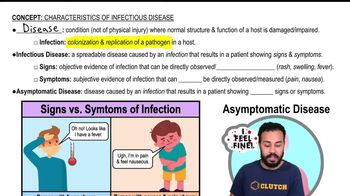
Intro to Characteristics of Infectious Disease