Ch. 22 - Microbial Diseases of the Nervous System
Tortora - Microbiology: An Introduction 14th Edition
Tortora14th EditionMicrobiology: An IntroductionISBN: 9780138200398Not the one you use?Change textbook
Chapter 22, Problem 4

After receiving a corneal transplant, a patient developed dementia and loss of motor function, then became comatose and died. Cultures were negative. Serological tests were negative. Autopsy revealed spongiform degeneration of brain tissue. The patient most likely had
a. Rabies.
b. Creutzfeldt-Jakob disease.
c. Botulism.
d. Tetanus.
e. Leprosy.

Verified step by step guidance
1
Step 1: Identify the key clinical features described: dementia, loss of motor function, progression to coma, and death, along with negative cultures and serological tests.
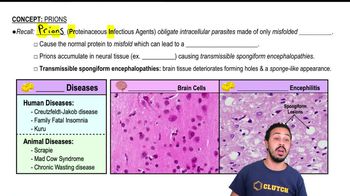
Step 2: Note the autopsy finding of spongiform degeneration of brain tissue, which is a hallmark of prion diseases.
Step 3: Recall that prion diseases, such as Creutzfeldt-Jakob disease (CJD), cause spongiform changes in the brain and are not detected by standard cultures or serological tests because they are caused by infectious proteins, not bacteria or viruses.
Step 4: Compare the options: rabies is a viral infection with different pathology; botulism and tetanus are caused by bacterial toxins with distinct clinical presentations; leprosy affects peripheral nerves and skin, not brain tissue.
Step 5: Conclude that the clinical picture and pathology are most consistent with Creutzfeldt-Jakob disease, a prion disease causing spongiform encephalopathy.

Verified video answer for a similar problem:

This video solution was recommended by our tutors as helpful for the problem above.
Video duration:
1m
Was this helpful?

Key Concepts

Here are the essential concepts you must grasp in order to answer the question correctly.

Prion Diseases and Spongiform Encephalopathies

Prion diseases are caused by misfolded proteins called prions that induce abnormal folding of normal brain proteins, leading to neurodegeneration. Spongiform encephalopathies, like Creutzfeldt-Jakob disease (CJD), are characterized by sponge-like holes in brain tissue, causing dementia, motor dysfunction, and death. These diseases are not detected by standard cultures or serological tests.
Recommended video:

Clinical Presentation and Diagnosis of Creutzfeldt-Jakob Disease

CJD typically presents with rapidly progressive dementia, motor symptoms such as ataxia or myoclonus, and eventually coma. Diagnosis is challenging because cultures and serology are negative; definitive diagnosis often requires brain biopsy or autopsy showing spongiform changes. It can be transmitted iatrogenically, including via corneal transplants.
Recommended video:

Differentiation from Other Infectious Neurological Diseases

Diseases like rabies, botulism, tetanus, and leprosy have distinct clinical features and diagnostic markers. Rabies causes encephalitis with viral detection; botulism and tetanus involve neurotoxins causing paralysis but not dementia; leprosy affects peripheral nerves and skin. Negative cultures and serology with spongiform brain changes point specifically to prion disease.
Recommended video:
Guided course
05:09
Intro to Characteristics of Infectious Disease