Ch. 27 - Environmental Microbiology
Tortora - Microbiology: An Introduction 14th Edition
Tortora14th EditionMicrobiology: An IntroductionISBN: 9780138200398Not the one you use?Change textbook
Chapter 27, Problem 5

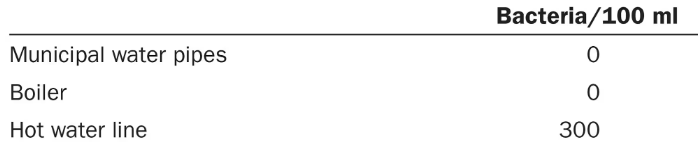
The water used to prepare intravenous solutions in a hospital contained endotoxins. Infection control personnel performed plate counts to find the source of the bacteria. Their results:
Table showing bacterial counts per 100 ml: zero in municipal pipes and boiler, 300 in hot water line.
All of the following conclusions about the bacteria can be drawn except which one?
a. They were present as a biofilm in the pipes.
b. They are gram-negative.
c. They come from fecal contamination.
d. They come from the city water supply.
e. none of the above

Verified step by step guidance
1
Step 1: Analyze the bacterial counts from the table. The municipal water pipes and boiler show zero bacteria per 100 ml, while the hot water line shows 300 bacteria per 100 ml. This suggests that the source of bacteria is not the municipal water or boiler but the hot water line.
Step 2: Understand the nature of endotoxins. Endotoxins are components of the outer membrane of gram-negative bacteria, so the presence of endotoxins implies the bacteria are gram-negative.
Step 3: Consider the possibility of biofilm formation. Since bacteria are detected only in the hot water line and not in the water supply or boiler, it is likely that bacteria are growing as a biofilm inside the hot water pipes, which can harbor bacteria even if the water itself is initially sterile.
Step 4: Evaluate the source of bacteria. Since the municipal water pipes have zero bacteria, the bacteria in the hot water line do not come from the city water supply, ruling out option (d).
Step 5: Assess fecal contamination. Endotoxins and gram-negative bacteria can be associated with fecal contamination, but since the municipal water is free of bacteria, fecal contamination is unlikely to be the source here.

Verified video answer for a similar problem:

This video solution was recommended by our tutors as helpful for the problem above.
Video duration:
2m
Was this helpful?

Key Concepts

Here are the essential concepts you must grasp in order to answer the question correctly.

Endotoxins and Gram-negative Bacteria

Endotoxins are toxic components found in the outer membrane of gram-negative bacteria. Their presence indicates contamination by these bacteria, which can cause immune responses. Understanding endotoxins helps link bacterial contamination to specific bacterial types.
Recommended video:
Guided course
02:20
Gram-Positive & Gram-Negative Bacteria

Biofilms in Water Systems

Biofilms are communities of microorganisms attached to surfaces, such as pipes, protected by a slimy matrix. They can harbor bacteria even when water tests show no free-floating bacteria, explaining persistent contamination in water lines despite clean municipal water.
Recommended video:

Source Tracking of Bacterial Contamination

Identifying the origin of bacteria involves analyzing bacterial counts at different points in a water system. Zero counts in municipal pipes and boilers but high counts in hot water lines suggest contamination occurs within the hospital's plumbing, not from city water or fecal sources.
Recommended video:
Guided course
03:06
Bacterial Transformation