Ch. 27 - Environmental Microbiology
Tortora - Microbiology: An Introduction 14th Edition
Tortora14th EditionMicrobiology: An IntroductionISBN: 9780138200398Not the one you use?Change textbook
Chapter 27, Problem 7

Use the following choices to answer the question:
a. Aerobic respiration
b. Anaerobic respiration
c. Anoxygenic photosynthesis
d. Oxygenic photosynthesis
Chemical equation showing sulfate ions reacting with protons and electrons to form hydrogen sulfide and water.

Verified step by step guidance
1
Step 1: Carefully examine the image provided in the problem to identify key features such as the presence or absence of oxygen production, types of electron donors and acceptors, and the environment where the process occurs.
Step 2: Recall the definitions and characteristics of each process: (a) aerobic respiration uses oxygen as the final electron acceptor; (b) anaerobic respiration uses a molecule other than oxygen as the final electron acceptor; (c) anoxygenic photosynthesis does not produce oxygen and uses molecules like hydrogen sulfide as electron donors; (d) oxygenic photosynthesis produces oxygen and uses water as the electron donor.
Step 3: Match the observed features in the image with the characteristics of each process. For example, if oxygen is produced and water is the electron donor, it suggests oxygenic photosynthesis.
Step 4: Eliminate options that do not fit the observed features. For instance, if the process involves oxygen production, anaerobic respiration and anoxygenic photosynthesis can be ruled out.
Step 5: Select the most appropriate process from the choices based on your analysis of the image and the characteristics of each metabolic pathway.

Verified video answer for a similar problem:

This video solution was recommended by our tutors as helpful for the problem above.
Video duration:
2m
Was this helpful?

Key Concepts

Here are the essential concepts you must grasp in order to answer the question correctly.

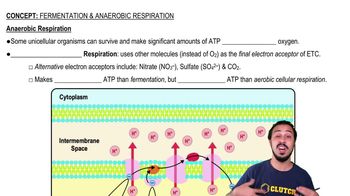
Aerobic and Anaerobic Respiration

Aerobic respiration uses oxygen as the final electron acceptor to produce energy efficiently, while anaerobic respiration uses other molecules like nitrate or sulfate in the absence of oxygen. Both processes involve electron transport chains but differ in their electron acceptors and energy yields.
Recommended video:
Guided course
03:35
Anaerobic Respiration

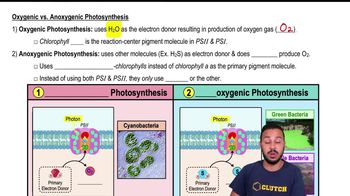
Oxygenic and Anoxygenic Photosynthesis

Oxygenic photosynthesis produces oxygen by splitting water molecules and uses light energy to convert CO2 into organic compounds, typical of plants and cyanobacteria. Anoxygenic photosynthesis does not produce oxygen and uses other electron donors like hydrogen sulfide, common in certain bacteria.
Recommended video:
Guided course
05:23
Oxygenic vs. Anoxygenic Photosynthesis

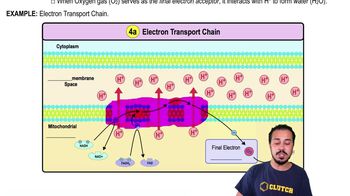
Electron Transport Chain and Energy Production

The electron transport chain (ETC) is a series of protein complexes that transfer electrons to generate a proton gradient, driving ATP synthesis. Both respiration and photosynthesis rely on ETCs, but the source of electrons and final acceptors differ, influencing the organism's metabolism and energy efficiency.
Recommended video:
Guided course
07:41
Electron Transport Chain