Ch. 9 - Biotechnology & DNA Technology
Tortora - Microbiology: An Introduction 14th Edition
Tortora14th EditionMicrobiology: An IntroductionISBN: 9780138200398Not the one you use?Change textbook
Chapter 9, Problem 10

Match the following choices to the statement provided below.
a. Antisense
b. Clone
c. Library
d. Southern blot
e. Vector


DNA that hybridizes with mRNA.

Verified step by step guidance
1
Understand the key terms provided: antisense, clone, library, Southern blot, and vector, as they relate to molecular biology and microbiology techniques.
Recall that 'antisense' DNA is a strand complementary to the mRNA sequence, meaning it can hybridize or bind specifically to mRNA through base pairing.
Recognize that the question asks for the type of DNA that hybridizes with mRNA, which implies a complementary sequence to the mRNA.
Eliminate other options: 'clone' refers to a copy of DNA, 'library' is a collection of DNA fragments, 'Southern blot' is a technique for detecting DNA, and 'vector' is a DNA molecule used to carry foreign genetic material.
Conclude that the correct match for DNA that hybridizes with mRNA is 'antisense' DNA, as it is complementary and can base-pair with mRNA.

Verified video answer for a similar problem:

This video solution was recommended by our tutors as helpful for the problem above.
Video duration:
4m
Was this helpful?

Key Concepts

Here are the essential concepts you must grasp in order to answer the question correctly.

Antisense DNA

Antisense DNA refers to a strand of DNA that is complementary to the mRNA sequence. It can hybridize or bind specifically to mRNA, blocking its translation into protein. This property is used in molecular biology to regulate gene expression or detect specific RNA sequences.
Recommended video:
Guided course
04:01
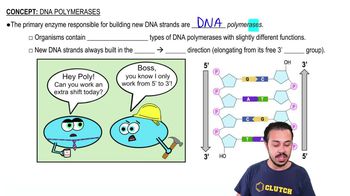
DNA Polymerases

Hybridization

Hybridization is the process where two complementary nucleic acid strands, such as DNA and RNA, bind to form a double-stranded molecule. This principle is fundamental in techniques like Southern blotting and antisense technology to identify or regulate specific sequences.
Recommended video:
Guided course
07:44
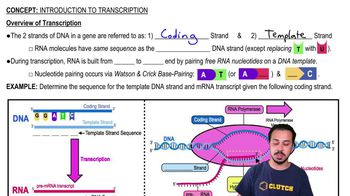
Overview of Transcription

mRNA (Messenger RNA)

mRNA is the RNA molecule transcribed from DNA that carries the genetic code to ribosomes for protein synthesis. Understanding mRNA's sequence and function is essential for studying gene expression and for techniques that involve complementary DNA or RNA binding.
Recommended video:
Guided course
08:44
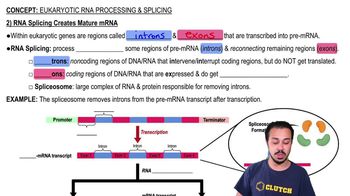
2) RNA Splicing Creates Mature mRNA