Ch. 3 - Observing Microorganisms Through a Microscope
Tortora - Microbiology: An Introduction 14th Edition
Tortora14th EditionMicrobiology: An IntroductionISBN: 9780138200398Not the one you use?Change textbook
Chapter 3, Problem 9

In 1996, scientists described a new tapeworm parasite that had killed at least one person. The initial examination of the patient’s abdominal mass was most likely made using:
a. Brightfield microscopy
b. Darkfield microscopy
c. Electron microscopy
d. Phase-contrast microscopy
e. Fluorescence microscopy

Verified step by step guidance
1
Step 1: Understand the context of the problem. The question involves identifying the microscopy technique most likely used for the initial examination of a patient's abdominal mass containing a tapeworm parasite.
Step 2: Recall the characteristics of each microscopy type: brightfield microscopy uses visible light and is commonly used for stained or naturally pigmented specimens; darkfield microscopy enhances contrast in unstained samples; electron microscopy provides very high resolution but is more complex and used for ultrastructural details; phase-contrast microscopy enhances contrast in transparent specimens without staining; fluorescence microscopy uses fluorescent dyes to highlight specific structures.
Step 3: Consider the practical aspects of an initial clinical examination of a parasite in tissue. Typically, the first examination is done using a straightforward and widely available method that allows visualization of the parasite within tissue or fluid samples.
Step 4: Evaluate which microscopy technique fits this scenario best. Brightfield microscopy is the standard initial method for examining stained tissue sections or smears to identify parasites, as it is simple and effective for observing morphology.
Step 5: Conclude that the initial examination was most likely performed using brightfield microscopy, as it is the most common and practical method for initial parasite identification in clinical samples.

Verified video answer for a similar problem:

This video solution was recommended by our tutors as helpful for the problem above.
Video duration:
1m
Was this helpful?

Key Concepts

Here are the essential concepts you must grasp in order to answer the question correctly.

Brightfield Microscopy

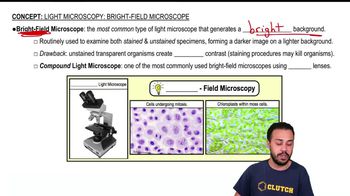
Brightfield microscopy is the most common light microscopy technique where the specimen is illuminated with white light and observed against a bright background. It is widely used for examining stained or naturally pigmented samples, including parasites in tissue sections or bodily fluids.
Recommended video:
Guided course
03:46
Light Microscopy: Bright-Field Microscopes

Electron Microscopy

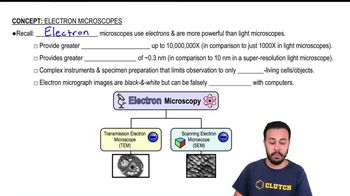
Electron microscopy uses a beam of electrons instead of light to achieve much higher resolution, allowing visualization of ultrastructural details of microorganisms. It is typically used for detailed structural analysis rather than initial clinical diagnosis due to complexity and cost.
Recommended video:
Guided course
03:08
Electron Microscopes

Microscopy Techniques for Parasite Identification

Different microscopy methods serve specific purposes in parasite detection: brightfield is common for initial examination, darkfield enhances contrast of live, unstained organisms, phase-contrast improves visualization of transparent specimens, and fluorescence uses labeled antibodies or dyes for specific detection.
Recommended video:
Guided course
03:46
Light Microscopy: Bright-Field Microscopes