 Back
BackChapter 2: Trade-offs, Comparative Advantage, and the Market System – Microeconomics Study Notes
Study Guide - Smart Notes
 Tailored notes based on your materials, expanded with key definitions, examples, and context.
Trade-offs, Comparative Advantage, and the Market System
Scarcity and Trade-offs
Scarcity is a fundamental concept in economics, referring to the situation where unlimited wants exceed the limited resources available to fulfill those wants. Because resources are scarce, households, firms, and governments must make choices about how best to allocate them, leading to trade-offs. Economics provides tools to analyze and make optimal trade-offs.
Scarcity: Unlimited wants vs. limited resources.
Trade-off: Choosing one option means forgoing another.
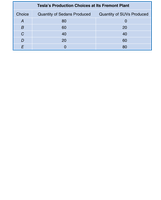
Example: If Tesla uses more workers and machinery to produce Model X SUVs, fewer resources are available for Model S sedans.
Production Possibilities Frontier (PPF) and Opportunity Costs
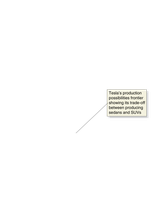
The Production Possibilities Frontier (PPF) is a curve that shows the maximum attainable combinations of two goods that can be produced with available resources and technology. The PPF is a positive tool, illustrating "what is" rather than "what should be." It helps analyze opportunity costs and trade-offs in production.
PPF: Maximum combinations of two goods producible.
Opportunity Cost: The highest-valued alternative forgone to engage in an activity.
Points on the PPF: Attainable and efficient.
Points below the PPF: Inefficient (not all resources used).
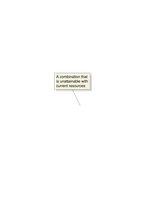
Points above the PPF: Unattainable with current resources.

Opportunity Cost Example
Moving from one point to another on the PPF involves opportunity costs. For example, if Tesla movecvs from producing more sedans to more SUVs, the decrease in sedans is the opportunity cost of increasing SUV production.
Formula:
Increasing Marginal Opportunity Costs
Opportunity costs are often increasing because some resources are better suited to one task than another. As more resources are devoted to an activity, the payoff from additional resources diminishes, leading to a bowed-outward PPF.
Increasing Marginal Opportunity Cost: The more you produce of one good, the higher the opportunity cost of producing additional units.
Economic Growth and Shifts in the PPF
Economic growth occurs when more resources or improved technology allow the economy to produce more goods and services. This is represented by an outward shift of the PPF.
Economic Growth: Ability to increase production.
Technological Improvement: Allows more production of one good without affecting the other.
Comparative Advantage and Trade
Comparative advantage is the basis for trade. It refers to the ability to produce a good at a lower opportunity cost than others. Even if one party has an absolute advantage in producing both goods, both parties can benefit from trade by specializing according to their comparative advantage.
Absolute Advantage: Producing more of a good with the same resources.
Comparative Advantage: Producing a good at a lower opportunity cost.
Specialization: Focusing on goods with comparative advantage increases total output and allows gains from trade.
Gains from Trade
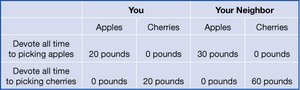
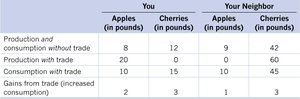
By specializing and trading, both parties can consume more than they could without trade. The table below summarizes the gains from trade.
Apples (in pounds) | Cherries (in pounds) | Apples (in pounds) | Cherries (in pounds) | |
|---|---|---|---|---|
You | Your Neighbor | |||
Production and consumption without trade | 8 | 12 | 9 | 42 |
Production with trade | 20 | 0 | 0 | 60 |
Consumption with trade | 10 | 15 | 10 | 45 |
Gains from trade (increased consumption) | 2 | 3 | 1 | 3 |
Opportunity Costs Table
The opportunity cost of picking apples and cherries for each party determines comparative advantage.
Opportunity Cost of Picking 1 Pound of Apples | Opportunity Cost of Picking 1 Pound of Cherries | |
|---|---|---|
You | 1 pound of cherries | 1 pound of apples |
Your Neighbor | 2 pounds of cherries | 0.5 pound of apples |

The Market System
The market system is the mechanism by which goods and services are exchanged. It involves two main groups: households and firms. Households provide factors of production (labor, capital, natural resources, entrepreneurial ability) to firms via factor markets, and firms supply goods and services to households via product markets.
Households: Provide factors of production.
Firms: Supply goods and services.
Factor Markets: Where firms buy resources from households.
Product Markets: Where households buy goods and services from firms.


Free Markets and the "Invisible Hand"
A free market is characterized by minimal government restrictions. Flexible prices allow households and firms to signal the relative worth of goods and services, leading to efficient allocation of resources. Adam Smith described this process as the "invisible hand," where individual self-interest leads to collective benefit.
Free Market: Few government restrictions.
Invisible Hand: Individual actions collectively satisfy consumer wants.
Entrepreneurship and Economic Growth
Entrepreneurs play a vital role in economic growth by bringing together factors of production and introducing new products. Government policies that encourage entrepreneurship can increase economic growth and raise living standards.
Entrepreneur: Operates a business, combines resources.
Contribution: Responds to consumer demand, introduces innovations.
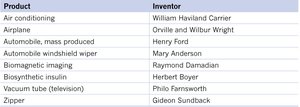
Product | Inventor |
|---|---|
Air conditioning | William Haviland Carrier |
Airplane | Orville and Wilbur Wright |
Automobile, mass produced | Henry Ford |
Automobile windshield wiper | Mary Anderson |
Biomagnetic imaging | Raymond Damadian |
Biosynthetic insulin | Herbert Boyer |
Vacuum tube (television) | Philo Farnsworth |
Zipper | Gideon Sundback |
Legal Foundations of Market Systems
For markets to function efficiently, governments must provide a sound legal environment, including protection of private property and enforcement of contracts. Property rights ensure individuals and firms have exclusive use of their property, incentivizing hard work and investment. An independent court system is essential for enforcing contracts and property rights.
Property Rights: Exclusive use, right to buy/sell property.
Contract Enforcement: Critical for transactions over time.
Intellectual Property and Innovation
Copyrights and patents protect intellectual property, encouraging innovation by granting creators exclusive rights to their inventions and works. Legal disputes can arise over these rights, affecting incentives for future innovation.
Copyright: Protects creators' works.
Patent: Protects inventors' inventions.
