 Back
BackCompetitive Supply, Market Equilibrium, and Welfare in Microeconomics
Study Guide - Smart Notes
 Tailored notes based on your materials, expanded with key definitions, examples, and context.
Profit Maximization and Supply in Competitive Markets
Short-Run Profit Maximization
In the short run, a competitive firm chooses its output to maximize profit by comparing marginal revenue and marginal cost. The firm will produce at the output level where marginal revenue equals marginal cost, provided that the price covers average variable cost.
Profit-Maximizing Condition: , where is the market price and is marginal cost.
No Shut Down Condition: , where is average variable cost.
If no satisfies both conditions, the firm should shut down and produce zero output.
Long-Run Profit Maximization
In the long run, all inputs are variable, and the firm will only operate if the price covers average cost.
Profit-Maximizing Condition:
No Shut Down Condition: , where is average cost.
If no satisfies both, the firm exits the market.
Deriving the Supply Curve
The supply curve of a competitive firm shows the profit-maximizing output at each possible market price. It is the portion of the marginal cost curve that lies above the relevant average cost curve (AVC in the short run, AC in the long run).
For each price , find such that and (short run) or (long run).
The set of pairs forms the supply curve.
Example: Finding a Firm's Supply Function
Suppose a firm has cost function . Labor is the only variable input.
Marginal Cost:
Average Variable Cost:
Since for all , the no shut down condition is always satisfied.
Set
Supply Function:
Shifts in the Supply Curve
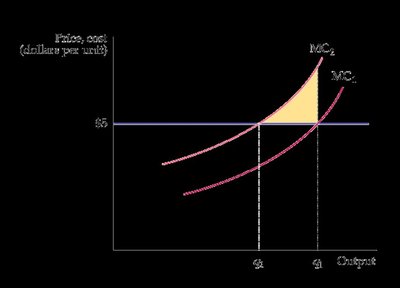
The supply curve can shift due to changes in input prices or technology. An increase in variable input prices raises marginal cost and shifts the supply curve up, while technological improvements lower marginal cost and shift the supply curve down.
Market Supply and Competitive Equilibrium
Short-Run Market Supply Curve
The market supply curve is the horizontal sum of all individual firms' supply curves at each price level.
If there are identical firms, each with supply , then .
If firms have different supply functions, sum them:
Competitive Equilibrium
A competitive equilibrium occurs where market supply equals market demand. The equilibrium price and quantity are found by solving .
Equilibrium Price: such that
Equilibrium Quantity:
Producer Surplus and Welfare
Producer Surplus
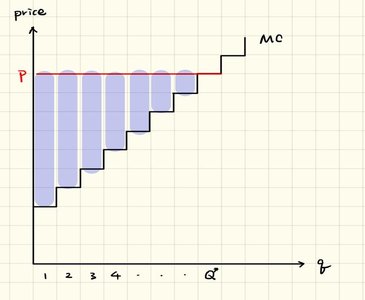
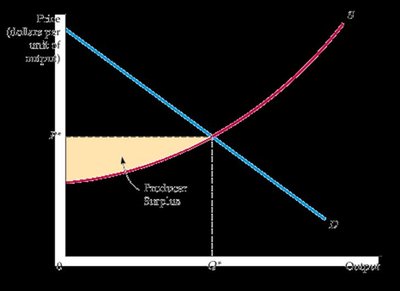
Producer surplus is the difference between what producers are paid for a good and the minimum amount they are willing to accept. It is the area above the supply curve and below the market price, up to the quantity sold.
For each unit:
Total producer surplus for units: , where is total revenue and is variable cost.
Total Welfare and Efficiency
Total welfare in a market is the sum of consumer surplus and producer surplus. At the competitive equilibrium, total welfare is maximized, making the outcome efficient.
Consumer Surplus: Area below the demand curve and above the price.
Producer Surplus: Area above the supply curve and below the price.
Total Welfare:
Government Interventions: Price Ceilings and Floors
Price Ceiling
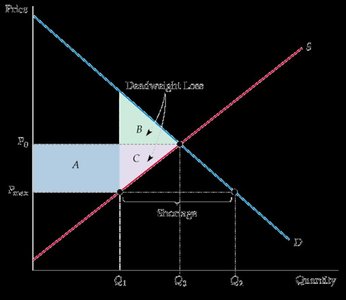
A price ceiling is a legal maximum price set below the market-clearing price. It leads to a shortage and creates deadweight loss, reducing total welfare.
Without Price Ceiling: Market clears at , quantity .
With Price Ceiling : Quantity falls to , some surplus is redistributed, and deadweight loss occurs.
Deadweight Loss: The loss in total welfare due to the price ceiling.
Price Floor
A price floor is a legal minimum price set above the market-clearing price. It leads to a surplus and also creates deadweight loss.
Without Price Floor: Market clears at , quantity .
With Price Floor : Quantity supplied exceeds quantity demanded, resulting in surplus and deadweight loss.
Deadweight Loss: The loss in total welfare due to the price floor.
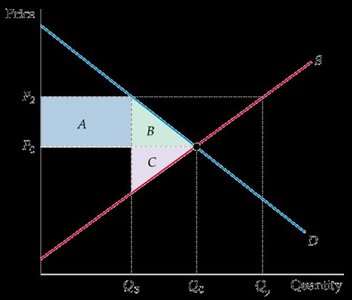
Redistribution and Fairness
While price controls reduce total welfare, they also redistribute surplus between consumers and producers. Other criteria, such as fairness, may be considered in policy evaluation.
