 Back
BackConsumer Behaviour: Utility, Demand, and Consumer Surplus
Study Guide - Smart Notes
 Tailored notes based on your materials, expanded with key definitions, examples, and context.
Chapter 6: Consumer Behaviour
6.1 Marginal Utility and Consumer Choice
Understanding how consumers make choices is central to microeconomics. This section introduces the concepts of utility, marginal utility, and the principle of utility maximization.
Utility: The satisfaction or pleasure a consumer receives from consuming a good or service.
Total Utility: The total satisfaction obtained from consuming a certain quantity of a product.
Marginal Utility: The additional satisfaction gained from consuming one more unit of a product.
Law of Diminishing Marginal Utility: As a consumer consumes more units of a good, the marginal utility from each additional unit decreases.
Example: Drinking water when thirsty provides high utility at first, but as more water is consumed, the additional satisfaction from each extra glass diminishes.
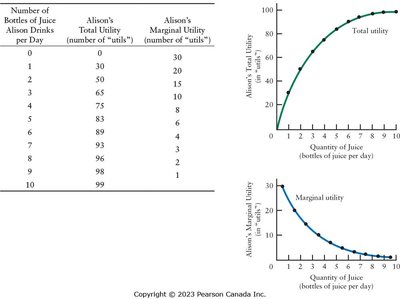
Utility Schedules & Graphs
Utility schedules and graphs visually represent how total and marginal utility change with consumption. The table and graphs above show Alison's total and marginal utility from drinking juice, illustrating diminishing marginal utility.
Maximizing Utility
Consumers aim to maximize their total utility given their income and the prices of goods. The utility-maximizing rule states that consumers allocate their spending so that the marginal utility per dollar spent is equal across all products.
Utility-Maximizing Condition (for two goods X and Y):
Where MU is marginal utility and P is price.
If the marginal utility per dollar is higher for one good, the consumer should buy more of that good and less of the other until equality is restored.
Example: If Alison gets more utility per dollar from juice than from burritos, she should buy more juice and fewer burritos until the marginal utility per dollar is equalized.
Rationality and Framing
Economists assume consumers are rational and maximize utility, but real-world choices can be influenced by how options are presented (framing).
Policy "nudges" can guide choices without restricting freedom.
The Consumer’s Demand Curve
When the price of a good changes, the consumer adjusts their consumption to restore the utility-maximizing condition. If the price of a good rises, the consumer buys less of it, and vice versa. This behavior underlies the negatively sloped demand curve.
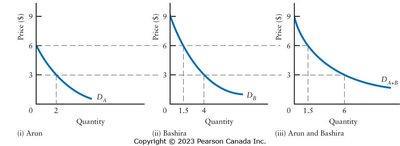
6.2 Income and Substitution Effects of Price Changes
A price change affects consumer choices through two channels: the substitution effect and the income effect.
Substitution Effect: The change in quantity demanded resulting from a change in the relative price of a good, holding real income constant. Consumers substitute towards goods that become relatively cheaper.
Income Effect: The change in quantity demanded resulting from a change in real income (purchasing power), holding relative prices constant. For normal goods, a price decrease increases real income and quantity demanded.
Real Income: The purchasing power of a consumer’s income, or the amount of goods and services that can be bought with it.
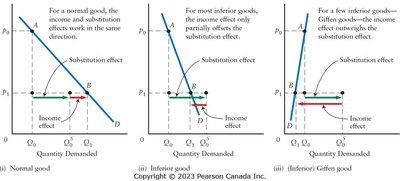
The Slope of the Demand Curve
For normal goods, both the substitution and income effects work in the same direction, making the demand curve negatively sloped.
Giffen Goods: Inferior goods for which the income effect outweighs the substitution effect, resulting in a positively sloped demand curve. These are rare and require the good to be a large part of the consumer’s budget.
Conspicuous Consumption Goods: Goods bought for their status or "snob appeal." While some individuals may buy more at higher prices, the overall market demand curve is still likely negatively sloped.
6.3 Consumer Surplus
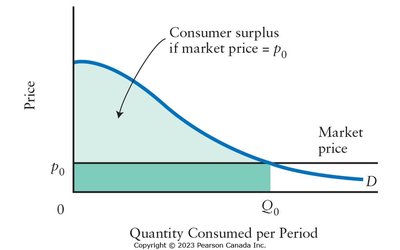
Consumer surplus measures the benefit consumers receive when they pay less for a product than the maximum amount they are willing to pay.
Consumer Surplus: The difference between the total value consumers place on a good and the amount they actually pay.
Graphically, it is the area under the demand curve and above the market price line, up to the quantity purchased.
Example: If Moira is willing to pay $6 for the first litre of milk but only pays $1, her consumer surplus for that litre is $5.
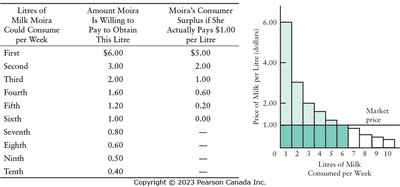
Identifying Consumer Surplus
The total consumer surplus in the market is the sum of the surpluses for all units purchased by all consumers.
The Paradox of Value
The paradox of value asks why essential goods like water have low prices, while non-essential goods like diamonds have high prices. The answer lies in the interaction of supply and demand, and the distinction between total and marginal utility.
Marginal Value: The value placed on the last unit consumed, which determines the market price.
Water is abundant, so its marginal value and price are low, but its total value is high. Diamonds are scarce, so their marginal value and price are high, but their total value is low.
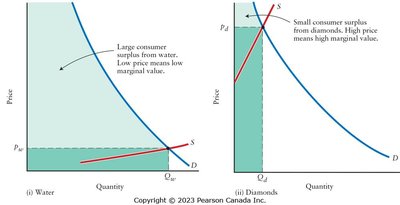
Key Insight: Price reflects marginal utility, not total utility. The supply of a good is crucial in determining its price.
