 Back
BackConsumer Choice and Utility Theory: Microeconomics Study Notes
Study Guide - Smart Notes
 Tailored notes based on your materials, expanded with key definitions, examples, and context.
Consumer Choice Theory
Introduction to Consumer Choice
Consumer choice theory examines how individuals make decisions to allocate their limited resources among various goods and services to maximize their satisfaction, or utility. This chapter explores the concepts of utility, consumer optimum, and the effects of price changes, as well as behavioral economics and advanced indifference curve analysis.
Utility Theory
Utility and Utility Analysis
Utility is the want-satisfying power of a good or service. Utility analysis is the study of consumer decision-making based on the maximization of utility. The utility function measures the satisfaction a consumer receives from any basket of goods.
Util: A representative unit by which utility is measured.
Utilitarianism: Developed by Jeremy Bentham, this school of thought emphasizes maximizing total utility.
Total and Marginal Utility
Total utility is the overall satisfaction from consuming a certain quantity of goods, while marginal utility is the additional satisfaction from consuming one more unit of a good.
Marginal Utility:
Marginal utility is the slope of the total utility function.
Marginal utility falls as more is consumed (law of diminishing marginal utility).
When marginal utility becomes negative, the good becomes a "bad" and rational consumers stop consuming it.
Example: Downloading digital apps: As more apps are downloaded, total utility increases but marginal utility decreases, eventually becoming zero or negative.
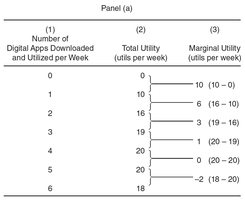
Diminishing Marginal Utility
The law of diminishing marginal utility states that as an individual consumes more of a particular commodity, the total utility increases at a decreasing rate. If increasing marginal utility existed, consumers would consume only one good or service.
Optimizing Consumption Choices
Consumer Optimum
A consumer optimum is the combination of goods and services that maximizes satisfaction for a consumer, given their limited income.
Consumers allocate their income so that the last dollar spent on each good yields the same marginal utility.
Rule of Equal Marginal Utility per Dollar Spent:
This rule ensures the largest possible total utility from a given income.
Example: A consumer may purchase a $100 plain white T-shirt if the marginal utility per dollar spent is equal to that of other goods.
Effects of Price Changes on Consumer Optimum
Substitution and Real-Income Effects
When the price of a good changes, two effects influence consumer choices:
Substitution Effect: Consumers substitute cheaper goods for more expensive ones.
Real-Income Effect: A change in purchasing power due to a price change. If the price of a good rises, real income falls; if it falls, real income increases.
Purchasing Power: The value of money for buying goods and services.
Example: If the price of digital apps falls, consumers can buy more apps or allocate income to other goods.
Deriving the Demand Curve
The demand curve is derived by holding income, tastes, expectations, and the prices of related goods constant while varying the price of the good in question. Marginal utility determines the price, as illustrated by the diamond-water paradox.
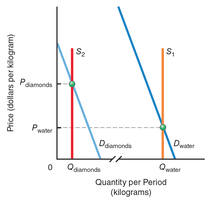
Behavioral Economics and Consumer Choice Theory
Bounded Rationality and Behavioral Economics
Behavioral economics questions the assumption that consumers always act rationally to maximize utility. Bounded rationality refers to the limitations in decision-making due to cognitive constraints, imperfect information, and other factors.
Despite these doubts, utility theory remains widely used because it provides clear predictions about consumer choices.
Advanced Consumer Choice Theory: Indifference Curves and Budget Constraints
Indifference Curves
An indifference curve represents combinations of goods that yield the same level of satisfaction. Key properties include:
Higher indifference curves are preferred to lower ones.
Indifference curves are downward sloping and convex to the origin.
Indifference curves do not cross.
Marginal Rate of Substitution (MRS): The rate at which a consumer is willing to substitute one good for another while maintaining the same level of satisfaction.
Budget Constraint and Consumer Optimum
The budget constraint shows all possible combinations of goods that can be purchased with a fixed budget. The consumer optimum is achieved at the tangency point between the highest indifference curve and the budget constraint.
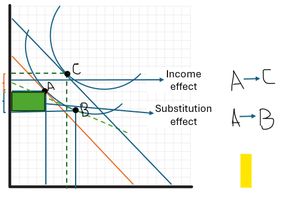
Deriving the Demand Curve from Indifference Curves
When the price of one good changes, the budget line rotates, resulting in a new consumer optimum. The demand curve slopes downward, reflecting increased consumption as price falls.
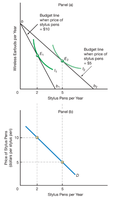
Summary of Key Concepts
Total Utility: Total satisfaction from consumption.
Marginal Utility: Additional satisfaction from consuming one more unit.
Consumer Optimum: Achieved when marginal utility per dollar spent is equalized across all goods.
Substitution Effect: Consumers substitute cheaper goods for more expensive ones.
Real-Income Effect: Price changes affect purchasing power.
Indifference Curves: Represent combinations of goods yielding equal satisfaction.
Budget Constraint: Shows possible purchases given income and prices.
Demand Curve: Derived from changes in price and consumer optimum.
