 Back
BackEconomic Efficiency, Government Price Setting, and Taxes: Microeconomics Study Guide
Study Guide - Smart Notes
 Tailored notes based on your materials, expanded with key definitions, examples, and context.
Economic Efficiency, Government Price Setting, and Taxes
Introduction
This chapter explores how government interventions, such as price controls and taxes, affect economic efficiency in markets. It introduces the concepts of consumer surplus, producer surplus, and economic surplus, and analyzes the consequences of price floors, price ceilings, and taxation.
Consumer Surplus and Producer Surplus
Surplus in Market Transactions
Economists use the term surplus to describe the net benefit participants receive from market transactions. Two main types are:
Consumer Surplus: The difference between the highest price a consumer is willing to pay and the actual price paid.
Producer Surplus: The difference between the lowest price a producer is willing to accept and the actual price received.
Deriving the Demand Curve and Consumer Surplus
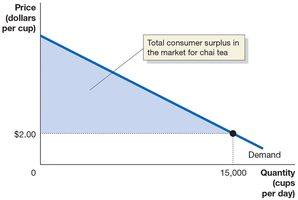
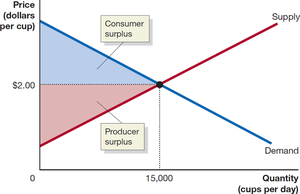
The demand curve can be constructed by considering the maximum price each consumer is willing to pay for a good. Consumer surplus is visually represented as the area below the demand curve and above the market price.
Marginal Benefit: The additional benefit from consuming one more unit of a good.
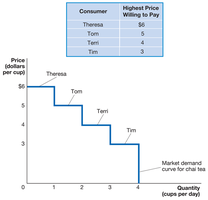
Measuring Consumer Surplus
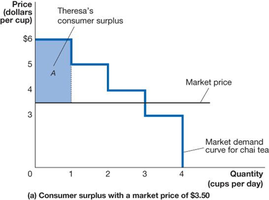
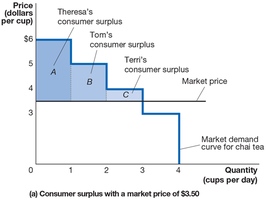
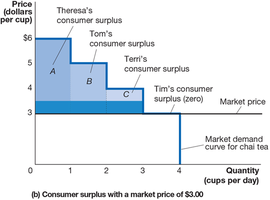
Consumer surplus is calculated for each buyer as the difference between their willingness to pay and the market price. The total consumer surplus is the sum of individual surpluses.
At a price of $3.50, three consumers gain surplus; at $3.00, all four benefit, but Tim's surplus is zero.
Total Consumer Surplus in Larger Markets
In larger markets, consumer surplus is the area below the demand curve and above the price line.
Application: Consumer Surplus from Uber
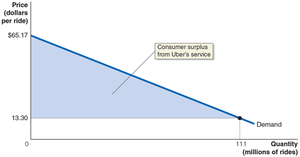
Consumer surplus can be estimated for services like Uber by analyzing the demand curve and market price.
Producer Surplus and Marginal Cost
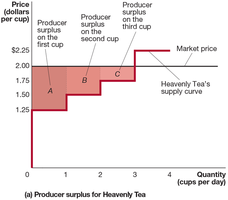
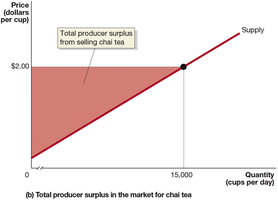
Producer surplus is the difference between the market price and the marginal cost of production for each unit sold. Marginal cost is the change in total cost from producing one more unit.
Net Benefits: What Surplus Measures
Consumer Surplus: Net benefit to consumers = Total benefit received - Total amount paid.
Producer Surplus: Net benefit to producers = Total amount received - Cost of providing the good.
The Efficiency of Competitive Markets
Defining Market Efficiency
A market is efficient if:
All trades occur where marginal benefit exceeds marginal cost.
The sum of consumer and producer surplus (economic surplus) is maximized.
Marginal Benefit and Marginal Cost at Equilibrium
The demand curve represents marginal benefit; the supply curve represents marginal cost. Efficiency is achieved when these are equal at the equilibrium quantity.
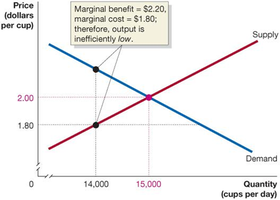
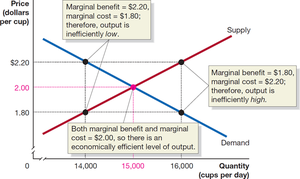
Economic Surplus
Economic surplus is the sum of consumer and producer surplus, maximized at competitive equilibrium.
Deadweight Loss and Market Inefficiency
When a market is not in equilibrium, deadweight loss occurs, representing lost economic surplus.
Deadweight Loss: The reduction in economic surplus from market inefficiency.
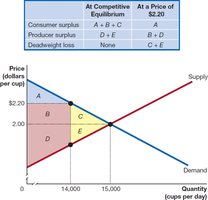
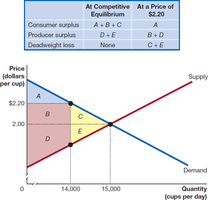
Definition of Economic Efficiency
Economic efficiency is achieved when the marginal benefit to consumers equals the marginal cost of production, and the sum of consumer and producer surplus is maximized.
Government Intervention: Price Floors and Price Ceilings
Types of Price Controls
Price Ceiling: Legally determined maximum price sellers may charge.
Price Floor: Legally determined minimum price sellers may receive.
Examples include minimum wages, rent controls, and agricultural price supports.
Economic Effects of Price Floors
Imposing a price floor above equilibrium reduces the quantity traded and creates deadweight loss.
Surplus and Excess Supply
Price floors can lead to excess supply, as producers may produce more than can be sold at the floor price.
Minimum Wage as a Price Floor
The minimum wage is a price floor in labor markets. Its effects are debated: it may raise incomes for low-skilled workers but can also reduce employment and impose costs on businesses.
Natural Experiments and Minimum Wage
Economists use natural experiments to study the effects of minimum wage changes, comparing similar groups with different wage policies.
Economic Effects of Rent Ceilings
Rent ceilings below equilibrium create shortages and deadweight loss, transferring surplus from landlords to renters.
Illegal Markets and Peer-to-Peer Sites
Shortages from price ceilings may lead to illegal markets or alternative rental arrangements, such as Airbnb, which can partially alleviate deadweight loss but reduce legal protections.
Results of Price Controls
Some people win (e.g., renters with lower rents).
Some people lose (e.g., landlords, renters unable to find apartments).
Economic efficiency is reduced (deadweight loss).
Price Gouging During Emergencies
During emergencies, demand surges can lead to high prices (price gouging). Government-imposed price ceilings may prevent excessive profits but create shortages.
The Economic Effect of Taxes
Per-Unit Taxes
Governments often impose per-unit taxes, which shift the supply curve upward by the amount of the tax, increasing prices and reducing quantity traded.
Tax Efficiency and Excess Burden
The deadweight loss from a tax is called its excess burden. Efficient taxes impose a small excess burden relative to the revenue raised.
Tax Incidence: Who Pays?
Tax incidence refers to the actual division of the tax burden between buyers and sellers, determined by the relative slopes of the demand and supply curves—not by legal obligation.
Application: Social Security Tax Burden
The burden of payroll taxes like Social Security depends on the relative sensitivity of employers and workers to wage changes. Workers, being less sensitive, bear most of the tax burden.
Key Formulas
Consumer Surplus:
Producer Surplus:
Economic Surplus:
Deadweight Loss:
Summary Table: Effects of Price Controls
Type of Control | Effect on Quantity | Effect on Surplus | Deadweight Loss? |
|---|---|---|---|
Price Floor (e.g., minimum wage) | Decreases | Transfers surplus from consumers to producers | Yes |
Price Ceiling (e.g., rent control) | Decreases | Transfers surplus from producers to consumers | Yes |
Tax | Decreases | Some surplus becomes tax revenue; some is lost as deadweight loss | Yes |
Conclusion
Government interventions such as price floors, price ceilings, and taxes can significantly affect market efficiency, consumer and producer surplus, and the overall economic surplus. Understanding these effects is crucial for evaluating public policy and its impact on welfare.
