 Back
BackEfficiency, Fairness, and Power in Economic Allocations: Microeconomics Study Guide
Study Guide - Smart Notes
 Tailored notes based on your materials, expanded with key definitions, examples, and context.
Institutions, Power, and Economic Allocations
Institutions and Rules in Economic Interactions
Institutions and rules define who can do what and how pay-offs are distributed in economic interactions. They determine the power individuals have to achieve their objectives, especially when interests conflict.
Power: The ability to do and obtain what one wants, even against others' intentions.
Structural Power: Limited by the other party's next best alternative; one cannot get more than the other would accept based on their alternatives.
Bargaining Power: Determines the outcome between upper and lower limits set by structural power; influenced by the ability to set terms or impose costs.
Evaluating Allocations: Efficiency and Fairness
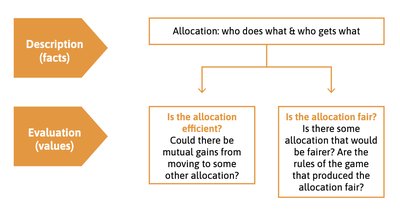
Allocations in economics are evaluated based on efficiency and fairness. Efficiency asks whether mutual gains are possible, while fairness considers both the outcome and the process.
Efficiency (Pareto Efficiency): An allocation is efficient if no one can be made better off without making someone else worse off.
Fairness: Judged by substantive (outcome-based) and procedural (process-based) criteria.
Modeling Power and Rules: The Angela and Bruno Example
Scenarios of Institutional Settings
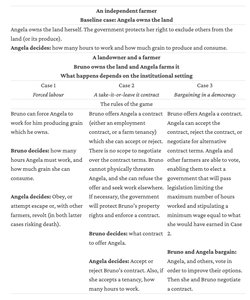
The model examines how different rules affect the distribution of income and power between a worker (Angela) and a landowner (Bruno). Three main scenarios are considered:
Case 1: Forced Labour – Bruno uses force and ownership to extract grain from Angela.
Case 2: Take-it-or-leave-it Contract – Bruno offers a contract; Angela can accept or reject based on her alternatives.
Case 3: Bargaining in a Democracy – Legal and political rights allow Angela to negotiate and influence rules.
Preferences and Technology in the Model
Angela's Preferences: Indifference Curves
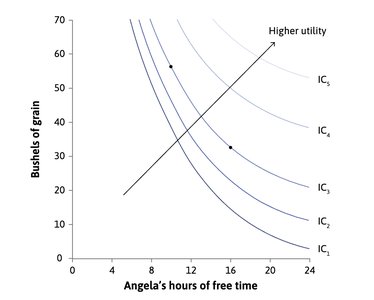
Angela values both grain (income) and free time. Her preferences are represented by indifference curves, each showing combinations of grain and free time she values equally.
Indifference Curve (IC): A curve where each point represents a combination of goods yielding the same utility.
Marginal Rate of Substitution (MRS): The rate at which Angela is willing to trade grain for free time, represented by the slope of the indifference curve.
Bruno's Preferences
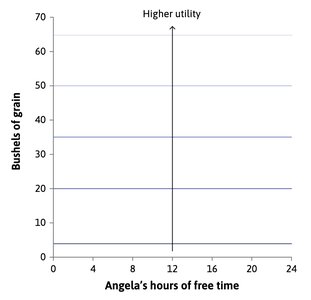
Bruno cares only about the amount of grain he receives. His indifference curves are horizontal, indicating that his utility increases only with more grain, regardless of Angela's free time.
Production Technology: Feasible Frontier
The production function shows how grain output depends on Angela's work hours. The feasible frontier represents the trade-off between free time and grain output, determined by technology.
Marginal Rate of Transformation (MRT): The rate at which free time can be transformed into grain, given the production technology.
As Angela works more, the additional grain produced per hour diminishes due to fixed land.
Optimal Allocation: Independent Farmer Scenario
Angela's Constrained Choice
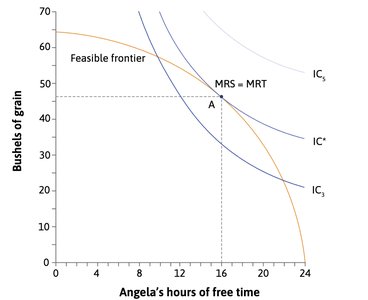
As an independent farmer, Angela chooses the combination of free time and grain that maximizes her utility, subject to the feasible frontier. The optimal point is where MRS equals MRT.
Optimal Allocation: at the point of tangency between the indifference curve and feasible frontier.
Angela's best outcome: 16 hours of free time, 46 bushels of grain.
Power and Allocation: Forced Labour Scenario
Impact of Bruno's Ownership and Force
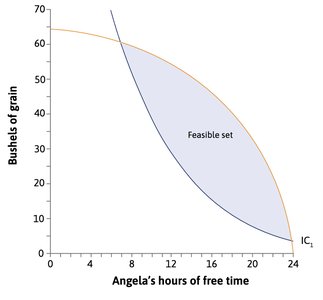
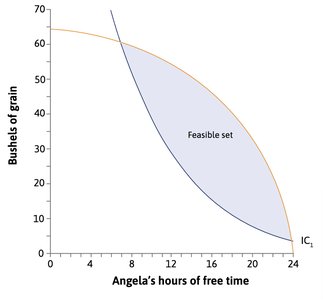
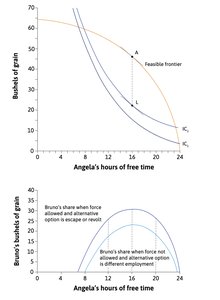
When Bruno owns the land and uses force, Angela's share of grain is reduced. The feasible set is now determined by Bruno's extraction and Angela's reservation indifference curve (minimum utility for survival).
Angela's reservation indifference curve (IC1) sets the minimum utility she must receive.
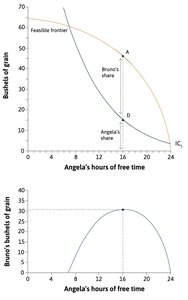
Bruno maximizes his grain extraction subject to Angela's survival constraint.
Maximum Grain for Bruno
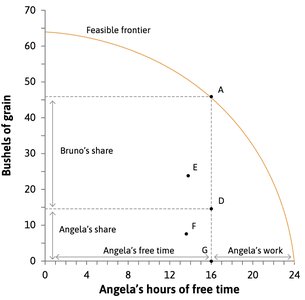
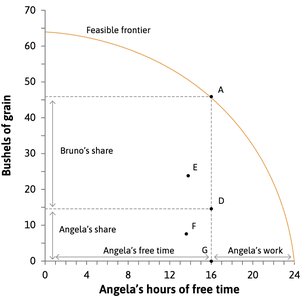
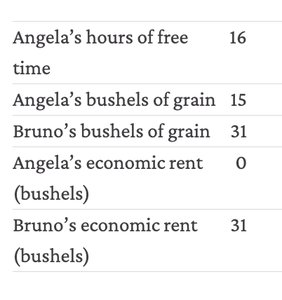
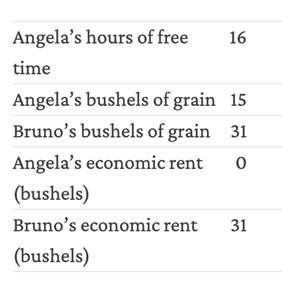
Bruno's optimal allocation is where Angela works enough to produce maximum grain, but receives only her reservation utility. This allocation is Pareto efficient but unfair.
Economic Rent: The benefit above one's next best alternative. Angela receives no rent; Bruno receives all surplus.
Pareto Efficiency: No reallocation can make one better off without making the other worse off.
Take-it-or-leave-it Contract Scenario
Improved Reservation Option
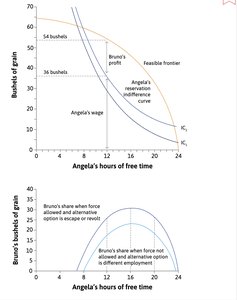
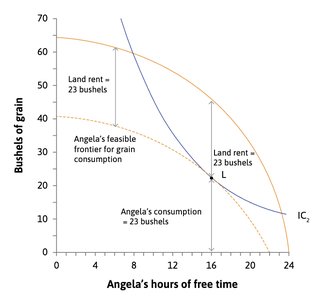
Angela's reservation option improves (e.g., alternative employment). Bruno must offer at least as much utility as Angela's new reservation indifference curve (IC2).
Bruno sets working hours and wage to maximize his own rent, but Angela can reject offers below her reservation utility.
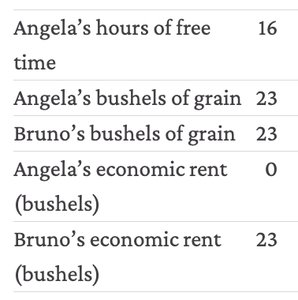
Optimal allocation: 16 hours free time, 23 bushels each for Angela and Bruno.
Tenancy Contract Example
Bruno can achieve the same outcome by charging Angela a land rent equal to the joint surplus, leaving her with only her reservation utility.
Comparison of Forced Labour and Contract
Efficiency and Fairness
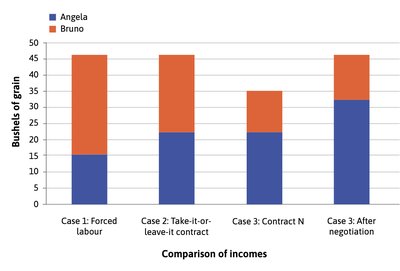
Both forced labour and take-it-or-leave-it contract are Pareto efficient, but the contract is fairer as Angela's structural power is higher due to better alternatives.
Angela's economic rent remains zero, but her income increases.
Bruno's rent decreases as Angela's reservation option improves.
Bargaining in a Democracy: Legal and Political Power
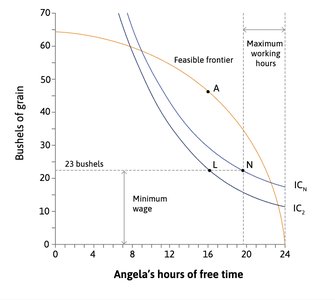
Impact of Pro-worker Legislation
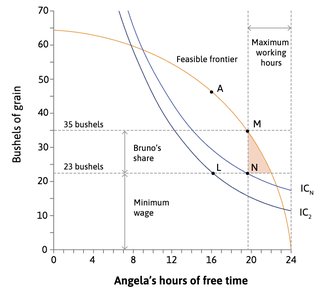
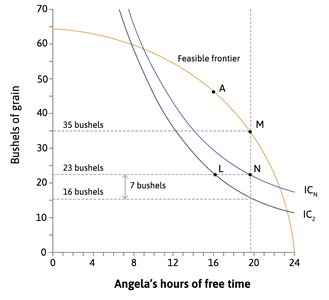
Democratic rights allow Angela to influence laws, improving her reservation position. Legislation may set minimum wages and maximum working hours, further limiting Bruno's options.
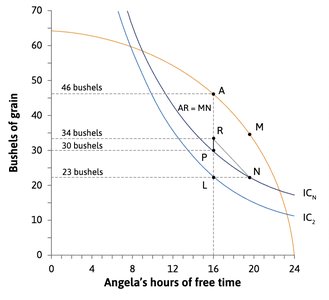
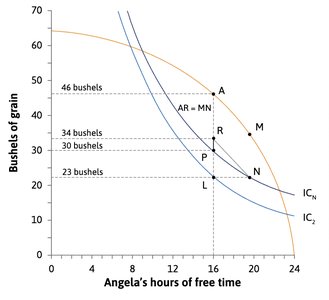
Angela's new reservation indifference curve (ICN) is higher, reflecting improved utility.
Bruno must offer contracts within the legal constraints, resulting in lower rent for himself and higher utility for Angela.
Pareto Efficiency and Negotiation
Negotiating a Pareto Efficient Sharing of Surplus
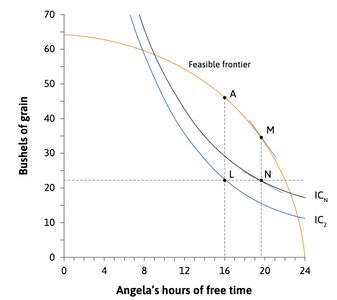
After legislation, the allocation may not be Pareto efficient. Angela and Bruno can negotiate to reach a Pareto-efficient allocation, maximizing joint surplus and sharing gains.
Surplus is maximized where .
Negotiation allows both parties to be better off compared to the legislated outcome.
Summary of Outcomes and Lessons
Distribution of Income and Power
The allocation of income depends on endowments, productivity, reservation options, and institutional rules. Power dynamics and legal frameworks shape both efficiency and fairness in economic outcomes.
Forced labour: Minimum utility for worker, maximum rent for landowner.
Contract: Worker receives reservation utility, landowner captures surplus.
Democracy and negotiation: Improved worker utility, surplus shared.
Key Concepts and Formulas
Pareto Efficiency: An allocation is Pareto efficient if no reallocation can make someone better off without making someone else worse off.
Economic Rent:
Marginal Rate of Substitution (MRS): (rate at which grain is traded for free time along an indifference curve)
Marginal Rate of Transformation (MRT): (rate at which free time is transformed into grain along the feasible frontier)
Example: If Angela's reservation option improves (e.g., government support), her minimum acceptable wage rises, increasing her structural power and resulting in a fairer allocation.
Additional info: The study notes expand on the original material by providing definitions, formulas, and structured explanations suitable for microeconomics students.
